))
))
> sliding glass doors would work best rather than hinged doors that swing out, yes?
A double-glazed door is the best (I’ll be referencing Marks enclosures often and, yes, Mark makes double-glazed doors). Can be hinged or sliding. Otherwise, condesate will be constantly building up on the glass and drip down (ruining the view and leaving stains). This makes sliding doors a worse choice as you need to invent a drainage system for railings.
> For background heat I’d like to use radiant heat panels, though I want to ask if there’s anything wrong with regular ceramic heat emitters? is there a reason RHP are favored?
Nothing is wrong, really. However, CHE are non-directed sources of heat and you need a wide reflector dome if you want to efficiently heat up large space at 30″ distance. They also have higher running temperature, which makes them less optimal for plastic enclosures (plasticity of PVC increases with temperatures). RHPs provide mild ambient heat dissipated over large area and look better
Placement of RHPs sound right.
I don’t use any humidity controls (passive ventilation works for me). Yet, there are options like hygrostats, off-the-shelf smart sockets + sensors + automation gateways or custom solutions like the one you plan to implement.
I, usually, have two-three temperature/humidity sensors (but number depends on how many “climate zones” you make). Usually one smart sensor goes in the middle, a few inches above substrate (so I get median historical humidity/temp data). A thermostat probe goes to the cold end (a thermostat has a display + Hi/Lo temperature alarms). A third sensor is somewhere nearby of the basking area (just a simple digital display for a quick glance). An automation gateway is programmed to switch off all lights and thermostat sockets if smart sensor readings go through the roof (a sort of a kill switch, but not 100% reliable)
A few tips:
1. Line the bottom. Even if it’s properly sealed, this will give you extra warranty.
2. You will need quite a few support beams for ceiling and bottom. PVC is not 100% rigid and humidity and heat make things worse.
3. 4′ deep enclosures are hard to clean – plan in advance how to clean things near back wall, where to place water dish so you can replace it easily.
4. You can add some ramps or walk-through galleries, platforms, tunnels made of PVC while you’re at.
5. I think, a good base with castors is also a must have (8×4 enclosure with all substrate and decor is basically an immovable property).
6. Plant shelves or pot hanging spots can be planned in advance (you don’t want any plant to touch UVB or basking light)
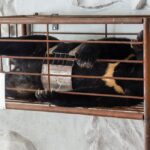
I attach a few photos of a current 6×3 setup for my Redfoot (she spends a lot of time outside, just in case).
1. Cold end – two hides: terracotta pot half right under RHP, a huge piece of palm “bark” under fern is a “cold-cold” hide.
2. A placeholder for the water dish – far enough from walking routes (perimeter). I put terracotta saucer on top of the plastic one so substrate doesn’t stick
3. Warm end – cork bark bunker and slate near the basking lamp.
4. RHP – I use two long and narrow, span whole enclosure, closer to the front windows. Jungle Dawn LED bars span 3/4 of enclosure length in the middle.
5. “Basking area”: Arcadia ProT5 UVB 39W, Desert 12%, 100W basking bulb and a JungleDawn LED. Below is a round dark slate. Fern under the UVB lamp doesn’t feel good (they need more shade).
6. There is a chicken wire sheet attached to the backwall: I use it to attach plant wall pockets and fern fronds and pothos vines happily climb over it (hopefully, kudzu will do too).