

Fights to enforce NYC foie gras ban & win governor’s signature to prevent octopus farming also still underway
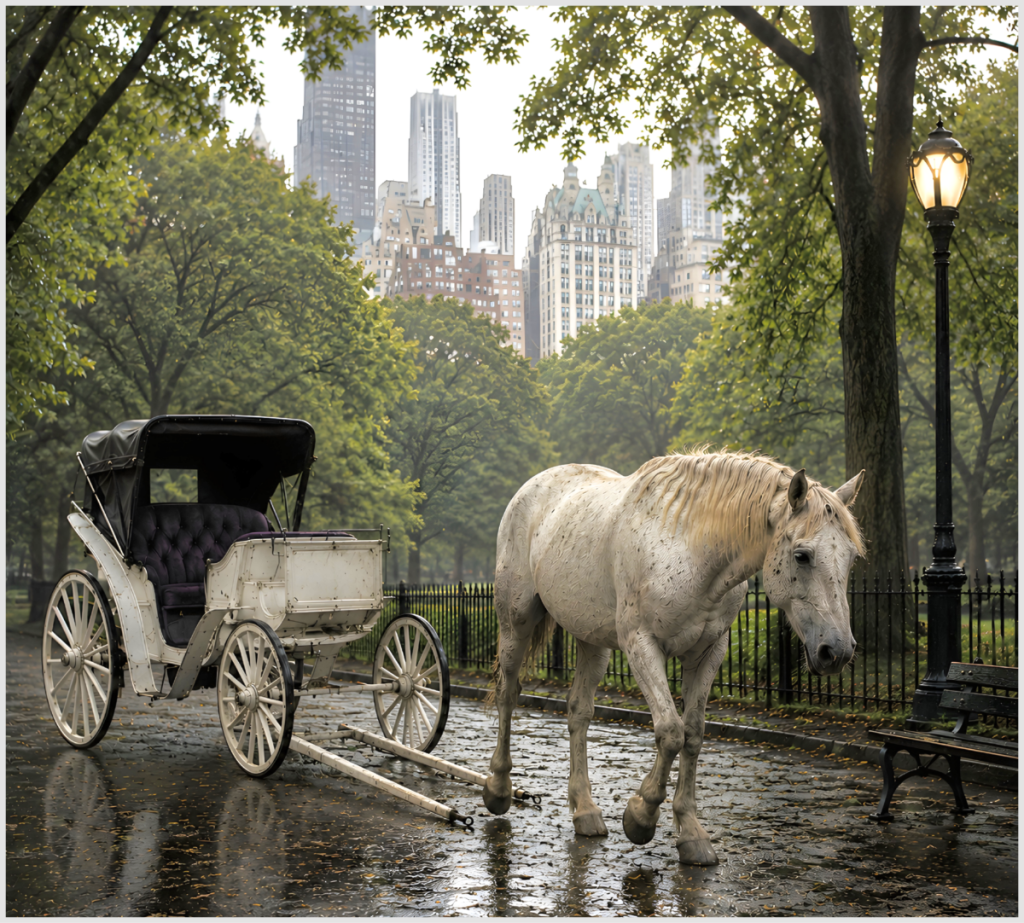
NEW YORK CITY, N.Y.––”New York City Council speaker Julie Menin just publicly endorsed Romanch’s Law, formerly known as Ryder’s Law, the bill that would finally end the horse-drawn carriage industry in New York City,” exulted newly designated Voters for Animal Rights director Julie Cappiello on July 14, 2026.
“Speaker Menin’s support is instrumental in getting this bill passed into law,” Cappiello explained.
Decades of New York City activists opposed to the horse-drawn carriage industry have butted heads with hostile City Council speakers aligned with the Transportation Workers Union, which represents the carriage drivers and owners as well as the workers in the city subway and bus systems.

Romanch’s Law gains council majority
A day later, on July 15, 2026, Cappiello updated, “Mian Osumi, our new Policy & Advocacy Manager, alongside a team of volunteers, sat in today’s New York City Council Health Committee hearing for nearly 10 hours to testify for Romanch’s Law.
“As Mian finished testifying,” Cappiello said, “the 26th council member signed on to ban horse carriages. With speaker Julie Menin’s support, we now have 27 council members backing this bill. That’s more than a majority of the council.”
Ryder’s Law was also believed to have gained majority New York City Council support at times, but was never brought up for a full council vote because of speaker opposition.
“This isn’t over,” Cappiello warned. “We still need the Health Committee and the full council to schedule a vote. With Health Committee chair Lynn Schulman and speaker Menin behind us, we believe that vote is coming soon.

“Bills don’t pass themselves”
“But bills don’t pass themselves,” Cappiello emphasized. “Getting to this moment took fifteen years of lobbying, organizing, protesting, and campaigning. Getting the vote scheduled, and getting it won, will take that same fight.”
“Nearly 15 years ago,” Cappiello remembered, “I joined the fight to ban horse carriages in New York City. I made thousands of calls asking volunteers to show up. I wrote media statements and testimonials late into the night. I sat in council members’ offices, again and again, asking them to just look at what was happening to these horses. I slept under a desk in a windowless office when days ran too long and protested at Central Park in the bitter cold.
“In 2015,” Cappiello continued, “I waited all day for two minutes at a podium, begging the City Council to get the horses off the streets. Most days it felt like nobody was listening. It has been a hard fifteen years.”

160-year struggle
And a hard 160 years for generations of New York City animal advocates preceding Cappiello.
“Almost from the day the first [horse-drawn carriages] appeared in the 1860s, critics have sought to ban or regulate them,” detailed New York Times writer John Leland on July 17, 2026.
“The American Society for the Prevention of Cruelty to Animals, or ASPCA, was formed in 1866 after founder Henry Bergh witnessed the mistreatment of a New York carriage horse. Its inaugural seal, which now adorns the founder’s grave at Green-Wood Cemetery in Brooklyn, shows a sword-wielding angel protecting a cart horse from its abusive driver.”
Actually Bergh witnessed the abuse of a carriage horse in St. Petersburg, Russia, during earlier service as U.S. ambassador to Russia. The ASPCA logo was and is an engraving based on the 1626 Rembrandt van Rijn painting “Balaam and the Ass.”
But Bergh (1813-1888) did steadfastly oppose the use of horse-drawn trolleys and carriages.

From 1989 to now
Previous bills intended to phase out the New York City horse-drawn carriage industry have often been before the city council, especially since the 1989 passage of the city Carriage Horse Protection Act, which introduced restrictions on when and where carriage horses could operate.
In effect for five years, those restrictions were repealed on December 29, 1993 when former mayor David Dinkins vetoed an updated version of the Carriage Horse Protection Act during his last days in office, but the same regulations were later brought back into effect.
The latest previous attempt to ban horse-drawn carriages, Ryder’s Law, was named after a carriage horse who collapsed in the street at 45th and 9th in Midtown Manhattan on August 10, 2022, but was killed by “lame duck” council members on November 14, 2025.

“Open, Sesame!”
Julie Cappiello took office with Voters for Animal Rights, like sesame seeds, on a roll through newly opened doors.
Announced her predecessor, Allie Taylor, on July 12, 2026, “After 10 years of building Voters For Animal Rights from the ground up, I have accepted a position as the director of the New York City Mayor’s Office of Animal Welfare,” appointed by first-term New York City mayor Zohran Mamdani.
Mamdani previously appeared for nearly six months to be juggling conflicting fall 2025 election promises he made both to horse-drawn carriage industry opponents and to Transportation Workers Union president John Samuelsen, a leading defender of the carriage trade.

“An incredible opportunity to advance”
Her new role, Taylor said, “feels like a natural extension of everything I’ve poured into this work. I believe this is an incredible opportunity to advance animal rights from inside City Hall. I’ll remain involved with VFAR in an advisory capacity,” Taylor pledged, “and I will always be cheering loudly for this organization from whatever seat I’m in.”
Cappiello, Taylor introduced, helped me bring Voters for Animal Rights to life,” as “an essential part of VFAR’s leadership and growth, transforming our digital fundraising, communications, and grassroots engagement while helping shape our political strategy.”
Taylor also introduced Mian Osumi to the Voters for Animal Rights team “as our new policy and advocacy manager — our first-ever hire! Mian,” Taylor said, “has been a dedicated volunteer with Voters for Animal Rights, and brings years of social justice organizing experience with Mercy For Animals, The Humane League, and Sunrise Movement. In her new role, she’ll be on the ground organizing animal rights voters across New York State.
Taylor further introduced a new Voters for Animal Rights board member, Suriya Khan, “founder of EthicsMap and an advisor to Fairstart Movement, where she works to transform food systems and advance a more sustainable and just world.”

Octopus farming ban passed by New York State legislature
Taylor exited by announcing that, “At 1:27 AM this morning — as the very last bill on the agenda — the New York State Assembly passed our legislation to prohibit industrial octopus farming from coming to our state, with a vote of 129–13!
“Just hours earlier, the New York State Senate also passed the bill with a vote of 55-5! This strong bi-partisan victory shows that the legislature heard us loud and clear: Octopuses are intelligent, curious, and sentient animals who do not belong on factory farms.
“Our deepest appreciation to our partners at Woodstock Farm Sanctuary,” Taylor said, “who helped transform a bold idea into a historic victory for octopus.
“The bill now heads to New York governor Kathy Hochul’s desk to be signed into law.”

Governor fights foie gras ban
That, however, is hardly a certainty. Announced New Yorkers for Animal Rights on April 16, 2026, “Hochul is appealing the Appellate Division’s recent unanimous ruling to enforce New York City’s foie gras sales ban, throwing her weight behind an industry that tortures birds for profit. She is intentionally delaying implementation of New York City’s foie gras sales ban by months, or even years.
“The New York City Council, Voters for Animal Rights, and 50-plus [other] organizations fought hard for this ban. Voters overwhelmingly support it. The courts upheld it. And now the governor is trying to rip it away because she is beholden to foie gras producers at two factory farms in the state.”
The outcome of that fight, like the ultimate outcome of Romanch’s Law and the passage of the bill to ban octopus farming, remains undetermined.

Romanch Mahajan
Eighteen-year-old Romanch Mahajan on June 17, 2026 became the first human to die in a New York City horse-drawn vehicle accident at least since 1989, when horse-drawn carriages were restricted to operating in Central Park and on the streets leading to and from their stables.
Mahajan may have been the first human killed in a New York City horse-drawn vehicle accident in more than a century, but relevant records, including the archives of The New York Times, 1851-present, have proved prohibitively difficult to search without having more specific search terms than just “horse-drawn,” “carriage,” and “fatal accident.”

(Family photo)
Visiting from India
Explained Evan Simko-Bednarski for the New York Daily News on July 16, 2026, “Romanch, his parents and his little brother were visiting the Big Apple from India when the family took a horse-drawn carriage ride in Central Park. The horse bolted after the driver stepped out of the carriage, trying to take the family’s photo.
“In the ensuing chaos, Romanch’s mother fell from the carriage, and the teen went after her, fatally hitting his head.”
Deepak Mahajan, father of Romanch Mahajan, testified via video link in favor of Romanch’s Law at the July 15, 2026 New York City Council Health Committee hearing.
“He sat beside his wife, Priya Mahajan, who held a photo of their dead son,” reported Simko-Bednarski.
Romanch’s Law “would end all horse-drawn carriage rides by June 2028,” Simko-Bednarski summarized. If made law, it would immediately end the issuance of new medallions for carriage horses, and end the industry entirely in the summer of 2028.”

(Family photo)
The cost of obstruction
“A 2025 attempt to force a hearing on a ban,” Simko-Bednarski recounted, “failed after only one member of the Health Committee, Brooklyn council member Simcha Felder, voted in favor of it. Four committee members voted against that effort and two abstained. Two others — including now-council speaker Julie Menin — didn’t show up to vote.
“But Romanch Mahajan’s tragic death appears to have turned the tide,” Simko-Bednarski assessed. The speaker’s eleventh-hour nod came amid a groundswell of support. Twenty-six of the Council’s 51 members have signed onto the bill as co-sponsors.
Reminded Robert Holden, the former Queens member of the New York City Council who introduced the 2022 first edition of Ryder’s Law, “My original bill would have banned horse-drawn carriages in New York City on June 1 of this year. Romanch died on June 17. That is the cost of four years of obstruction.”
Holden’s successor on the New York City Council, Democrat member James Gennaro of Queens, has introduced a bill competing with Romanch’s Law, “which would require stricter driver training and provisions like hitching posts, but would allow carriage rides to continue,” mentioned Simko-Bednarski.

(Beth Clifton collage)
Deniz
Mahajan died eight days after Deniz, a 16-year-old spotted draft horse, abruptly died on June 9, 2026, apparently after eating Japanese yew, a poisonous plant occurring in Central Park.
Deniz, reported Animals Matter, NYC blogger Elizabeth Forel, was “The 30th horse death since I’ve been keeping records,” a time frame approximately coinciding with the restriction of carriage horses to Central Park.
The deaths of Romanch Mahajan and Deniz “had very different causes, but both are tied to an industry with a long history of recklessness that no longer deserves free rein in the biggest city in America,” alleged Animal Wellness Action and Center for a Humane Economy president Wayne Pacelle.
“Chicago banned horse-drawn carriages in 2020, and Philadelphia did so just recently. Those major metropolitan jurisdictions recognized that this enterprise is a relic with risks for horses and people,” Pacelle reminded.

(See also Will human sacrifice end the New York City horse-drawn carriage trade?, “Enough horse poop,” St. Augustine tells carriage trade, while NYC dithers, Lame ducks, dragons, & the fight over future of NYC horse-drawn carriages, Why was a sick horse, too old to work, pulling a New York City carriage?, Malaga, Spain bans horse-drawn carriages; NYC campaign mires, and NYC mayor Eric Adams endorses bill to phase out horse-drawn carriages.)
Please donate to help our work:
More related posts:
Discover more from Animals 24-7
Subscribe to get the latest posts sent to your email.