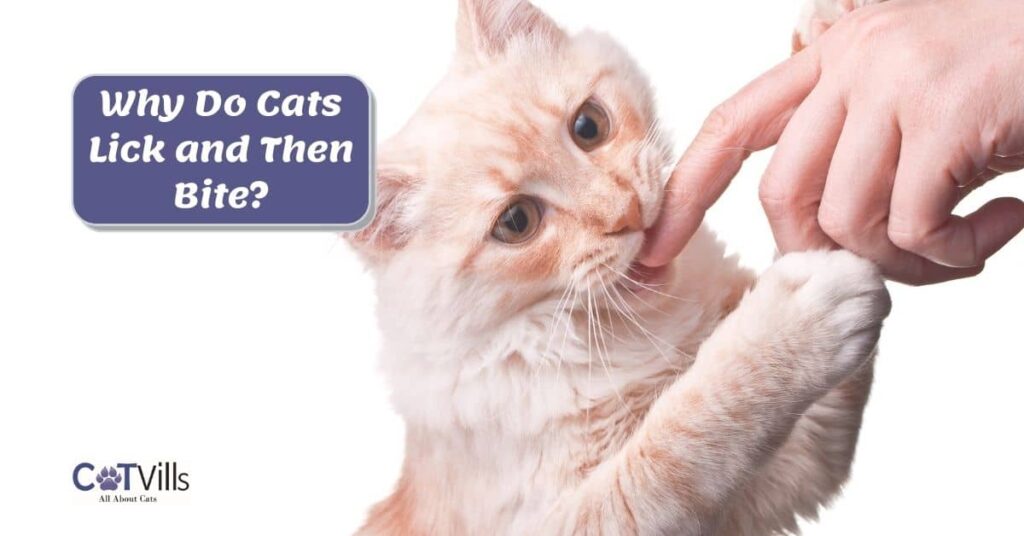

Cat Licking Behavior: The Complete Guide
Why they lick you
Allogrooming — it means you are family. Cats only lick individuals they trust and consider part of their social group.
Lick then bite
Overstimulation, a “we time is over” signal, or grooming turned to play — almost never aggression. Read the body language.
After you pet them
Not a rejection — your cat is processing your scent and possibly completing a reciprocal grooming ritual.
Licking the floor
Usually harmless (food residue, curiosity). Sudden, persistent floor licking can signal nausea or GI distress — worth a vet call.
When to worry
Excessive licking causing hair loss, sudden new behavior, or licking + other symptoms = vet visit.
Why it is worth your scroll
That lick-bite combo might be the most misread thing cats do. This guide covers all of it — every body part, every weird surface, and when to take it seriously.
If you have ever sat down with your cat and had her immediately start licking your hand, your hair, or — if she is anything like Leia — your entire face, you have probably asked yourself what that is actually about. Is it affection? Is she claiming you? Is she just, inexplicably, a fan of your moisturizer?
The honest answer is: all of those things are possible. Cat licking behavior is one of the most researched and still-debated areas of feline science. It means different things in different contexts, and some of it we are still figuring out. This guide covers everything — why cats lick you, why they lick specific body parts, why they lick then bite, why they lick the floor, and when licking stops being a quirky cat thing and starts being a vet thing.
Why Do Cats Lick? The Science Behind It
Before we get into the specific behaviors, a little context makes everything else make sense.
Cats spend up to 8% of their waking hours grooming — licking is not incidental, it is central to how they live, communicate, and form relationships. A cat’s tongue is one of their most sophisticated tools: covered in tiny hollow spines called papillae that wick saliva deep into the fur for effective cleaning. (A 2018 PNAS study by Noel & Hu at Georgia Tech was the first to document this wicking mechanism properly — and it is genuinely fascinating engineering.)
🔬 What Allogrooming Actually Is
Allogrooming means grooming another individual. In cats, it evolved as a bonding and social regulation mechanism — not just hygiene. According to Dr. John Bradshaw of the University of Bristol, the behaviors binding cat social groups together, including mutual grooming, have obvious parallels in how pet cats behave toward their owners. A 1998 Journal of Ethology study found that 91.6% of grooming interactions between cats are one-directional — one cat grooms while the other receives. Modern interpretations emphasize this as primarily affiliative bonding rather than strict dominance signaling. The bottom line: when a cat grooms you, you are in their social group.
The scent dimension matters too. Cat saliva contains pheromones, and licking creates a shared group scent between individuals. This is the same mechanism behind bunting (head-butting) and allorubbing — all of it is building a chemical identity that says ‘we are family.’ Hands, faces, and hair are all targeted because they carry strong concentrations of human scent that mix effectively with feline pheromones.
Why Do Cats Lick You? The Main Reasons

1. You Are in Their Social Group
This is the big one. Cats do not allogroom strangers. Dr. David Sands, an animal psychologist with the Animal Behaviour Clinic, explains that cats will only lick individuals they trust and do not consider competition. When your cat licks you, she is incorporating you into her social group — the same way she would groom a bonded feline companion.
So yes, it is affection. But it is more specific than that — it is acceptance and belonging.
2. She Likes the Way You Smell (or Taste)
Cat taste buds are extraordinarily sensitive. Dr. Sands notes they can pick up scents from skin that include pheromone secretions from other animals. Salt from your skin, your lotion, something you cooked — all of it is biochemically interesting to your cat. She is gathering information as much as she is bonding.
💡 Pro Tip
If your cat suddenly starts licking you far more than usual, consider whether you have changed products — lotion, soap, shampoo. Some formulas genuinely attract cats. One important caveat: certain ingredients in skincare and hair products can be toxic if ingested. If your cat is obsessively licking your skin after product application, check with your vet about the ingredients.
3. She Is Looking for Attention
Cats learn fast. If licking has ever gotten a reaction from you — talking to her, petting her, laughing — she has filed that away as an effective attention strategy. Attention-seeking licking tends to be more persistent and starts when you are distracted or sitting still.
4. She Is Anxious or Self-Soothing
Licking releases endorphins. For a stressed or anxious cat, licking a trusted person can have a genuinely calming effect. If your cat tends to lick you more during thunderstorms, after changes in the household, or at certain times of day, this is likely what is happening.
Why Does My Cat Lick Specific Body Parts?
Not all licking targets are created equal. Here is what each location usually signals.
Why Does My Cat Lick My Hands?
Hands are the most common target, and it makes sense: your hands carry your strongest personal scent plus whatever you have touched all day. From a cat’s perspective, they are an information goldmine.
Your cat licking your hand is classic allogrooming directed at a trusted social companion. It also often has a self-reinforcing attention component — you tend to respond to hand licking, which rewards the behavior. If it is uncomfortable (cat tongues are rough), it is fine to gently redirect her to a toy rather than pulling away sharply.
Why Does My Cat Lick My Nose?
Your nose and face carry the most concentrated version of your personal scent. Your breath, your facial oils, the warmth radiating from your skin — it is all intensely interesting to a bonded cat. Nose licking in particular is often seen in cats who sleep on or near your face, and it tends to be a morning greeting behavior.
It is one of the highest trust signals in the cat-human relationship. Cats that lick your nose or face have deeply incorporated you into their social world. Leia does this to me at approximately 4:30am every morning. I have simply accepted this as my life.

Why Does My Cat Lick My Hair?
Head and facial grooming are the most intimate form of allogrooming between cats. Bonded feline companions specifically groom each other’s heads because they are hard-to-reach areas with high concentrations of scent glands. When your cat licks your hair, she is doing exactly what she would do for her closest cat companion.
This is also sometimes reinforced by interesting scents in hair products. If she is particularly persistent about licking your hair right after you wash or style it, the product is part of the draw. Worth checking that whatever you use is not something she should be ingesting.

Why Does My Cat Lick My Feet?
Feet smell strongly — that is just the reality. From a cat’s perspective, your feet and ankles carry a high concentration of your personal scent, plus traces of everywhere you have walked. Feet also have sweat glands that produce the salt cats are often drawn to.
Cats who lick feet tend to also be cats who are highly scent-oriented in their bonding. Some cats also show this behavior when they are particularly comfortable and relaxed — stretched out near you while you are sitting down, feet within easy reach. It is less common than hand or face licking but entirely normal.
Why Do Cats Lick Then Bite?
This is the most searched and most misread cat behavior in this whole topic. Let me be honest: it almost never means what people think it means.
Reason 1: Overstimulation
The most common cause by far. Cats have a threshold for how much petting or interaction they can handle before it tips from pleasant to overwhelming. When you cross that threshold, the sequence is often: lick (a social greeting or affiliative behavior), then bite (a clear signal to stop). It is not aggression — it is communication.
The lick can actually be a last attempt at a friendly signal before the bite. They are trying to tell you ‘I like you, but I am done right now’ in the most polite way first.
Body language to watch for before the bite:
• Tail starts flicking or thumping
• Skin along the back ripples or twitches
• Ears rotate back or flatten
• Pupils dilate
• She stops purring or her body stiffens
💡 Pro Tip
When you notice even one of these signs during a petting session, stop before the bite happens. End the interaction calmly, give her space, and let her come back to you on her own terms. Cats who get to leave on their own schedule are far less likely to bite.
Reason 2: Playtime Spillover
Kittens and young cats especially can get so ramped up during play that the line between grooming and play-biting blurs. If your cat licks then bites during or right after an exciting play session, that is play behavior, not dominance or aggression. Let her calm down on her own.
Reason 3: Grooming Behavior (Love Bites)
Scientists have documented what is called ‘groom biting’ — a pattern where cats incorporate gentle biting into their grooming sequences, the same way they do with each other. A study by Eckstein & Hart (2000) in Applied Animal Behaviour Science documented the organization and control of grooming in cats, noting that biting is a natural component of feline grooming sequences.
If the bite is genuinely gentle — not enough to break skin, more of a nibble — this is almost certainly what is happening. Your cat is grooming you the way she would groom a bonded cat companion. It is, in its own slightly weird way, a compliment.
Reason 4: Stress
A stressed or newly adopted cat may lick-then-bite as they navigate an unfamiliar environment or relationship. What looks like mixed signals is actually a cat who genuinely wants connection but whose anxiety keeps interrupting the moment. Given time and consistent calm interaction, this usually resolves on its own.
If the biting breaks skin or escalates:
Veterinarian Rachel Barrack notes that the most common reason a cat bites is because they are not enjoying the current interaction. Biting is their way of communicating when they feel threatened or annoyed. If bites are breaking skin, the first step is always a vet visit to rule out pain as a cause — a cat in pain bites more readily. Then address the environmental stressors.
⚠️ When to Call the Vet:
Cat bites can be medically significant. Dr. Deborah Greco of Purina notes that cat bite wounds are particularly prone to infection due to the bacteria present in a cat’s mouth — the puncture-wound nature of a cat bite drives bacteria deep into tissue. If a bite breaks your skin, clean it immediately with warm soapy water and monitor for signs of infection. Seek medical attention if you see redness spreading, swelling, or feel unwell.
For overstimulated cats, redirecting their attention to an interactive toy may help.
Catit Senses 2.0 Digger Interactive Slow Feeder – Turn Mealtime into Play Time
The Catit Senses 2.0 Cat Digger is a slow feeding system that helps to curb your cat’s cravings by incorporating a bit of playful discovery into mealtime. Outfitted with 5 tubes of varying heights and widths, this feeding tool encourages your fur baby’s natural tendency to paw out smaller portions of food and stimulates activity while reducing binge-eating.

We earn a commission if you make a purchase, at no additional cost to you.
Why Does My Cat Lick Himself After I Pet Him?
This one confuses almost every cat owner. You pet your cat. She seems to enjoy it. Then you lift your hand and she immediately starts licking the exact spot you touched. Does she hate you? Is she cleaning off your cooties?
Almost certainly not.
There are two well-supported explanations, and neither of them is rejection.
The Scent-Processing Theory
Your touch deposits your scent onto your cat’s fur. Licking that area immediately afterwards may be how cats process, identify, and file that scent information. Cats experience the world primarily through scent before sight — licking may be how they fully ‘read’ what just happened.
The Reciprocal Grooming Theory
💡🔬 Research Note: Post-Petting Self-Licking
Animal behavior researcher Michael Broad has noted that it is entirely plausible that cats interpret our stroking as a form of allogrooming. The immediate self-licking that follows may be part of a reciprocal social ritual, rather than rejection or scent removal. Crucially, cats that dislike being touched do not usually groom after petting — they avoid the contact altogether. The fact that your cat licks after petting is more consistent with engagement in a bonding sequence than avoidance of your touch.
FYI, this is an area where the science genuinely has not caught up yet. The specific behavior of post-petting self-licking has received surprisingly little formal research attention. What we do know: it is extremely common, it is not a sign of distress, and cats who do it are typically cats who actively seek and enjoy petting.
Why Is My Cat Licking the Floor?
Okay, this one is a little different. Licking you or another cat is clearly social behavior. Licking the floor is more of a mixed bag — some of it is harmless, and some of it is worth paying attention to.
The Harmless Reasons
• Food residue: The most common reason. Cats have far more sensitive noses than we do. That beef juice you wiped up from the kitchen floor? To your cat it is still clearly there. Tile, hardwood, and grout all hold scent traces long after the visible mess is gone.
• Interesting scents: Outdoor shoes, shopping bags, other animals’ scent on your clothing — if anything interesting has been on that floor, your cat will find it.
• Cool surface in hot weather: Some cats lick cool tile simply because it feels good on a warm day. It is the floor-licking equivalent of pressing your cheek against a cold pillow.
• Boredom or habit: Some cats, especially indoor-only cats without enough enrichment, develop floor licking as a boredom behavior. It is self-stimulating and slightly OCD-adjacent in nature.
The Reasons Worth a Vet Call
Here is the one to know: sudden, persistent licking of the floor — especially if new behavior — is a classic sign of nausea or GI distress in cats. Cats who feel nauseated often lick floors, walls, or other surfaces in an apparent attempt to settle their stomachs. If your cat’s floor licking appeared out of nowhere and is happening repeatedly, treat it like you would treat any other new symptom.
⚠️ When to Call the Vet:
Sudden persistent licking of floors, walls, or the air is a recognized sign of nausea or GI distress in cats. If this is new behavior for your cat, especially if combined with vomiting, changes in appetite, lethargy, or weight loss, consult your vet. Compulsive surface licking can also indicate pica (the urge to ingest non-food items), which in its more serious form can cause intestinal blockage
One safety note: if your cat is licking floors you have recently cleaned, the cleaning product is a concern. Even after drying, some residues can be toxic to cats. Keep cats out of rooms you have cleaned until surfaces are fully dry, and choose pet-safe cleaning products where possible.
When Cat Licking Becomes Excessive — Warning Signs
Licking is normal. Excessive licking is not. Here is how to tell the difference.
Watch for these signs:
- Licking combined with changes in appetite, energy, weight, or litter box habits
- Licking causing visible hair loss (called ‘fur mowing’ by Cornell vets — often allergy or parasite-driven)
- Licking that creates raw, red, or broken skin
- Sudden increase in licking frequency with no obvious trigger
- Licking the same spot obsessively — may indicate pain or inflammation in that location
- Licking non-food surfaces compulsively (floors, walls, fabric, plastic)
🔬 Cornell Feline Health Center: What Drives Excessive Licking
According to Dr. William Miller Jr., VMD, Professor Emeritus at Cornell’s College of Veterinary Medicine, cats lick when an area is itchy or painful. If pain is the cause, licking focuses on the painful area. With itchy diseases (allergies, parasites), licking tends to be more widespread. Cornell’s term for cats who over-groom themselves is ‘fur mowers’ — the mowed area gives clues to the underlying cause. Compulsive licking can also have psychological causes: stress from changes in environment, schedule, or the loss of a companion animal can trigger it.
The challenge is that licking releases endorphins — which means it can become a self-reinforcing habit even after the original cause resolves. If you catch excessive licking early and address the underlying cause, you can often prevent it from becoming an entrenched behavior.
The PetPace Smart Cat Collar is a really helpful tool for keeping an eye on your cat’s health and detecting issues early.
PetPace Smart Cat Collar V3
The PetPace Cat Collar goes beyond simple tracking by monitoring vital signs like temperature, pulse, respiration, stress levels, sleep, and activity. With AI-powered health insights and built-in GPS, it gives cat owners a deeper look at their pet’s overall wellness.
⭐ GUARANTEED BEST PRICE ⭐
USE COUPON CODE TECHNO10 AT CHECKOUT TO SAVE 10%

We earn a commission if you make a purchase, at no additional cost to you.
How to Reduce Licking If It Bothers You
Let me be honest — cat licking is almost always a compliment. But if the rough tongue situation is getting old, or if a specific licking behavior is something you want to redirect, here is what actually works.
• Do not punish: Scolding, squirting water, or applying bitter spray can compromise your bond and increase your cat’s anxiety — which may make the licking worse. Punishment is not the move here.
• Walk away calmly: If your cat licks for attention, the most effective response is to get up and move away without drama. Consistently doing this removes the reward and the behavior gradually fades.
• Redirect before it starts: If you know licking tends to happen when you sit still, have a toy nearby to redirect her to interactive play instead.
• Cover your skin: If you find the texture uncomfortable, long sleeves or placing a small towel between you and your cat during cuddle time removes the stimulus without rejection.
• Address the anxiety angle: If licking is stress-driven, look at what has changed in her environment. Feliway or similar pheromone diffusers can help reduce baseline anxiety for cats prone to stress behaviors.
Quick Reference: Cat Licking Behavior at a Glance
Frequently Asked Questions
Why do cats lick you?
Cats lick humans as a form of allogrooming — the same social grooming behavior they use with bonded feline companions. It signals that you are part of their social group, that they trust you, and that they want to create a shared scent that marks you as family. It can also be attention-seeking behavior, scent exploration, or self-soothing during stress.
Why does my cat lick me then bite me?
Most commonly: overstimulation. Your cat has a threshold for how much petting or interaction they can handle, and the lick-then-bite sequence is their way of saying ‘I like you, but I am done now.’ Watch for warning signs before the bite — tail flicking, skin twitching, ears rotating back. Stop before the bite happens. If bites are hard or frequent, rule out pain with a vet visit first.
Why does my cat lick my hair specifically?
Head grooming is the most intimate form of allogrooming between bonded cats — they groom each other’s heads because it is hard to reach and has concentrated scent glands. When your cat grooms your hair, she is treating you exactly like her closest feline companion. It is one of the clearest signals of a deep bond.
Why does my cat lick himself after I pet him?
Not a rejection. The two most likely explanations are: she is processing and filing your scent (licking enables cats to fully ‘read’ a scent), or she is completing a reciprocal grooming sequence. Research suggests cats who dislike being touched do not groom after petting — they avoid the contact entirely. Post-petting self-licking is more consistent with bonding behavior than avoidance.
Why is my cat licking the floor?
If occasional: food residue, interesting scents, cool surface, or mild boredom. If sudden and persistent: take it seriously — this is a recognized sign of nausea or GI distress in cats. Combine with other symptoms and call your vet. Also be aware that cleaning products left on floors can attract cats and are toxic — keep cats out until surfaces are fully dry.
Is it okay to let my cat lick me?
Generally yes, with a few caveats. Cat saliva is not harmful to most people in the ordinary course of things. The main considerations: if you have open wounds or broken skin, avoid cat licking of those areas (bacteria risk). If you use skincare products, check that the ingredients are safe — some are not. And if you are immunocompromised, talk to your doctor about general hygiene practices with pets.
How do I get my cat to stop licking me?
The most effective approach is calm redirection rather than correction. Get up and move away when licking starts (removes the attention reward), redirect to a toy before licking begins, or cover your skin during cuddle sessions. Never use punishment — it backfires by increasing anxiety, which often worsens licking.
When should I be worried about my cat licking excessively?
When it causes hair loss, creates raw or broken skin, focuses obsessively on one spot, involves licking non-food surfaces compulsively, or appears suddenly as new behavior. Any of these combined with other symptoms (appetite changes, weight loss, vomiting, lethargy) is a vet visit. Cornell’s Feline Health Center notes that excessive licking can have both physical causes (allergies, parasites, pain) and psychological ones (stress, anxiety, habit).
Final Thoughts
Most of the time, when your cat licks you — for whatever reason, in whatever location, with whatever follow-up nibble — it is a good thing. You are in her social group. She has decided you are worth the grooming effort. She trusts you enough to incorporate you into the most intimate behavioral repertoire she has.
That lick-then-bite, though. Let me leave you with this: the bite is almost never the problem. The problem is that we missed the signals before the bite. Cats are remarkably consistent communicators once you know what to look for. Start watching the tail, the ears, and the skin. You will catch yourself anticipating the bite before it ever happens — and your cat will love you more for giving her the space she was trying to ask for.