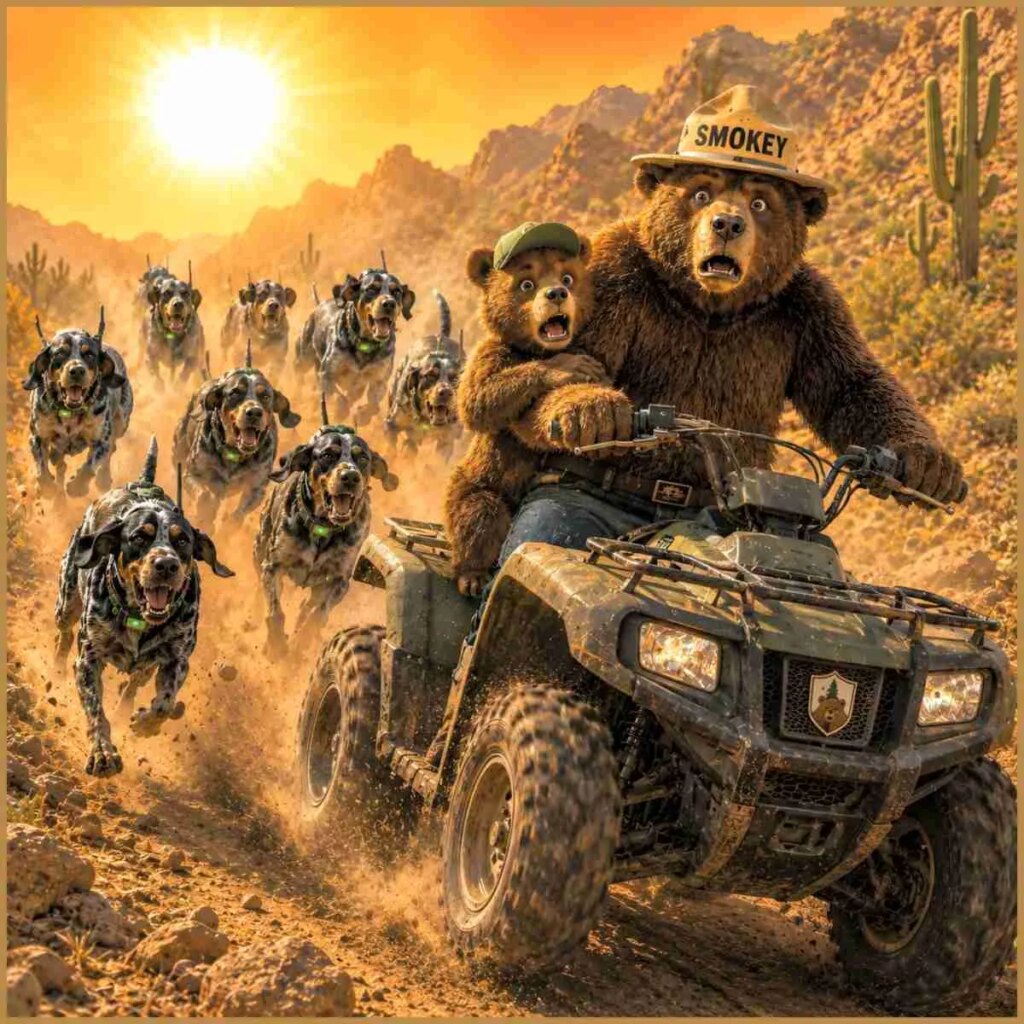


“Hazing” bears with dogs & then baiting them increases risk of conflict
MADISON, Wisconsin––Only in the warped minds of pack hunters could using dogs to roust bears from quietly feeding in the backwoods, making the bears hungrier, grouchier, and more reactively defensive, and then accustoming them to consume bait piles of human food, be construed as protecting humans from bear attack.
Such “bear hazing,” rationalized as teaching dogs to track bears and as teaching bears to avoid humans, is a late summer ritual almost everywhere that bears are hunted.
What it really teaches bears, besides that both humans and dogs are deadly enemies, can be debated.
Beyond that, “bear-hazing” in 2026 has taken on an additional dimension of cruelty across northern Minnesota and Wisconsin, in a manner likely to increase the risk of bear/human conflict.

“Pause running bears with dogs during heat advisories”
“As wildfires spread through Minnesota and smoke blankets the region,” wrote Great Lakes Wildlife Alliance executive director Melissa L. Smith on July 21, 2026, “the Great Lakes Wildlife Alliance is asking the Wisconsin Department of Natural Resources and the Natural Resources Board to adopt an emergency rule protecting black bears from being pursued by hounds during dangerous heat, air quality, and wildfire conditions.
“The Great Lakes Wildlife Alliance is requesting a narrow, common-sense emergency rule,” Smith elaborated: “That the running of bears by dogs be paused when a heat advisory is in effect, when air quality reaches unhealthy levels, or when temperatures climb into the range that is dangerous for bears. It also asks that the distance a bear may be pursued be limited in warm conditions — so that a frightened bear and her cubs cannot be chased mile after mile to the point of overheating and collapse.

Switching in new dogs
“The rules as they stand now,” Smith explained, “allow hound hunters to keep switching in new dogs if their other dogs get overheated. The agency recommends many things to the bear dog trainers,” Smith said, “but doesn’t do much of anything for the bears.
“The request does not seek to end the activity,” Smith stipulated, aware of hunter clout in Wisconsin, “only to pause it during the specific windows when conditions are hazardous, and to keep the chase within limits an animal can survive.”
Meanwhile, Smith observed, “bear hazing” in Wisconsin is “almost entirely unregulated. No license is required to run dogs on bears during the training season, and the rules governing it are minimal. Virtually anyone in Wisconsin can participate, and the state has no reliable way to know how many are doing so or where.

14,000 dogs chase bears
“The most recent data available, from 2014,” Smith said, “indicated more than 14,000 dogs on the landscape during the season; since then, that data has not been collected.”
Since Wisconsin annually sells more than 15,000 bear hunting licenses, and many bear hunters use multiple dogs, the estimate of 14,000 dogs hounding bears may be conservative.
The Wisconsin Department of Natural Resources, incidentally, estimates the total bear population of the state as 24,000.
“Black bears are physiologically unable to cope with these conditions,” Smith continued. “Unlike people, bears cannot sweat; their only defenses against heat are shade, water, and rest — exactly what a sustained chase takes away.
“Heat stress in black bears begins at approximately 68° Fahrenheit,” Smith pointed out. “In northern Wisconsin the average summer day already sits above that threshold.

“Consequences are well documented”
“The consequences are well documented in the scientific literature. Prolonged pursuit in heat can cause exertional (capture) myopathy,” Smith said, meaning “muscle breakdown that leads to collapse and death, often a day after the chase.”
The bear may die, but because the death occurs outside of hunting season, and is not witnessed, it is not counted as hunting-related.
Smith cited several studies demonstrating the harm to bears’ lungs from inhaling smoke and soot.
“Severe wildfire is associated with major black bear population decline,” Smith continued, though the cause of that has more to do with loss of habitat than with either wildfires themselves or hounding bears.
“A University of California study of Lassen Volcanic National Park,” Smith mentioned, “documented a 63% drop in bear density, with females down 51%.

“Cubs are most vulnerable”
“Dependent cubs — on the landscape during the July–August season — are the most vulnerable of all, with immature lungs and limited stamina,” but run by hounds “alongside the adults.
“If this air and heat are unsafe for us and for our pets,” Smith emphasized, “they are even more dangerous for a bear being chased for miles with no way to cool down.
“Imagine, for a moment,” Smith said, “that you are the bear. You’re locked in a car in ninety-six-degree heat. You’re put on a treadmill and made to run three miles. The windows are up, and you’re made to breathe smoke like you’ve had seven cigarettes.
“Then add the terror of six trained dogs chasing you, and your cubs running for their lives beside you. That is what a bear endures out there right now. We’re simply asking the state to say: not in this heat, not in this smoke.”

(Beth Clifton collage)
“Garbaging for bears”
In her focus on hounding, Smith did not even get to what happens next to the surviving bears, the practice that hunting writer Ted Williams calls “garbaging for bears.”
Began Williams in a July 14, 2025 essay posted by Animal Wellness Action, “If you feed bears because you’re trying to photograph them, you’re likely to get busted. But feeding bears in twelve states and national forests in ten of those states is fine if you’re only trying to kill them.”
“Garbaging for bears,” Williams explained, consists of filling “buckets or bags with stale donuts, grease-soaked bread, old candy, scraps of rancid meat, rotten fruit, and any other handy garbage, the smellier the better,” to attract hungry bears to bait piles set up conveniently near shooting platforms.

Shooting bears from behind
“After bears have safely chowed down on the garbage for a few days or weeks — and after mother bears have learned it’s safe to bring their cubs to the smorgasbord,” Williams wrote, the hunter can “harvest” his bear with a shot from behind.
The hungrier the bears, of course, the more successful “garbaging for bears” tends to be.
Hunting guides are particularly addicted to bear-baiting, to ensure their clients a trophy and themselves a pay day.
“Some guides even will burn honey to attract their targets from miles around,” Williams quoted Wayne Pacelle, president of both Animal Wellness Action and the Center for a Humane Economy.

“Walk-in” baits
“Others use ‘walk-in’ baits, in which they load up an old horse or mule with food, walk the animal into a forest, shoot him, and then add the carcass to the bait pile,” Pacelle said, taking the information straight from hunting how-to literature.
“Baiting,” Pacelle detailed, “takes unfair advantage of the survival strategies and life cycle of the black bear. In the fall, bears feed for up to 15 hours a day — a phase known as hyperphagia — to build fat reserves for a long period of dormancy. Baiting exploits their need to feed almost constantly by providing a ready source of food. In some states, the bait can be set out a few weeks before the actual hunting season starts,” right after hounding ends, having been used to deplete bears’ fat reserves at the very time they should have been fattening up.

“Don’t Feed the Bears Act”
Michigan Congressional Representative Shri Thanedar a year ago, on July 15, 2025, introduced the “Don’t Feed the Bears Act of 2025,” HR 4422, to prohibit bear baiting on public lands managed by federal agencies, including the National Park Service, U.S. Forest Service, and other federal land managers.
Thanedar, a Democrat, attracted only four co-sponsors. The Republican majority in the House of Representatives ensured the “Don’t Feed the Bears Act of 2025″ will almost certainly die in the House Committee on Natural Resources, or in the House Committee on Agriculture if by some miracle it clears the Committee on Natural Resources.

(Lori Shank photos)
Trump administration moves to reinstate baiting bears in Alaska
On March 6, 2026, meanwhile, the National Park Service under Donald Trump administration appointee Jessica Bowron proposed a “rulemaking” to undo the existing prohibition on baiting grizzly bears and black bears on the 20 million acres of National Park Service lands in Alaska.
Recalled Pacelle, “In its 2024 rulemaking to maintain the prohibition on bear baiting on Alaska’s national preserves, the National Park Service highlighted acute risks from allowing trophy hunting to drag mounds of food onto these lands to lure bears into shooting range.
“In adopting the anti-baiting rule, the National Park Service noted that it intended to ‘lower the probability of visitors encountering a bait station where bears may attack to defend a food source’ because ‘bears may defend a bait station similar to how they would defend a carcass.’

Bears run for their lives
“The National Park Service emphasized that feeding bears with human food waste ‘encourages bears to become conditioned to human-provided food, increasing the likelihood of negative human–bear interactions’ because the artificial foods used in bait piles are not a natural component of animal diets’ and ‘do not degrade quickly … resulting in a continued public safety risk of bears defending a food source,’” Pacelle continued.
“The National Park Service sought extensive input from experts across the continent before issuing the rule,” Pacelle added, including polling “28 North American bear management and research biologists from state and provincial agencies, universities, and non-National Park Service federal agencies,” all of whom “agreed that baiting bears…is functionally equivalent to feeding bears.”

(Beth Clifton collage)
The political odds don’t look good for bears on National Park Service lands in Alaska.
And the bears in Wisconsin are already running for their lives.
Please donate to help our work:
More related posts:
Discover more from Animals 24-7
Subscribe to get the latest posts sent to your email.