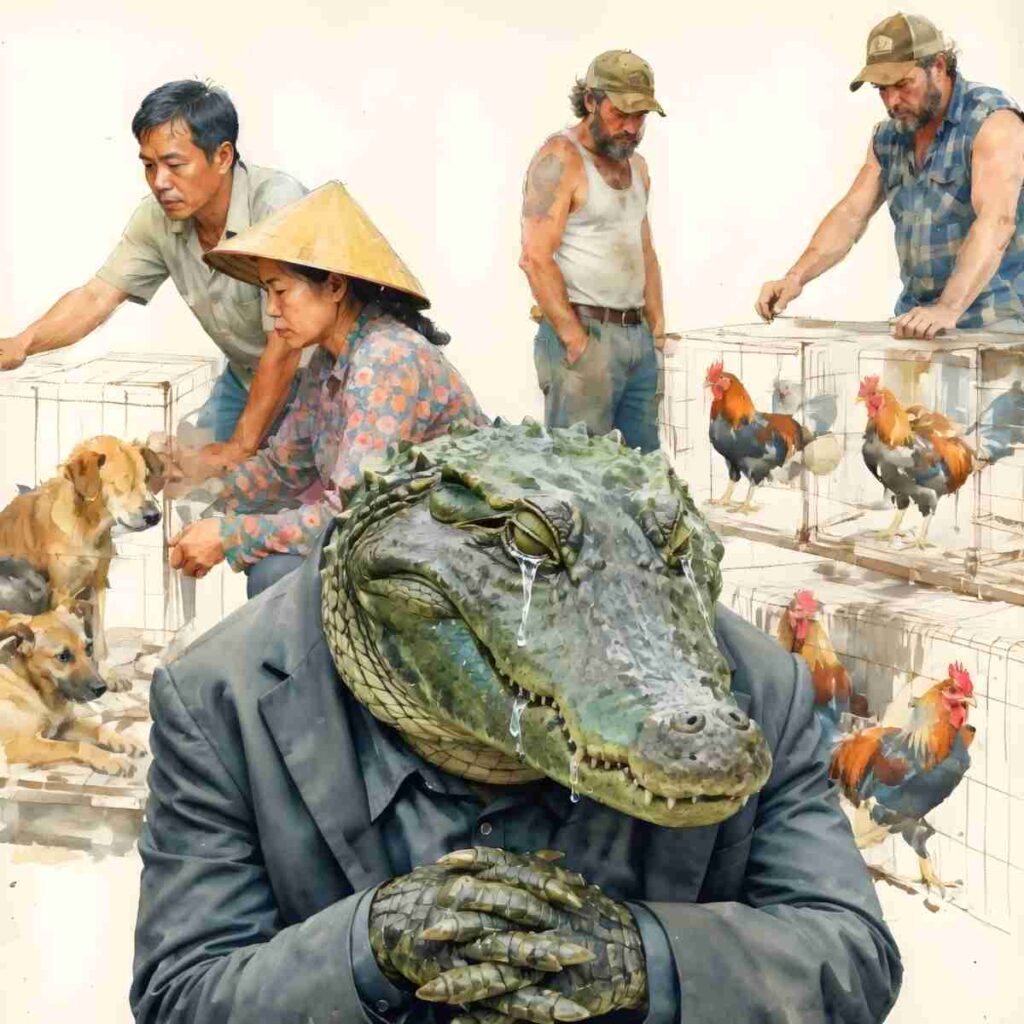


Cruel hypocrisy masquerades as concern for exploited dogs, cats, & gamefowl
SEOUL; HANOI; CROSS PLAINS, Texas; BENNETT, Colorado––One need not have spent much time personally investigating Southeast Asian dog and cat meat markets, or U.S. cockpits, or even just viewing the wealth of undercover and drone video of such operations gathered in recent years to recognize the often deliberately sadistic cruelty and abysmal contempt the dog and cat meat merchants and the cockers have for their victims.
Few if any dogs or cats killed for meat or gamefowl pitted against each other have ever died a quicker, less painful death than even most of the estimated 70 to 80 billion chickens per year slaughtered for human consumption.

Last defense is a guilt trip
In light of that reality, the screeching violin music played for themselves lately by South Korean and Vietnamese dog and cat meat vendors forced out of business, and by U.S. cockfighters and their friends lamenting the lost lives of impounded gamefowl, sounds less like an authentic dirge, even for economic losses, than like a cynical ploy to inflict guilt on animal advocates as a last-ditch defense of the indefensible.
Yes, some dogs, cats, and gamefowl may be euthanized in the course of shutting down these atrocious industries, but any guilt for that accrues to the profit-pocketing breeders, not to animal advocates and law enforcement who, at the very least, are ensuring that no more dogs, cats, and gamefowl will be bred to suffer as countless millions already have at the hands of the entrepreneurs now purporting to mourn the animals’ loss.

Selling out & moving on
In South Korea and Vietnam, meanwhile, many of those entrepreneurs appear to have already cashed out, selling their animal stock and moving on to other businesses.
“What happened to the hundreds of thousands of dogs once bred for human consumption?” asked Agence France Presse, reporting from Seoul, South Korea, in a June 29, 2026 feature article distributed by, among others, CTV, Barron’s, and the Taipei Times.
“In January 2024,” Agence France Presse recounted, South Korea “passed a law banning the breeding, slaughter and sale of dogs for food. Once it takes effect in February 2027, violators will risk prison sentences of up to three years.”
(See Dog meat trade ban helps signal a new day for animals in South Korea.)

Dog meat industry disappearing
“As the ban looms, the dog meat industry is disappearing much faster than many expected,” the Agence France Presse team observed.
“Government figures show between 400,000 and 450,000 dogs were being raised for meat in 2024,” Agence France Press continued. “Today, the agriculture ministry estimates just 20,000 dogs remain on farms.”
Where did they all go?
Interviewing government officials, dog meat dealers, and representatives of humane organizations who campaigned against the dog meat industry for decades, Agence France Press found one set of explanations.
Investigating on the ground 25 years earlier in the Moran Market, formerly the biggest dog and cat meat sales venue in South Korea, ANIMALS 24-7 found another explanation that also may yet make sense.
(See Largest dog and cat meat market in South Korea set to close by May.)

“Where the animals went was not tracked”
“To help farmers transition,” Agence France Presse said, “the government offered up to 600,000 won (about $390) for every dog they got rid of.
“But where the animals went was not tracked.”
“Data obtained by a lawmaker,” Agence France Presse detailed, “showed that by February 2026 just 623 dogs had been adopted, and just under 500 were sent to shelters.
“Most of the rest were likely killed, animal welfare groups and former farmers believe.”
Agreed Kim Young-hwan, identified by Agence France Presse as a representative of the animal rights group CARE, “If large numbers of rescued dogs had entered adoption programs, animal groups like us would know about them.”

(Beth Clifton photo)
Were missing dogs “already eaten”?
CARE itself claims to have “rescued and rehomed about 2,500 farmed dogs, most of them sent overseas,” Agence France Presse added.
Christian minister and former dog meat farmer Ju Yeong-bong, who in June 2025 lamented to Gavin Butler and Hyunjung Kim of BBC News that he had 600 dogs to dispose of before February 2027, suggested to Agence France Presse that the missing dogs had “already been eaten.”
That possibility is “infuriating,” said CARE’s Kim. But reality is that South Korean animal welfare groups lacked the resources to rescue more dogs, Kim said.

82% of dog meat farms already closed
“According to the agriculture ministry, 1,265 dog farms––about 82% of the total––had applied to shut down as of May 2026,” Agence France Press finished..
If 1,265 dog farms were 82% of the total identified in January 2024, when South Korea began the phase-out of the dog meat industry, there were 1,543 dog meat farms at that time.
Compare those numbers to those cited by Humane World for Animals president Kitty Block on January 9, 2026.
Wrote Block, “Today marks two years since the ban on dog meat officially passed in South Korea. Since enforcement began, 1,204 dog farms—or about 78% of all dog farms in the country—have closed. When we started advocating for an end to the industry, about a decade ago, government estimates indicated that there were more than 17,000 dog meat farms.

“Huge achievement,” but didn’t do the math
“The phase-out of this industry—from 17,000 dog meat farms to now just over 330—represents a huge achievement,” Block correctly assessed.
But Block self-evidently did not do the math.
If there ever were 17,000 dog meat farms in South Korea, more than 90% of them must have disappeared between the beginning of Humane World for Animals involvement in the issue and the enactment of the dog meat industry ban in 2004.
Very likely the number 17,000 represented a gross exaggeration, following decades of exaggeration by dog meat industry representatives trying to inflate the economic importance of their business, by government officials trying to defend the dog meat industry, and by anti-dog meat activists trying to win global support for their campaign.

Bogus claims
At that, the claim of 17,000 South Korean dog meat farms was considerably deflated from 2008, when agriculture ministry spokespersons told Kim Tae-jong of the Korea Times that about 720,000 South Korean farms raised 2.3 million dogs per year for slaughter.
Those numbers were easily refuted, since the total number of farms of any type in South Korea acknowledged by the South Korean government to the United Nations Food & Agricultural Organization was about 720,000, and the total number of humans living on farms was 2.3 million.
ANIMALS 24-7 in May 2001 found on the ground in South Korea that all published estimates of the dog meat trade were inflated by magnitudes of order.
That likely still being the case, it is also likely that hardly any dogs are left unaccounted for by the gradual shut-down of the industry.

Cats too
Touting the Humane World for Animals “Models for Change program, which has helped dog meat traders in South Korea, Viet Nam and India switch to livelihoods that are less dangerous and more humane,” Kitty Block on June 25, 2026 noted that while, “In Vietnam’s cruel and illegal meat trade, the suffering dogs are in the spotlight, cats too are caught up in this cruel and illegal trade.”
Eating cats has officially been illegal in Vietnam at least since 1998, but has persisted as a criminal vice in absence of aggressive discouragement.
“That changed this week in Ho Chi Minh City,” Kitty Block wrote.
“More than 400 cats were seized by police in what appears to be one of the largest single cat meat trade interceptions in Vietnam’s history,” Block recounted.

(Soi Dog Foundation photo)
Where the cats went
What became of the impounded cats?
“Two local organizations, HavePaws and Vietnam Cat Welfare,” Kitty Block explained, “have been at the forefront of the massive effort to meet the urgent needs of the rescued cats on site, along with volunteer veterinarians. They have been providing around-the-clock care, helping to meet the animals daily welfare needs.
“Humane World for Animals Viet Nam has provided initial emergency assistance and is working with local groups on the ground to assess longer-term support needs for the cats as the case progresses.”
Almost certainly some sick and injured cats will have required euthanasia. But sad though this reality is, humane euthanasia is a quicker, kinder death than anything done to cats in Southeast Asian live markets, the details of which ANIMALS 24-7 will spare our already long since sensitized readers.

Clucking and crowing from east Texas cockers
This brings us around to the latest rounds of clucking and crowing from east Texas cockers about the impoundment and euthanasia of gamefowl.
Many hours of drone footage gathered by Showing Animals Respect & Kindness [SHARK] in 2026 alone show east Texas cockfighters killing roosters who lose in the pits by methods including stomping, strangulation, and bodily dismemberment.
ANIMALS 24-7 has viewed the Showing Animals Respect & Kindness video from probably more cockfights over the seven years that the SHARK “Crush Cockfighting” investigative campaign has been underway than most actual cockfighters have attended.
But one need not actually view the video evidence to understand just how sadistic cockfighting is. One need only know what a “drag pit” is: a side pit where mortally wounded roosters no longer capable of giving an entertaining performance in the main pit are dumped to suffer, and perhaps fight a little more, until one of them dies, making the other “the winner” until all the bets on the outcome are paid off.
Then “the winner” will also be stomped, strangled, or have his head yanked off.

Van Zandt County
Emailed Animal Wellness Action representative Kevin Chimbers to ANIMALS 24-7 on the morning of July 23, 2026, about a case we had already been following for days, “After a two-month investigation by the Van Zandt County, Texas sheriff’s office and the SPCA of Texas, authorities executed a search warrant on July 16, 2026 at a gamefowl breeding operation.
“According to my contact at the SPCA,” Chambers said, “investigators found gaffs and other equipment commonly associated with cockfighting. They also seized 174 roosters, seven hens, and a bloodstained trailer reportedly used as a cockhouse.”
The Van Zandt County Sheriff’s Office confirmed the details.

Herrons & gamefowl
“The defendant has been identified by different names in media reports, including Justin Blake Hart,” the name used by the Van Zandt County Sheriff’s Office and the SPCA of Texas, “and Justin Herron,” who identified himself as the property owner on Facebook.
“I have also been told that Herron’s father and grandfather were both well-known cockfighters,” Chambers wrote.
Be that as it may, a district director of the since legally dissolved Oklahoma Gamefowl Commission named Randy Herron, of Choctaw, Oklahoma, identified himself in 2024 as a “fourth generation game fowl breeder.”
Continued Chambers, “Yesterday, during a civil hearing to determine the disposition of the seized birds, district attorney Tonda Curry asked Justice of the Peace Don Ashlock to dismiss the civil case. The judge granted the request and ordered that the birds and the seized cockfighting equipment be returned to the defendant. The hearing reportedly lasted about 10 minutes, and no witnesses—including representatives from the SPCA of Texas—were permitted to testify. The return of the birds is underway today.

“May wait for new district attorney”
“The criminal case, however, has not been dismissed,” Chambers added. “District attorney Curry, who recently lost her reelection bid and will leave office at the end of the year, remains in office. There is speculation that the Van Zante County Sheriff’s Office may wait until a new district attorney takes office before filing criminal charges.”
According to a February 13, 2026 Facebook posting by “BBQ & A Prayer,” a Curry political foes who identifies himself as a food truck owner and “spiritual influencer,” Curry “for months…told the citizens of Van Zandt County that her hands are tied — that she cannot shut down game rooms [gambling dens] because of an ordinance passed by a previous Commissioners Court in 2022.”

“The pattern is clear”
A video link, however, summarizes BBQ & A Prayer, shows “Curry admitting that she wrote the ordinance that allowed the game rooms to operate in our county.
“She didn’t just inherit it,” BBQ & A Prayer alleged. “She created it. She encouraged the prior Commissioners Court to pass it. She stated she did her research and specifically structured the ordinance — including operating hours — to be favorable to the business owners.
“She also acknowledged working with game room operators in crafting this ordinance and even brought one of them to Commissioners Court in 2022 when this was pushed through,” BBQ & A Prayer continued.
“Campaign finance reports show that operators connected to these game rooms have donated to her campaign this year. That is public record. She maintains communication with them. The pattern is clear.”
“Research across Texas jurisdictions shows that game rooms are frequently associated with increased narcotics activity, prostitution, human trafficking, and money laundering,” observed BBQ & A Prayer, reciting precisely the same array of crime that is strongly associated with cockfighting throughout the U.S. and indeed the world.

“Exploitation of gamefowl & their owners”
Meanwhile back at the gamefowl ranch, alleged “General Cross Farm, Mike Ratliff Method’s Post,” in Cross Plains, Texas, via Facebook, “There is a war going on in America and a target is locked in on our beautiful gamefowl. Special interest groups and government agencies (KILL SQUADS) are determined to eradicate our treasured, historic bloodlines. They make money and keep themselves in business through the exploitation of gamefowl and their owners.”
According to the General Cross Farm page on Facebook, “General Cross Farm refers to the legacy and gamefowl breeding operation of the legendary Mike Ratliff,” who of course made a great deal of money “through the exploitation of gamefowl and their owners.”

Cockfighters’ “beloved chickens”
Law enforcement cracking down on cockfighting, “General Cross Farm” complained, “use guns, knives, phenobartital [the actual name is pentobarbital] electrical current, gases, cervical dislocation and the automated grinder, to name a few, and they kill birds without remorse…making choices that harm us and our beloved chickens.”
This, in reality, sounds much like the routine operations of any poultry farmer, including gamefowl breeders, except that farmers including gamefowl breeders usually don’t have legal access to pentobarbital, a closely regulated barbiturate, even if they can spell it.
Rhetoric similar in substance has often been posted in the name of animal advocacy by the Rooster Sanctuary at Danzig’s Roost’s in Bennett, Colorado.

“Roosters pay the price”
“The roosters themselves are the ones who pay the price,” after cockfighting busts, Rooster Sanctuary at Danzig’s Roost objects. “They are seized, killed, and discarded, while the cycle simply begins again. The birds are killed while the underlying networks remain intact.
“If someone is arrested twice and only pays a small fine, that tells you enforcement isn’t targeting what actually sustains the activity. Killing birds clearly didn’t stop it the first time. They were replaced. That’s the cycle.”
Rooster Sanctuary at Danzig’s Roost, in fairness, has a point. But the appropriate response is not to return impounded gamefowl to cockfighters.

Seizure & auction
Showing Animals Respect & Kindness founder Steve Hindi has argued since the beginning of the “Crush Cockfighting” campaign that anti-cockfighting legislation needs to be strengthened to the point of requiring convicted cockfighters themselves to pay for the cost of maintaining impounded gamefowl in sanctuary care for the balance of their natural lives.
This could be accomplished by seizure and auction of all property and vehicles used in connection with cockfighting, much as is done in drug busts and poaching cases, with the funds distributed to nonprofit organizations actually providing the sanctuary care.

Until legislation provides for that, the most effective means of reducing the death toll among gamefowl remains busting cockfighters and gamefowl breeders, at least cutting into their capacity for producing ever more victims.
Please donate to help our work:
More related posts:
Discover more from Animals 24-7
Subscribe to get the latest posts sent to your email.