

The best dog food for american bully dogs is complete and balanced for the correct life stage, measured to maintain a lean body condition, and practical for the dog’s activity, chewing comfort, health, and household. American Bullies do not need a special bulking diet. This veterinarian-authored guide compares five foods by distinct use case and explains how to verify the current label.
Our picks are starting points for healthy dogs, not prescriptions. Product formulas and calorie values can change, so compare the package you receive with the information used here. For breed size, temperament, structure, and general care, see Petful’s complete American Bully guide.

Don’t Guess When It Comes To Your Pet’s Care
Sign up for expert-backed reviews and safety alerts all in one place.
How we chose the best dog food for an American Bully
- 1Confirm AAFCO nutritional adequacy for the dog’s life stage before comparing ingredients.
- 2Compare calories per cup and per kilogram, then measure the dog’s actual portion.
- 3Manufacturer expertise, quality control, research, and access to nutrient information matter more than high-protein or premium wording.
- 4Persistent itching, digestive signs, weight change, or diagnosed disease needs veterinary guidance.
No ingredient list can tell you by itself whether a food is complete, well controlled in manufacturing, or appropriate for one dog. The AAFCO guide to reading pet-food labels explains the product name, intended species, quantity, guaranteed analysis, ingredient list, nutritional-adequacy statement, feeding directions, calorie content, and manufacturer information.
The adequacy statement is the first decision point. It should say that the food is complete and balanced for adult maintenance, growth, gestation or lactation, or all life stages. A product labeled for intermittent or supplemental feeding should not become the whole diet unless a veterinarian has designed the plan.
The WSAVA Global Nutrition Toolkit adds questions that package marketing often avoids:
- Who formulates the food, and what are that person’s qualifications?
- Where is the food manufactured?
- What quality-control steps and finished-product testing are used?
- Does the company conduct or publish nutrition research?
- Can it provide a typical nutrient analysis, not only minimums and maximums?
- How are product complaints and possible adverse events handled?
We then assessed each food for:
- A distinct role within the five-product comparison.
- Life-stage wording and calorie information on the current label or manufacturer page.
- Portioning and storage practicality for a muscular medium-to-large dog.
- Ingredient or format tradeoffs that could change an owner’s decision.
- Manufacturer transparency and ability to answer technical questions.
- A stable, identified product destination rather than a generic search page.
What food is good for an American Bully?
A good food is complete and balanced for the dog’s life stage, provides a calorie amount that can maintain a healthy body and muscle condition, and is tolerated without persistent digestive or skin signs. It should also come from a manufacturer that can explain formulation and quality control. Breed imagery, protein slogans, and “muscle” claims do not establish suitability.
What are American Bullies most allergic to?
There is no credible American Bully-specific list of top food allergens. In dogs generally, adverse food reactions are usually directed at proteins the dog has eaten, but itching can also result from fleas, environmental allergy, mites, infection, or other disease. A veterinarian-directed elimination diet followed by a controlled challenge is the standard way to investigate food allergy.
How many times should you feed an American Bully?
Many healthy adults do well with two measured meals daily, while puppies usually need three or more meals depending on age and veterinary advice. Dogs with diabetes, gastrointestinal disease, medication schedules, or other medical needs may require a different plan. Meal frequency does not determine total calories, so divide the daily allowance rather than adding full portions.
What two dogs make an American Bully?
UKC describes the American Bully as a natural extension of the American Pit Bull Terrier influenced by the American Pit Bull Terrier, American Bulldog, English Bulldog, and Olde English Bulldogge, not one fixed two-breed recipe. That history does not create a unique nutritional requirement. Choose food from the individual dog’s life stage, adult size, body condition, activity, health, and current label.
Which feed is best for an American Bully?
The best feed is the one that clears a decision sequence: correct nutritional adequacy, suitable calorie density, credible manufacturer information, practical format, comfortable eating, and good results in that dog. A healthy sedentary adult and a genuinely active adult may need different calorie density. A puppy or dog with disease belongs in a different decision branch.
What do you feed an American Bully dog?
Feed a measured complete diet appropriate to the life stage, with treats and extras counted within total calories. Dry, wet, fresh, or a correctly combined plan can work. Water should always be available. Avoid defaulting to high-calorie performance food, raw meat, or unbalanced home recipes merely because the breed is muscular.
What should an adult American Bully eat?
A healthy adult American Bully can eat dry, wet, or another safely handled format if the total diet is complete and balanced for adult maintenance and fits the dog’s energy needs. The best dog food for bullies is not necessarily the formula with the highest protein or the most animal ingredients pictured on the bag.
What is the best and healthiest dog food for bullies? It is a food that supports a lean waist, palpable ribs, preserved muscle, comfortable stool, normal skin and ears, and reliable appetite while meeting the dog’s life-stage and medical requirements. Those outcomes are assessed over time. One enthusiastic meal or dramatic before-and-after advertisement is not evidence.
Protein, fat, and calories
Protein is essential, but more is not automatically better. A complete adult diet already supplies required amino acids when formulated correctly. Protein percentage must be interpreted alongside energy density, fat, fiber, moisture, mineral balance, life stage, and health.
Fat is calorie dense. Performance formulas can be useful for dogs doing sustained, demanding work, but can oversupply energy to an ordinary companion. A food at 406 calories per cup requires a smaller measured volume than one at 340 calories per cup for the same calorie target.
Use calories rather than cup size to compare products. Then weigh the portion in grams because scoops vary and kibble settles.
Ingredient lists without ingredient-list fear
Ingredients appear in descending order by weight before processing. Water-rich meat can rank high, while a dry ingredient contributes differently after cooking. Corn, rice, oats, sorghum, by-products, and meals are not automatically good or bad simply because of their names.
Ask what the complete formula delivers and how it is controlled. Avoid choosing solely by:
- “Meat first.”
- Grain-free.
- Human-grade.
- Natural.
- Holistic.
- Ancestral.
- High protein.
- Bully-specific.
These phrases may describe a feature, but they do not replace the adequacy statement, calorie content, feeding evidence, quality control, or the dog’s response.
Our five American Bully food picks at a glance
Five American Bully foods compared by need
| Pick | Intended role | Label life stage to verify | Listed calories at review | Main tradeoff |
|---|---|---|---|---|
| Wellness Complete Health Chicken and Oatmeal | Best overall adult pick | Adult maintenance | About 427 kcal/cup | Calorie dense for easy keepers; chicken-based |
| Purina Pro Plan Adult Chicken and Rice | Best for active adults | Adult maintenance by feeding tests | 369 kcal/cup | Wheat, corn, and soy ingredients may deter some shoppers but do not make it nutritionally inferior |
| VICTOR Hi-Pro Plus | Best budget-conscious performance pick | All life stages except growth of large-size dogs expected to reach 70 pounds or more | 406 kcal/cup | Rich 30/20 formula and large bag can be wrong for sedentary dogs |
| Royal Canin Medium Adult | Best for measured maintenance | Adult maintenance; intended for 23-to-55-pound adults | 340 kcal/cup | Size range excludes many larger American Bullies |
| ACANA Free-Run Poultry | Best ingredient-variety pick | All life stages, including large-size growth on current U.S. page | 396 kcal/cup | Grain-free and legume-forward; poultry blend is not a diagnostic allergy diet |
Calorie values are useful comparison points, not permanent facts. Recheck the current package and manufacturer page before calculating portions. If the delivered formula differs, use the delivered label and ask the manufacturer to clarify.
The five picks do different jobs. “Best overall” means the most straightforward adult starting point in this slate, not a universal winner. The active and budget picks require especially honest assessment of activity and calorie needs, while the measured-maintenance pick fits only dogs within its labeled size band.
Wellness Complete Health: Best overall adult pick
Wellness Complete Health Adult Chicken and Oatmeal is our best overall adult starting point because it is a conventional grain-inclusive formula with an adult-maintenance role and a stable identified 30-pound product. The current linked product lists deboned chicken, chicken meal, oatmeal, ground brown rice, peas, salmon meal, and salmon oil among its ingredients; recipes can change, so verify the delivered bag.
- Clear everyday adult-maintenance role
- Grain-inclusive dry format
- Manufacturer publishes guaranteed analysis and feeding guidance
- Stable identified product with merchant SKU 34361
- About 427 calories per cup is relatively dense for an easy keeper
- Chicken-based formula will not suit every dog
- A large bag requires good storage
- Formula changes require checking the delivered label
Who it may suit
This pick may suit a healthy adult that tolerates chicken, maintains normal stool and skin, and needs a conventional dry food. It is easy to weigh, and part of the measured daily amount can be reserved for training.
It may also suit an owner who wants to avoid both a performance formula and a grain-free formula while retaining a moderate ingredient profile. That is a practical role, not evidence that the formula prevents disease.
Important tradeoffs
At roughly 427 calories per cup on the product information reviewed, it can deliver excess energy quickly to a low-activity dog. Measure in grams, count treats, and reassess body condition. The current label always takes priority because recipes and cup weights change.
Chicken appears in several forms, so this is not appropriate for a strict chicken-free elimination diet. It is also not a therapeutic food for skin disease, joint disease, obesity, kidney disease, or another diagnosis.
How to use it
Confirm the adult-maintenance statement and calories on the package. Convert the veterinary team’s daily calorie target to grams, then subtract treats and toppers. Store the food sealed in its original bag inside a clean container so the lot code and date remain available.
Check Wellness Complete Health
Purina Pro Plan Adult Chicken and Rice: Best for active adults
Purina Pro Plan Adult Chicken and Rice Formula fills the active-adult role. Purina’s current U.S. page for the Complete Essentials Shredded Blend Chicken and Rice formula says animal feeding tests substantiate complete and balanced nutrition for adult maintenance and lists 369 calories per cup.
- Adult maintenance substantiated by AAFCO feeding tests on the current manufacturer page
- 369 calories per cup is lower than several picks in this slate
- Manufacturer provides detailed feeding and transition information
- Dry format is easy to weigh
- Wheat, corn gluten meal, and soybean meal may not appeal to ingredient-list shoppers
- Chicken-based and unsuitable for a strict chicken-free trial
- Not a performance guarantee
- Calorie needs still require individual measurement
Who it may suit
This food may suit a healthy adult with regular exercise whose owner values feeding-trial language, a large manufacturer’s nutrition resources, and predictable dry-food handling. “Active” here means a dog with consistently higher energy expenditure, not a dog that takes one long weekend walk.
An athletic dog still needs a lean condition. Activity does not give owners permission to free-feed or ignore treats.
Important tradeoffs
The ingredient list includes grains and plant-protein ingredients that some owners avoid. Those ingredients do not make the food inherently poor quality or allergenic. The relevant questions are whether the formula is complete, controlled in manufacturing, appropriate for the dog, and tolerated.
This is not a novel-protein or limited-ingredient diet. A dog with persistent itching, recurrent ear disease, vomiting, diarrhea, or weight loss needs a diagnostic plan rather than a switch based on the chicken-and-rice name.
How to use it
Use the package guide only as a starting point. Weigh the daily amount, split it into meals, and assess weight and body condition every two weeks during an adjustment. If the dog gains despite expected activity, verify extras and reduce calories with veterinary guidance rather than adding more exercise to outrun overfeeding.
Check Purina Pro Plan Chicken and Rice
VICTOR Hi-Pro Plus: Best budget-conscious performance pick
VICTOR Hi-Pro Plus 30/20 is the budget-conscious pick for households that need a large bag and have a genuinely high-output dog. The identified 50-pound product lists 406 calories per cup and a 30% protein, 20% fat guaranteed analysis.
Its current manufacturer adequacy statement covers all life stages except growth of large-size dogs expected to reach 70 pounds or more as adults. That exception rules it out for many American Bully puppies even though the front of the bag may look performance-oriented.
- Large 50-pound bag can reduce cost per pound
- Calorie-dense formula can provide practical volume for sustained high activity
- Stable identified product with merchant SKU 120690
- Manufacturer publishes adequacy wording and guaranteed analysis
- Not labeled for growth of large-size dogs expected to reach 70 pounds or more
- 30/20 performance profile is too rich for many companion dogs
- Large bag may go stale before one dog finishes it
- Price per bag and calorie load can erase the apparent value
Who it may suit
This pick may suit an adult participating in sustained sport, conditioning, farm work, or another regular energy-intensive routine, provided the current adequacy statement and nutrient profile fit. It can also work for a multi-dog household that will finish the bag safely and can keep portions individualized. Do not use it for a puppy expected to reach 70 pounds or more unless the current label changes and a veterinarian confirms the diet fits.
The value case depends on cost per day, not the large bag alone. Divide package calories by the dog’s daily meal calories and account for waste, shipping, and storage.
Important tradeoffs
Most companion American Bullies do not need a 30/20 performance formula. High calorie density can shrink the meal volume and accelerate weight gain. Extra energy is stored as fat, not automatically turned into healthy muscle.
The 50-pound package is also a storage commitment. Heat, moisture, insects, repeated air exposure, or topping off a dirty bin can degrade food or obscure the lot. A cheap bag that becomes stale or contaminated is not economical.
How to use it
Verify the current package’s adequacy wording, calories, and feeding guide. Establish an activity-based calorie target with the veterinary team, then measure in grams. Reassess after two weeks and again after a full month using weight, waist, ribs, muscle condition, stool, and exercise recovery.
Do not use this product to force rapid puppy growth or add supplements intended to build mass. Growth and conditioning need separate veterinary plans.
Royal Canin Medium Adult: Best for measured maintenance
Royal Canin Medium Adult Dry Dog Food is the lowest-calorie pick in this slate at 340 calories per cup on the current U.S. manufacturer page. It is formulated for adult maintenance and marketed for dogs weighing 23 to 55 pounds, which creates both its role and its clearest limitation.
- 340 calories per cup offers more food volume than the denser picks for the same calorie target
- Manufacturer publishes gram-based feeding guidance
- Adult-maintenance adequacy on the current U.S. page
- Stable identified product with merchant SKU 115777
- Intended 23-to-55-pound size range excludes many Standard and XL Bullies
- Ingredient deck may not satisfy meat-first shoppers
- Higher price per pound
- Not formulated as a therapeutic weight-loss diet
Who it may suit
This pick may suit a healthy Pocket, Classic, or smaller Standard adult whose healthy weight falls within the product’s labeled range and who benefits from a less calorie-dense dry food. More volume per calorie can make precise maintenance easier for some dogs, though it does not guarantee satiety.
It may also suit an owner who prefers a manufacturer that publishes calories per kilogram, calories per cup, and grams in its feeding table.
Important tradeoffs
Many American Bullies weigh more than 55 pounds, especially larger Standard and XL dogs. The product name “Medium Adult” is not a general promise for every medium-height dog. Use actual healthy adult weight and the current intended range.
The ingredient list may look less appealing to shoppers trained to rank foods by the first few ingredients. Ingredient aesthetics do not decide nutritional quality, but price, acceptance, stool, and the dog’s health still matter.
How to use it
Confirm the dog’s healthy target weight falls within the labeled range. Use grams as Royal Canin recommends, not a rounded scoop. If the dog requires so little food that meals seem impractically small, ask whether a lower-calorie formula or a change in treat strategy would improve the plan.
Do not choose this as a weight-loss treatment for an obese dog without veterinary evaluation. Purpose-formulated therapeutic weight diets may provide different nutrient density and satiety support.
Check Royal Canin Medium Adult
ACANA Free-Run Poultry: Best ingredient-variety pick
ACANA Free-Run Poultry Dry Dog Food combines chicken, turkey, eggs, and other animal and plant ingredients in a grain-free formula. The current U.S. manufacturer page lists 396 calories per cup and says it meets AAFCO profiles for all life stages, including growth of large-size dogs.
- Multiple poultry ingredients create a distinct ingredient-variety role
- Current U.S. page publishes calorie distribution and guaranteed analysis
- All-life-stages adequacy includes large-size growth wording
- Stable identified product with merchant SKU 121059
- Grain-free, legume-forward formulation requires a deliberate decision
- Multiple proteins make it unsuitable for a controlled elimination trial
- 396 calories per cup still requires careful measurement
- Not a breed-specific nutritional requirement
Who it may suit
This food may suit a healthy dog whose owner specifically wants the identified poultry blend and has reviewed the grain-free formulation with the veterinarian. It can also suit a household that needs all-life-stages wording, although puppy feeding requires more than seeing those words.
Ingredient variety can improve acceptance for some dogs, but it does not make the formula hypoallergenic or medically superior.
Important tradeoffs
The formula is grain-free and includes lentils, beans, peas, and chickpeas. The FDA’s current canine dilated cardiomyopathy Q&A says the issue is complex and has not established a simple causal ingredient rule, but owners should discuss diet and cardiac concerns with their veterinarian.
This is also a poor choice for an elimination trial because it contains several animal proteins and plant ingredients. A dog suspected of food allergy needs a controlled veterinary diet with strict exclusion of other foods.
How to use it
Confirm the exact product because ACANA sells similarly named grain-inclusive and grain-free poultry recipes with different calories and adequacy statements. Match the delivered bag to the listing, record the lot, and calculate the portion from its actual label.
If feeding it to a puppy expected to reach 70 pounds or more, verify that the current U.S. package includes the large-size growth statement. Do not rely on a page from another country, where formulations and regulatory wording may differ.
Choosing food for an American Bully puppy
An American Bully puppy needs complete and balanced growth nutrition, controlled calories, and steady body-condition monitoring. Adult-maintenance food is not appropriate for growth. “All life stages” means the food meets growth requirements and may be calorie dense, so it is not permission to free-feed.
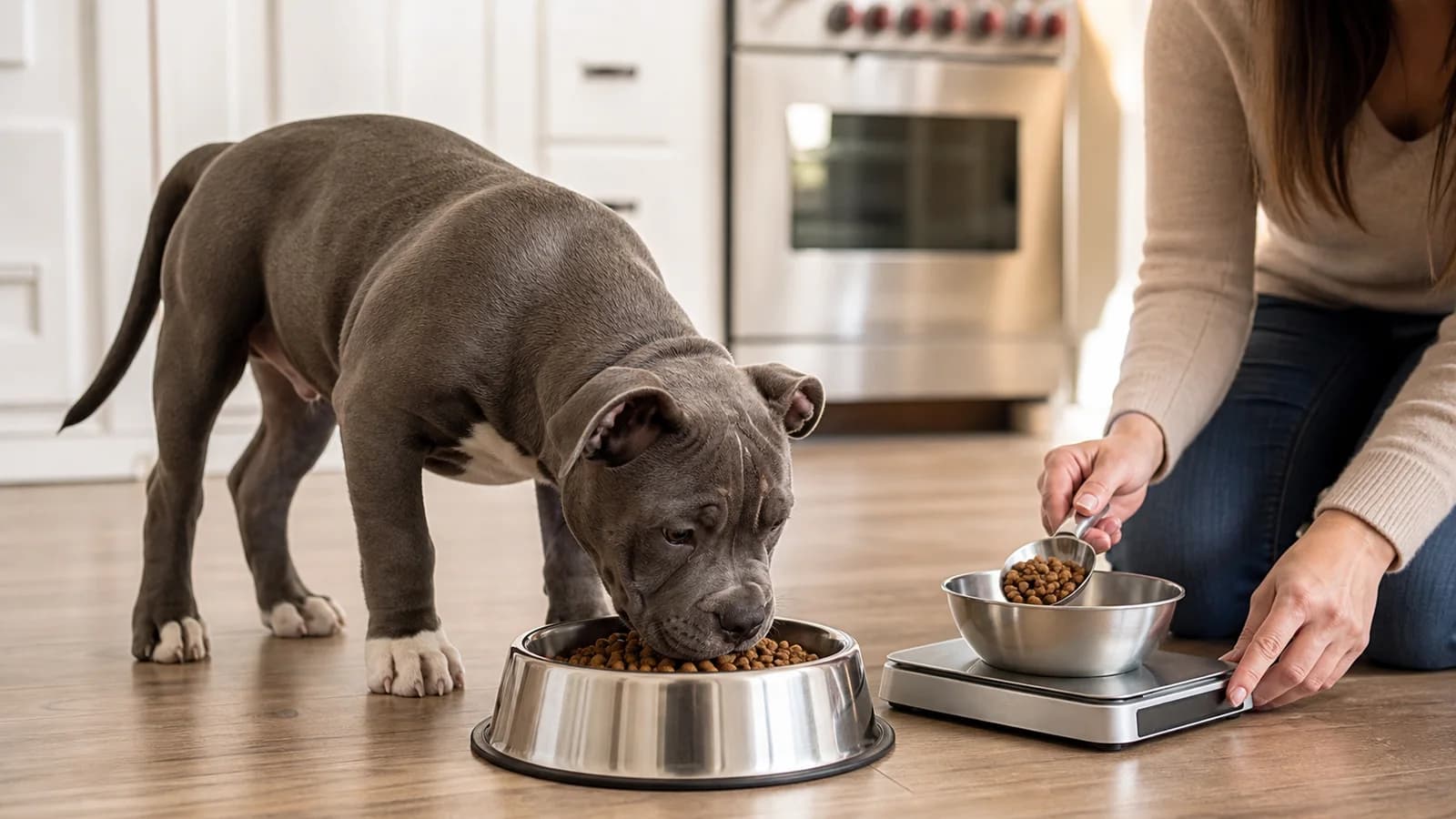
The FDA overview of complete and balanced pet food explains that a nutritional-adequacy statement identifies the species and life stage. For a puppy expected to weigh 70 pounds or more as an adult, the AAFCO statement should include growth of large-size dogs rather than say it is except for that growth category.
Predict adult size conservatively
American Bully classes vary substantially. If parent size is documented, use the larger plausible mature weight when deciding whether large-size growth wording applies. Petful’s American Bully puppy guide covers parent records, growth, training, and first-month setup.
When ancestry or adult size is uncertain:
- Ask the veterinarian to estimate a safe growth category.
- Bring parent weights and photographs if reliable.
- Track weight, body condition, and growth rate.
- Keep the puppy lean rather than pushing maximum size.
- Reassess after growth spurts.
Fast growth and excess weight do not create better bone. Avoid calcium, vitamin D, protein powders, muscle builders, and unbalanced meat additions unless a veterinarian or board-certified veterinary nutritionist has formulated the plan.
Puppy meal frequency
Young puppies usually need multiple measured meals. Three meals daily is common after weaning, while very young or medically vulnerable puppies may need a different schedule. Meal frequency can decrease as the puppy matures, but the total daily calories and growth trend remain the central controls.
Feed on a schedule that supports:
- House-training and predictable stool.
- Safe training rewards from the daily ration.
- Appetite monitoring.
- Prevention of frantic gulping.
- Medication or medical requirements.
A puppy that refuses food, repeatedly vomits, has diarrhea, becomes weak, trembles, seems unusually sleepy, or cannot keep water down needs prompt veterinary advice. Do not hide persistent low appetite under toppers.
Food-allergy questions in puppies
Puppies are not born needing a rare-protein food because of breed. Introducing random boutique proteins can make future diet trials harder by using up novel options. If itching or gastrointestinal signs develop, record every food and treat and let the veterinarian first rule out parasites, infection, and non-food causes.
An elimination diet must be exclusive. Flavored medicines, chews, table food, shared bowls, scavenging, and training treats can invalidate it.
How much should an American Bully eat?
There is no accurate breed-wide cup amount. A Pocket adult, a lean athletic Standard, and an XL dog with low activity can need very different calories. The food’s energy density can also vary by nearly 100 calories per cup among the five picks.
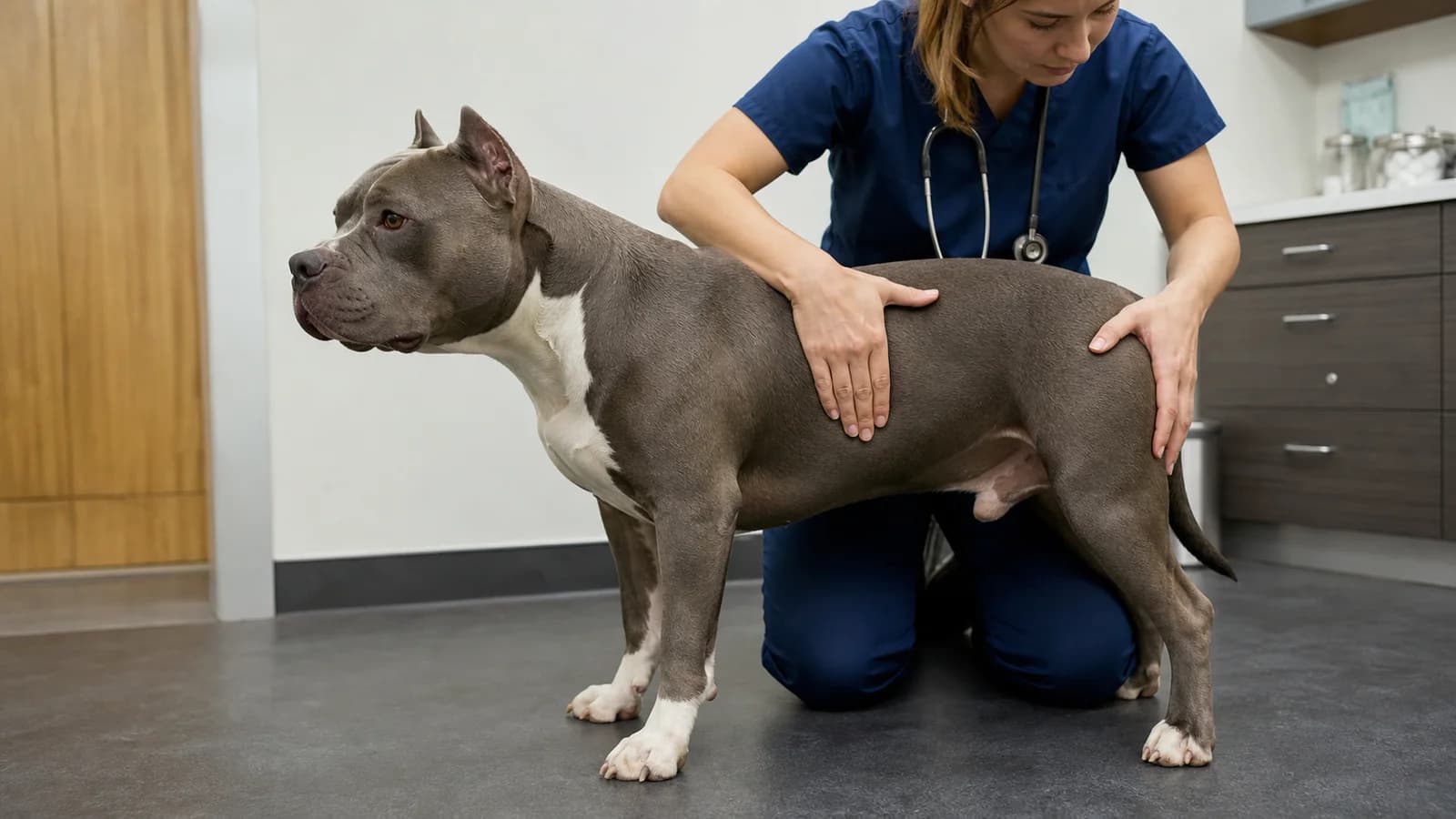
The AAHA nutrition and weight-management guidelines recommend a nutritional assessment that includes body condition, muscle condition, diet, feeding method, treats, supplements, and disease factors. The package guide is only a starting estimate.
A calorie-and-condition worksheet
Use this process instead of copying a cup amount from another owner:
- Record the baseline. Note weight, body condition score, muscle condition score, waist, ribs, activity, stool, and appetite.
- Set a starting calorie target. Ask the veterinary team for a target based on healthy weight and current condition.
- Reserve extras. Subtract calories for treats, chews, toppers, and training.
- Read the exact label. Find kilocalories per cup and per kilogram.
- Convert to grams. Use the cup weight or calories per kilogram for repeatable weighing.
- Divide into meals. Two meals often suit adults; puppies generally need more.
- Recheck at two weeks. Weigh under similar conditions and repeat body assessment.
- Adjust one variable. Change total daily calories modestly with veterinary guidance.
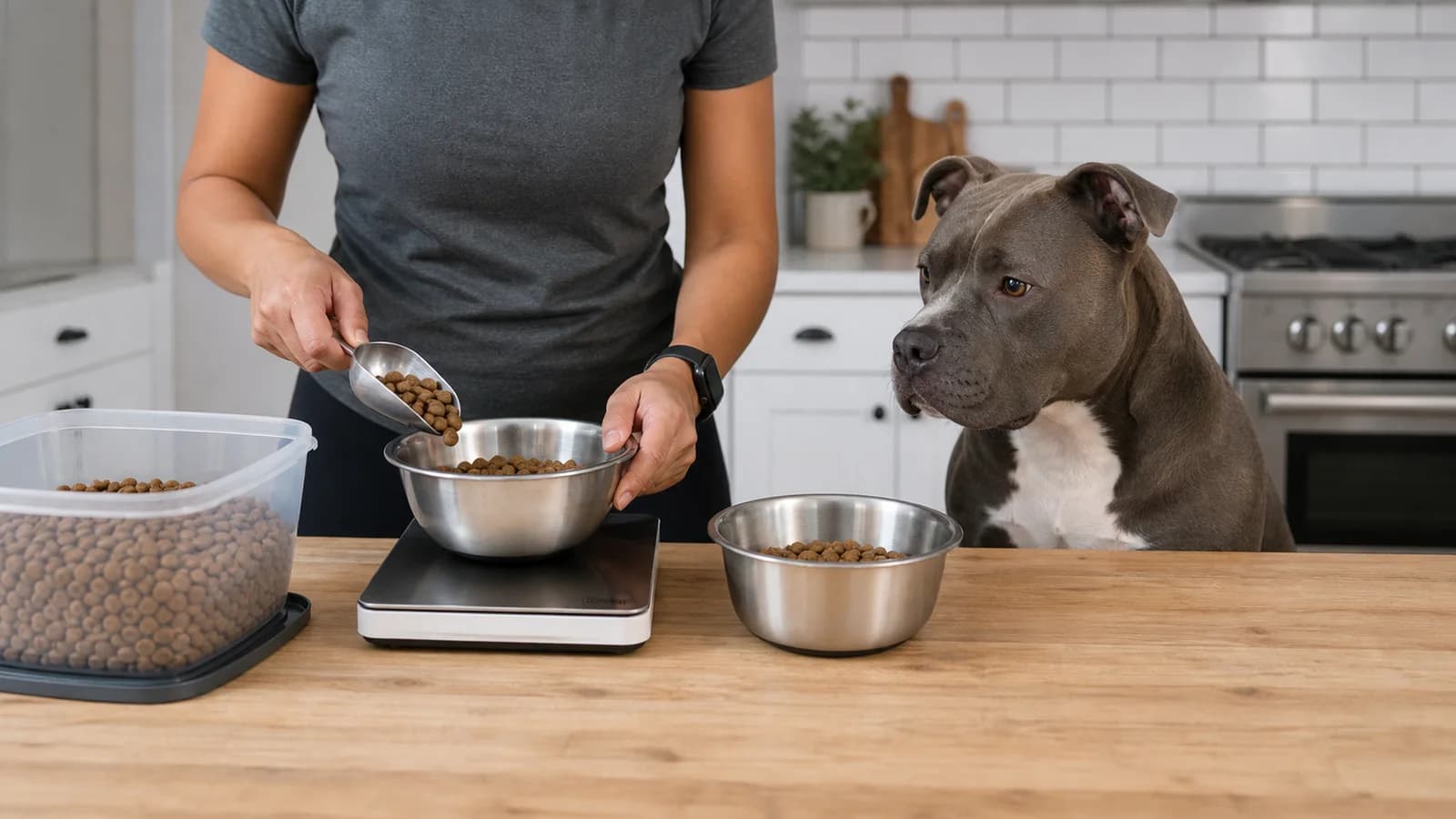
Example calculation
Suppose a veterinarian sets a starting target of 1,000 calories per day and 100 calories are reserved for training and chews. Meals must supply 900 calories.
For a food providing 369 calories per cup:
- 900 divided by 369 is about 2.44 cups per day.
- If one cup weighs 97 grams, that is about 237 grams per day.
- Split into two meals, each meal starts near 118 grams.
This is arithmetic, not a recommendation for a particular American Bully. The dog’s target, current food, label cup weight, treats, and response determine the real amount.
What the two-week check should include
Do not use weight alone. A dog can lose muscle while gaining fat or maintain scale weight while body condition changes.
At each check, record:
- Weight on the same scale when possible.
- Ribs and waist.
- Muscle over the thighs, shoulders, spine, and skull.
- Stool frequency and consistency.
- Appetite and food-seeking behavior.
- Exercise tolerance and recovery.
- Every meaningful extra calorie.
If the dog gains, verify measurement and household handouts before making a large cut. If the dog loses weight unexpectedly, loses muscle, drinks more, vomits, has diarrhea, or eats poorly, schedule an examination instead of simply increasing food.
Meal timing after the daily portion is set
For a dog that eats too quickly, a measured Outward Hound 4-cup slow feeder can change pace without changing the calorie target. Confirm capacity, wash it after use, and count only the food placed inside.
A PetSafe Smart Feed 2.0 automatic feeder can support a set dry-food schedule, but the machine does not determine the correct portion. Weigh the daily food first and verify the dispensed amount before relying on automation.
Most healthy adults can be fed twice daily, which can make appetite changes noticeable and prevent one very large meal. Some do well with three smaller meals. Puppies usually need more frequent feeding, and disease can change the schedule. Whatever the frequency, pre-weigh the full daily amount so extra meals do not become extra calories.
Treats and chews
Treats, chews, table food, dental products, and supplements all count. A large dog can accumulate hundreds of unrecorded calories without anyone noticing because each item looks small relative to the dog.
Meal tools do not set the calorie target
- A slow feeder or timed feeder can change pace or schedule, but it does not decide how much the dog needs. Set daily calories first, weigh the food, and count every treat and topper.
Use part of the complete ration for training. Break other treats into small pieces and count repetitions rather than size. Keep unbalanced extras to a modest fraction of daily calories, often no more than about 10% for a healthy dog unless the veterinary plan says otherwise.
Body condition, muscle, and the myth of bulking
An American Bully’s standard calls for a muscular appearance, but health is not measured by maximum scale weight. Overfeeding adds fat and mechanical load. It can worsen heat tolerance, obscure a waist, and increase strain on joints.
Muscle develops from genetics, adequate complete nutrition, safe progressive exercise, rest, and health. Food cannot create mature muscle in a growing puppy faster than the skeleton can safely support.
Avoid:
- Free-feeding calorie-dense performance food.
- Raw meat added on top of a complete ration.
- Protein powders or mass-gain products.
- Calcium or vitamin D supplements for growth.
- Forced pulling, jumping, or weighted exercise in puppies.
- Judging condition from chest width alone.
Ask the veterinary team to demonstrate the ideal rib cover and waist for that individual. Photographs from above and the side under consistent lighting can reveal trends that a front-facing pose hides.
Food allergies, itchy skin, and sensitive stomach claims
Itchy skin and recurring ear disease are common reasons owners change food, but food is only one possible cause. The AAHA allergic skin disease guidance emphasizes history, examination, parasite control, infection assessment, and structured diagnosis.
What an elimination trial involves
A veterinary elimination trial uses a hydrolyzed or carefully chosen novel-protein diet for a defined period, fed exclusively. Improvement is followed by a controlled challenge to determine whether food caused the signs.
During the trial, avoid:
- Other pet food.
- Table scraps.
- Flavored chews and dental products.
- Non-approved training treats.
- Flavored medicines unless cleared.
- Scavenging and shared bowls.
Over-the-counter limited-ingredient foods can have cross-contact or contain proteins not obvious from the front label. A prescription diagnostic diet is often chosen for stricter control.
Sensitive stomach is not a diagnosis
Vomiting, diarrhea, gas, poor appetite, weight loss, or abdominal discomfort can have infectious, parasitic, inflammatory, pancreatic, dietary, behavioral, toxic, or obstructive causes. Repeatedly rotating foods may create more variables without treating the problem.
Keep a three-day food record and a symptom timeline. Include treats, scavenged items, medications, supplements, stool frequency, vomiting, appetite, water intake, and weight.
Grain-free food and DCM context
Grain-free does not mean carbohydrate-free, hypoallergenic, or automatically better. Many grain-free formulas use peas, lentils, chickpeas, potatoes, or other starches in place of grains.
The FDA continues to describe diet-associated non-hereditary dilated cardiomyopathy as a complex scientific issue. It has not established that every grain-free food causes disease or that one ingredient alone explains reported cases.
Discuss the decision when:
- The dog eats a grain-free or legume-heavy food long term.
- A related dog has cardiomyopathy.
- The dog develops weakness, collapse, cough, reduced stamina, or fast resting breathing.
- The diet was chosen for a presumed allergy without diagnostic testing.
Do not stop a prescribed therapeutic diet based only on social media. Conversely, do not ignore cardiac signs because a package includes taurine.
Raw, home-cooked, and topper-heavy diets
Raw meat is not required for an American Bully. The AAHA raw-protein diet guidance discusses pathogen risks to pets and people. Bones can fracture teeth, obstruct the gastrointestinal tract, or cause injury.
A home-cooked diet can be appropriate when formulated for the individual by a board-certified veterinary nutritionist and followed exactly. Recipes assembled from meat, rice, vegetables, and supplements without nutrient analysis often miss essential minerals, vitamins, fatty acids, or amino acids.
Toppers can quietly displace complete nutrition. If the dog receives a full bowl of complete food plus meat, eggs, oil, broth, cheese, and treats, the total plan may be both excessive in calories and unbalanced. Use a topper only with a defined role:
- Improve acceptance during a veterinarian-approved transition.
- Deliver medication when compatible.
- Add a measured amount of moisture.
- Supply calories within a formulated plan.
Measure it, count it, and make sure it does not turn the complete food into a minority of intake.
Supplements for joints, skin, and muscle
A complete commercial diet already includes required vitamins and minerals for its stated life stage. Adding more can create excess or alter nutrient balance.
Joint supplements may be discussed for an individual dog, but they do not correct hip dysplasia, repair a torn ligament, or replace weight control and pain management. Skin supplements do not diagnose allergy or treat infection. Muscle supplements cannot replace conditioning and may add unnecessary calories or poorly characterized ingredients.
Before adding any supplement, ask:
- What specific problem or goal are we addressing?
- What evidence supports this ingredient and dose?
- Is the product independently quality tested?
- Could it interact with medicines or disease?
- How many calories does it add?
- What outcome and review date will determine whether it stays?
Bring the exact label to the veterinary visit. “Natural” does not mean risk-free.
How to switch foods safely
When the dog is stable, transition gradually over about seven to ten days unless the veterinarian gives a different schedule. A slower change may suit a dog with a sensitive history, while an urgent medical reason may require a different protocol.
A common transition pattern is:
- Days 1 and 2: about 25% new food and 75% old.
- Days 3 and 4: about 50% new and 50% old.
- Days 5 and 6: about 75% new and 25% old.
- Day 7 onward: 100% new if the dog remains well.
Keep total calories similar during the change. Cups are not interchangeable when calorie density differs, so calculate the old and new portions separately.
Track:
- Appetite.
- Vomiting or regurgitation.
- Stool frequency and consistency.
- Gas or abdominal discomfort.
- Itching, ears, and skin.
- Energy and behavior.
- Weight when the calorie density changes substantially.
Stop and seek advice for repeated vomiting, severe diarrhea, blood, marked lethargy, pain, refusal to drink, or worsening chronic disease. One soft stool may justify slowing the transition, but persistent signs need assessment.
When food choice needs a veterinarian

A roundup is not a medical diet plan
- Persistent itching, repeated ear infections, vomiting, diarrhea, unexplained weight change, muscle loss, poor appetite, difficulty chewing, collapse, cough, increased thirst, or diagnosed kidney, urinary, heart, pancreatic, liver, or gastrointestinal disease needs veterinary assessment. A therapeutic diet may pursue nutrient targets that ordinary foods do not.
Bring the veterinarian:
- The exact product name and package photograph.
- The adequacy and calorie statements.
- The measured grams or cups fed per day.
- Every treat, chew, topper, and supplement.
- A three-day food diary.
- Weight and body-condition trends.
- Symptom dates and photographs.
The best dog food for an American Bully with disease may be a therapeutic diet that is not one of the five picks. The medical goal outranks ingredient preference, format, bag price, and online popularity.
Urgent signs
Trouble breathing, blue or gray gums, collapse, repeated unproductive retching, a swollen painful abdomen, severe weakness, suspected toxin ingestion, uncontrolled bleeding, inability to keep water down, or major trauma needs urgent care. Do not wait for a new food to work.
Petful’s American Bully lifespan and health guide explains joint, airway, skin, eye, cardiac, and preventive-care signs in more detail.
Cost per day, not cost per bag
Large American Bullies can make package price feel decisive, but cost per pound still misses calorie density and waste. Calculate cost per feeding day.
Example:
- Bag price: $80.
- Bag contains 80,000 total calories.
- Dog’s food allowance: 1,000 calories per day.
- Bag provides about 80 feeding days.
- Food costs about $1 per day before treats, tax, shipping, and waste.
Use the exact package calories, not a generic brand estimate. Compare the same daily calorie supply across products.
Storage changes value
A 50-pound bag is not a bargain if it remains open too long. Keep kibble in its original bag, close it tightly, and place the bag inside a clean sealed container. Store it in a cool, dry place away from pests and chemicals.
Wash and fully dry the container between bags. Do not pour new food over old residue. Preserve the lot code, best-by date, receipt, and product name in case of a quality complaint or recall.
A 30-day food evaluation
Define success before switching. Otherwise normal day-to-day variation encourages constant rotation.
At day zero, record:
- Weight, body condition, and muscle condition.
- Daily food grams and calories.
- Treat and chew calories.
- Stool pattern.
- Appetite and eating comfort.
- Skin and ear status.
- Activity and recovery.
- The reason for changing.
At two weeks, check tolerance and calorie direction. At 30 days, decide whether the original goal improved without new problems.
A suitable food should support:
- Stable or intentionally changing weight.
- A visible waist and palpable ribs.
- Preserved muscle.
- Comfortable eating.
- Predictable stool.
- Normal appetite.
- Skin and ears that are not progressively inflamed.
- Energy appropriate to age and health.
If the goal was diagnosing an adverse food reaction, this generic evaluation is not enough. Follow the veterinary elimination and challenge protocol.
Choosing among the five picks
Use this order:
- Does the dog need a therapeutic diet? Use the veterinary plan, not this list.
- Is the dog growing? Verify growth adequacy and large-size growth wording when expected adult weight is at least 70 pounds.
- Is the adult over 55 pounds? Royal Canin Medium Adult falls outside its intended size range.
- Is the dog truly high-output? Consider whether VICTOR Hi-Pro Plus calorie density fits sustained work rather than a muscular appearance.
- Do you want a conventional grain-inclusive adult formula? Wellness fills the straightforward role.
- Do feeding trials and manufacturer resources lead the decision? Purina Pro Plan fills the active-adult role.
- Are you deliberately choosing a grain-free poultry blend? Review ACANA’s ingredients, calories, DCM context, and medical fit.
Then compare cost per day, bag size, storage, acceptance, stool, and body-condition trend. The product badge should never outrank life stage or disease.
American Bully feeding FAQs
Frequently Asked Questions
The best food is complete and balanced for the dog’s life stage, provides calories that maintain a healthy body and muscle condition, comes from a transparent manufacturer, and is tolerated well. No single brand is best for every American Bully. Health conditions, growth, activity, size, budget, and eating comfort can change the answer.
They need adequate high-quality protein within a complete diet, not the highest number on the shelf. A properly formulated adult food already supplies required amino acids. Higher-protein performance formulas can also be calorie dense. Choose by total nutrient and calorie fit, body condition, activity, health, and veterinary advice rather than a muscle-building slogan.
It depends on life stage and expected adult weight. A growing puppy expected to reach 70 pounds or more should have adequacy wording that includes growth of large-size dogs. Healthy adults do not automatically need a large-breed label, but size, calorie density, kibble format, joint health, and body condition can make one formulation more practical.
Feed a complete and balanced growth diet with calories measured for steady development. If expected adult weight is at least 70 pounds, verify the large-size growth statement. Keep the puppy lean, monitor growth and body condition, and avoid calcium, vitamin D, protein powders, raw add-ons, or unbalanced recipes unless specifically formulated by a veterinary nutrition professional.
There is no reliable breed-wide cup amount. Start with a veterinarian-guided daily calorie target, subtract treats and extras, convert the food’s calories to grams, and divide the daily amount into meals. Recheck weight, ribs, waist, muscle, stool, and appetite after about two weeks, then adjust one variable at a time.
Complete nutrition supports normal muscle, but excess calories do not become muscle automatically. Healthy muscle develops through genetics, safe progressive exercise, rest, and appropriate protein and energy. Overfeeding adds fat and joint load. Puppies should never be pushed toward rapid growth or maximum bulk with performance foods, supplements, weights, or forced exercise.
Itchy skin is not proof of food allergy. Fleas, environmental allergens, mites, and infection are common alternatives. Ask a veterinarian to examine the dog and decide whether a strict elimination diet is appropriate. Random food changes, mail-in intolerance tests, and over-the-counter limited-ingredient claims cannot reliably diagnose an adverse food reaction.
When the dog is stable, transition over about seven to ten days by increasing the new food gradually while keeping total calories consistent. Monitor stool, vomiting, appetite, skin, energy, and weight. Use the veterinarian’s instructions for illness or diagnostic diets, and seek care for severe, persistent, or systemic signs.
Bottom line
The best dog food for American Bully dogs is not the richest formula or the one with the strongest muscle claim. It is complete for the correct life stage, transparent in formulation and quality control, measured to the dog’s calories, and reassessed through body and muscle condition.
Use the five picks for their distinct roles. Verify the delivered label, calculate grams, count extras, transition carefully, and let disease or persistent symptoms move the decision to the veterinary team.

BVMS, MRCVS
Dr. Pippa Elliott, BVMS, MRCVS, is a veterinarian with nearly 30 years of experience in companion animal practice. Dr. Elliott earned her Bachelor of Veterinary Medicine and Surgery from the University of Glasgow. She was also designated a Member of the Royal College of Veterinary Surgeons. Married with 2 grown-up kids, Dr. Elliott has a naughty Puggle named Poggle, 3 cats and a bearded dragon.