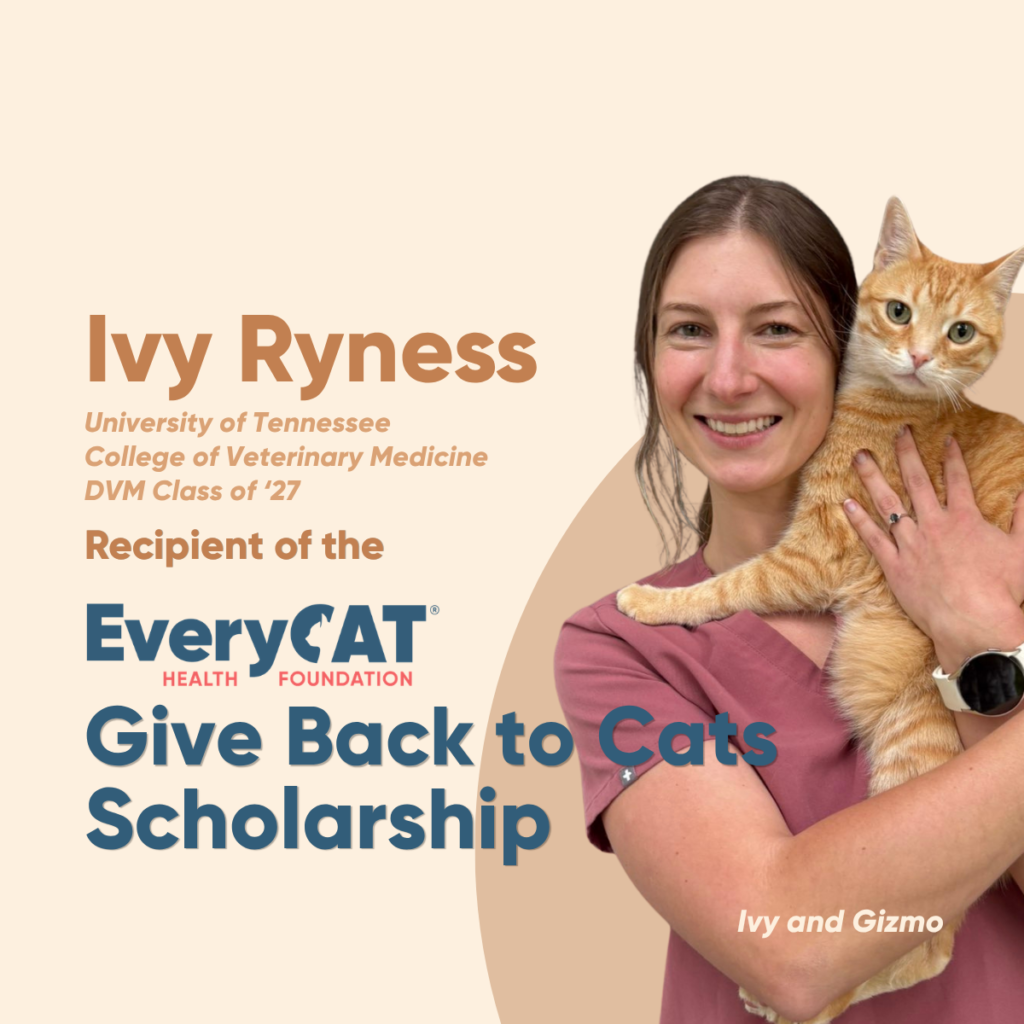

EveryCat Health Foundation is proud to announce that Ivy Ryness, a member of the DVM Class of 2027 at the University of Tennessee College of Veterinary Medicine, is the recipient of our 2026 “Give Back to Cats” Scholarship.

“Why Cats” An Essay by Ivy Ryness
Cats have a reputation for being inscrutable, aloof, or even difficult. Yet, the more time I spend working with cats, the more I have come to see the opposite: cats are remarkably honest. They do not seek human affection in the same manner as our other furry friends, nor do they trust lightly. Every behavior, subtle or overt, has meaning. This honesty, though frequently misunderstood, is what draws me to feline medicine.
Unlike dogs, who have been selectively bred for overt communication and loyalty to humans, cats communicate in quieter, more nuanced ways. Their honesty is not loud, but is consistent. This is where feline medicine becomes both challenging and deeply rewarding. It demands that we, as future clinicians, refine our observational skills and approach each patient without assumptions. Too often cats are labeled as fractious or difficult, when in reality they are responding to stress, fear, or pain. When we shift our perspective from managing behavior to understanding it, we not only improve patient care but also strengthen the human-animal bond.
The misconception of cats extends beyond the clinic into broader societal attitudes. Cats are frequently perceived as independent, to the point of being low maintenance, which can lead to gaps in preventative care and delayed medical attention. Advocating for feline patients therefore involves not only clinical experience but also client education in the form of helping owners recognize the subtle ways their cats express discomfort. I want to be part of changing this narrative, ensuring that cats receive the attentive care they deserve.
Feline medicine also appeals to me because it requires adaptability and empathy in equal measure. Handling a cat successfully often depends less on restraint and more on creating an environment where the animal feels safe. Small adjustments such as quiet exam rooms, gentle handling and allowing time for acclimation can dramatically change an interaction. These approaches align with my belief that good medicine is not only about diagnostics and treatment, but also about minimizing fear and respecting the patient’s experience.
Ultimately, my interest in feline medicine stems from a desire to work with a species that challenges me to be more observant, more thoughtful, and more compassionate. Cats are honest in a way that is easy to overlook but profoundly meaningful once understood. They require us to meet them on their terms, to listen carefully, and to earn their trust. That challenge is what makes feline medicine so deeply fulfilling.
The $2,500 Give Back to Cats scholarship recognizes an outstanding veterinary student leader dedicated to feline health, veterinary medicine, and giving back to the cat community. This year’s recipient was selected from more than 30 applicants based on academic achievement, leadership, financial need, and commitment to excellence in feline medicine.
Funding for the scholarship was generously provided by EveryCat Director Emeritus Dr. Vicki Thayer, DVM, DABVP (Feline). Through her support, this scholarship honors veterinary students who demonstrate both leadership and dedication to advancing feline health and welfare.