
Petful is reader supported. As an affiliate of platforms like Amazon and Chewy, we may earn a commission when you buy through links on this page. There is no extra cost to you.
The Cavalier King Charles Spaniel is a small companion with a sporting spaniel’s curiosity, a silky feathered coat, and a strong preference for being close to people. The breed can suit an attentive first-time owner, a family with gentle children, or an older adult, but it is a poor match for anyone seeking a highly independent dog or a low-stakes health profile.
- 1The official breed standard describes an adult around 12 to 13 inches and 13 to 18 pounds.
- 2Cavaliers are affectionate and adaptable, but close companionship is a real daily need.
- 3Their feathered coat sheds and needs regular brushing.
- 4Responsible ownership includes careful source screening and lifelong attention to heart, neurologic, eye, knee, and hip health.

Don’t Guess When It Comes To Your Pet’s Care
Sign up for expert-backed reviews and safety alerts all in one place.
Cavalier King Charles Spaniel at a glance
The Cavalier is an AKC Toy Group breed, but “toy” describes size rather than fragility or inactivity. The official standard calls for an active, graceful spaniel that is gentle and affectionate. Many adults enjoy neighborhood walks, sniffing games, basic training, and quiet time on the sofa. That combination makes the breed flexible, not effortless.
- Typical standard height: 12 to 13 inches at the withers.
- Typical standard weight: 13 to 18 pounds.
- Coat: silky, straight or slightly wavy, with feathering.
- Recognized colors: Blenheim, tricolor, ruby, and black and tan.
- Social style: people-oriented and usually eager to participate.
- Core owner commitment: companionship, grooming, preventive care, and responsible health planning.

Size charts are useful for planning a small-dog Y-front harness, carrier, bed, and safe vehicle restraint, but an individual dog’s proportions matter more than the label on the package. Measure chest girth, back length, and weight instead of buying by breed name alone.

Petful may earn a commission when you click through to Lemonade, at no extra cost to you.
Cavalier temperament and family life
Cavaliers were developed as companions, and the best-known temperament is warm, responsive, and sociable. Many want to follow family members from room to room. They may welcome visitors after an introduction and often enjoy living with another compatible pet. None of those tendencies is guaranteed. Genetics, early learning, health, and the household all shape the adult dog.
Affection should remain voluntary. A Cavalier who moves away, turns the head, licks the lips, freezes, or lowers the body is asking for space. Children need to interact on the floor, support the whole body, and leave the dog alone while eating or sleeping.
Affection and family life
Most Cavaliers do like to cuddle, but the useful answer is not simply yes. A healthy relationship lets the dog choose contact and leave freely. Some prefer a lap, some lean against a leg, and some settle nearby. Pain, heat, fear, or fatigue can change that preference. A sudden new reluctance to be touched deserves attention, especially if it comes with yelping, scratching near the neck, stiffness, or behavior change.
Is a Cavalier right for you?
Cavalier household-fit scorecard
| Decision | Usually a promising fit when | Think carefully when |
|---|---|---|
| Companionship | Someone is home often or absences can be built gradually | The dog will routinely be alone for a full workday |
| Exercise | You enjoy daily walks, sniffing, play, and short training | You want a heat-tolerant distance-running partner |
| Grooming | Several brushing sessions and routine bathing fit the schedule | You want a non-shedding wash-and-wear coat |
| Children | Adults supervise and children handle a small dog gently | Children are expected to carry, chase, or hug the dog |
| Health planning | Records, insurance or savings, and regular veterinary care are realistic | A high-variance medical budget would be unmanageable |
| Training | You can use rewards and patient repetition | You expect automatic obedience from a sweet expression |
The strongest fit is a household that enjoys a dog as an active participant. The weak fit is not defined by apartment size or yard ownership. It is defined by long isolation, rough handling, skipped coat care, and no plan for health costs.
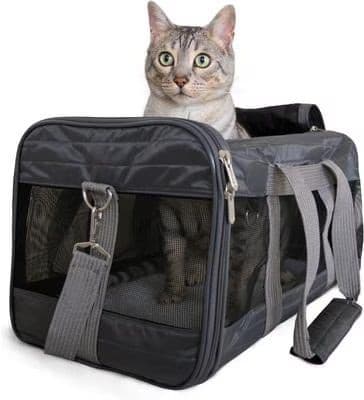
An airline-approved soft-sided carrier with mesh ventilation windows, a top-rated travel pick for cats and small dogs.
Petful may earn a commission when you click through to Chewy, at no extra cost to you.
For budget planning, a current Lemonade pet insurance quote lets you compare the premium, deductible, reimbursement rate, waiting periods, and exclusions before a need arises. Measure standing height and body length before comparing the Sherpa soft-sided carrier, and verify the exact car or airline rules that apply to the trip. For coat maintenance, the aumuca self-cleaning slicker brush is one tool to compare; use light pressure, work in small sections, and stop if the skin becomes irritated.
Daily care, exercise, and enrichment
A healthy adult often does well with a mix of walks, sniffing, play, and training rather than one exhausting workout. Start with the individual dog in front of you. Age, conditioning, weather, heart status, orthopedic comfort, and breathing all affect the right amount. Puppies need short, developmentally appropriate activity, and seniors may need shorter routes with more recovery.
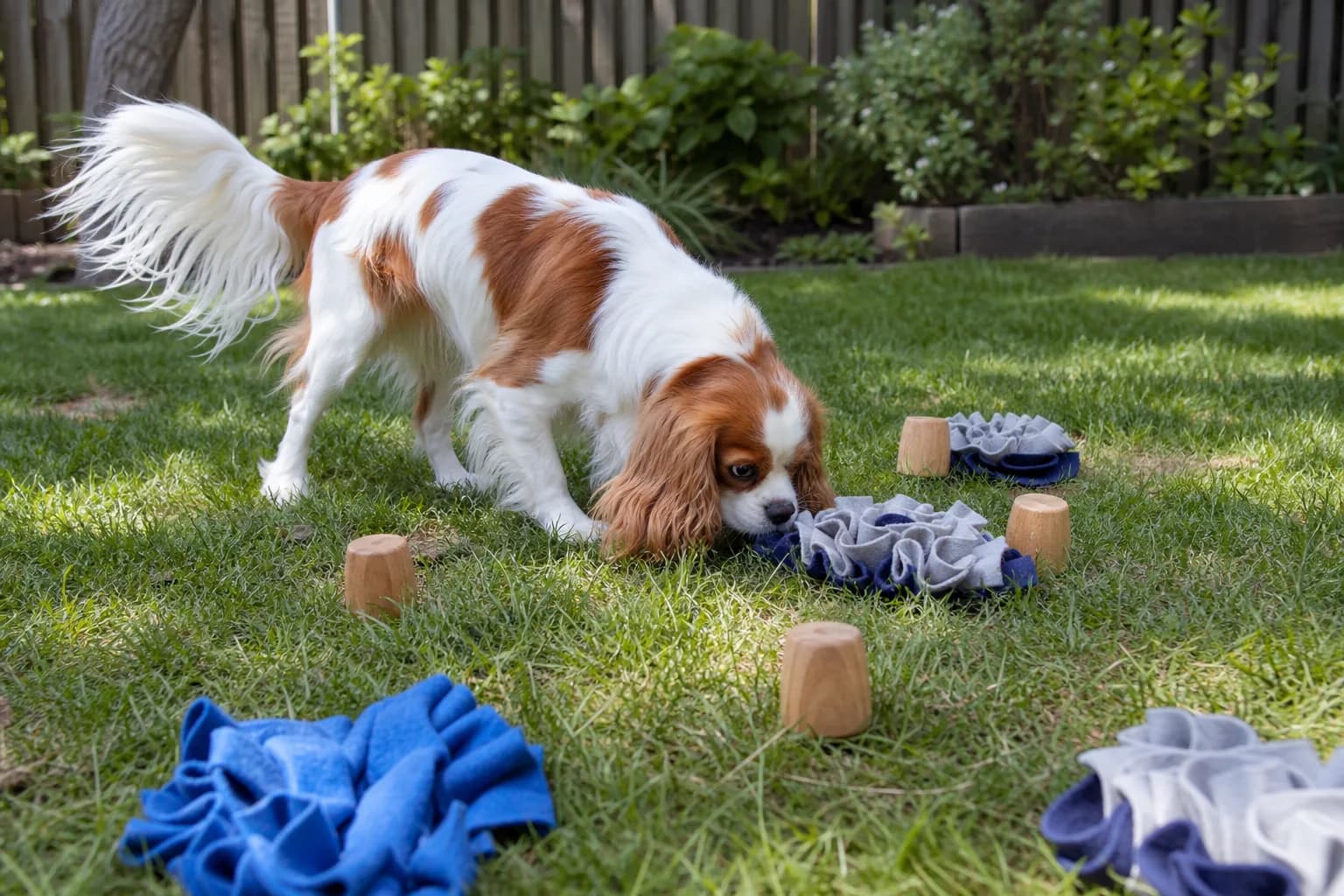
A practical weekday can include:
- A bathroom trip, measured breakfast, and a relaxed sniff walk.
- A short training or food-puzzle session.
- Rest near household activity.
- Another walk or play period later in the day.
- A coat, ear, eye, paw, and comfort check.
- Calm settling practice before bedtime.
A small interactive food puzzle can add mental work without forcing hard exercise. Count any food used in enrichment as part of the daily calories. Retrieve games should happen on nonslip footing with controlled repetitions, not constant jumping from furniture.
Barking and training
Cavaliers are not typically selected as relentless guard dogs, but they can bark at doors, people, animals, excitement, frustration, or isolation. “Do they bark a lot?” depends on the trigger and what the household reinforces. Reward quiet observation, teach a settle behavior, manage window access, and meet exercise and social needs before barking becomes a rehearsed habit.
Training works best in short, clear sessions. Use food, play, access, and praise as rewards. Avoid intimidation, leash corrections, or punishing a frightened dog. A dog who suddenly stops cooperating may be confused, overtired, worried, or painful.

Petful may earn a commission when you click through to Chewy, at no extra cost to you.
Alone-time needs
Cavaliers are companion dogs, so full-day isolation is a serious mismatch for many individuals. They can learn to rest alone, but that skill should be built in small steps while the dog is calm. Start after bathroom, exercise, and comfort needs are met. Leave for seconds or minutes, return without drama, and increase only while the dog remains relaxed.
Can Cavaliers be left alone? Yes, for reasonable periods after gradual training, but not every dog reaches the same duration. Repeated barking, pacing, drooling, destruction near exits, escape attempts, toileting, or refusal to eat when alone may signal distress. Record what happens and involve a veterinarian or qualified behavior professional rather than testing how long the dog can endure.
Use a safe rest area, water, comfortable temperature, and a camera if appropriate. A well-ventilated small-dog carrier is for trained transport and short management, not an all-day solution.
Cavalier shedding and coat care
The silky coat sheds year-round and catches tangles behind the ears, at the armpits, under harness straps, on the legs, and around the tail. Brush to the skin several times a week, then use a metal comb to find snags the brush missed. Bathe as needed for lifestyle and dry the coat thoroughly. Nails, teeth, ears, and eyes also need routine attention.
The dedicated guide explains how much Cavaliers shed and how to manage the coat. The Cavalier color guide shows Blenheim, tricolor, ruby, and black and tan without treating one as healthier or more valuable.
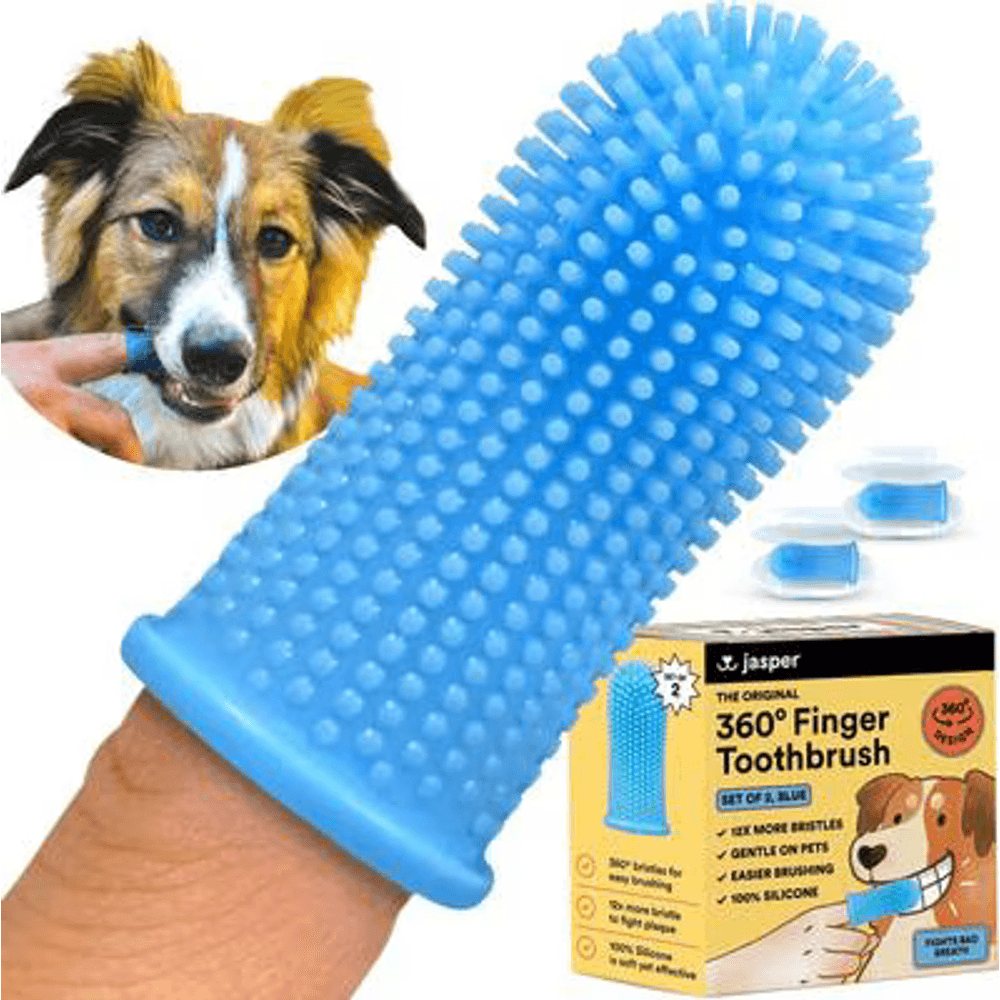
A 360-degree silicone finger toothbrush that brushes every side of a tooth at once. Gentle on gums and ideal for dogs new to brushing or owners who find a handled brush awkward.
Petful may earn a commission when you click through to Chewy, at no extra cost to you.
Cavalier health and lifespan
Cavaliers have meaningful breed-associated health risks. Myxomatous mitral valve disease and Chiari-like malformation with syringomyelia are especially important, alongside eye disease, patella luxation, hip dysplasia, dental disease, ear problems, and other individual conditions. Risk is not a diagnosis, and a normal-looking dog is not proof of normal screening.
Know the urgent signs
- Struggling or open-mouth breathing at rest, blue or gray gums, collapse, severe weakness, a seizure, major trauma, a painful or suddenly enlarged eye, or intense unexplained pain needs urgent veterinary guidance. A new cough, exercise intolerance, fainting episode, neck sensitivity, air scratching, behavior change, or gait change deserves a prompt appointment.
The Cavalier health and lifespan guide explains current evidence, screening, and symptom boundaries. When evaluating a source, ask for the parents’ named cardiac, eye, patella, and hip results, then verify records rather than accepting a verbal “vet checked” claim.
Choosing a Cavalier puppy
The phrase “Cavalier for sale” reveals almost nothing about welfare or quality. A responsible source can explain why a pairing was made, show where puppies are raised, identify the parents, provide health clearances and veterinary records, discuss socialization, use a clear contract, and take the dog back if the placement fails. No coat color, tiny-size promise, or quick delivery replaces that evidence.
Use the Cavalier puppy guide for a complete sourcing and first-week checklist. The price guide separates purchase price from setup, recurring care, and medical uncertainty.

Petful may earn a commission when you click through to Chewy, at no extra cost to you.
For gradual home dental care, the Jasper finger toothbrush is one size-conscious option to discuss with a veterinarian and introduce without forcing the mouth open. The Nina Ottosson Lickin’ Layers puzzle feeder can turn part of a measured meal into supervised enrichment; start easy and remove it if frustration or chewing replaces problem-solving. For walking equipment, measure the neck and chest before trying the Frisco padded no-pull harness, then recheck movement and strap clearance after the coat or weight changes.
Choosing food for a Cavalier
Food should be complete and balanced for the dog’s life stage, calorie-appropriate, and made by a company able to answer questions about formulation, quality control, and research. Breed branding is less important than nutritional adequacy, body condition, health, and reliable measurement. The veterinarian-led Cavalier food guide gives a product-neutral selection process.
Cavalier mixes and breed-name confusion
A Cavalier mix may inherit any combination of size, coat, energy, temperament, and disease risk from both parent lines. A designer name cannot guarantee low shedding or cancel heart risk.
The Cavalier King Charles Spaniel and King Charles Spaniel are separate breeds. In the United States, the latter is called the English Toy Spaniel. The Cavalier vs. King Charles Spaniel comparison explains naming, size, head shape, activity, and care.
Test the breed against a real weekday
A breed description becomes useful only when it is translated into time. A Cavalier usually wants to be near people, participate in daily life, move its body, use its nose, and settle in a comfortable place. Write down who will handle each part of the day before deciding that affection alone makes the match.
Use a weekday test:
- Name the person responsible for the first toilet trip, breakfast, medication if needed, and a short walk.
- Count the longest routine stretch when every adult is away.
- Reserve time for a second walk, play, training, brushing checks, and quiet companionship.
- Include commute delays, school events, illness, and days when the usual caregiver is unavailable.
- Decide who pays for a walker, sitter, groomer, trainer, or veterinary visit when the plan breaks.
If the schedule works only on ideal days, the household does not yet have a resilient care plan. A dog walker can help with a midday need, but hired care does not replace gradual alone-time training or the relationship a companion breed expects at home.
A realistic morning
Start with a toilet opportunity, a measured meal when appropriate, and enough time for the dog to finish without being hurried. A sniff-focused walk can provide movement and information without turning every morning into a long athletic session. Five minutes of reward-based practice can cover name response, leash attention, handling, or settling.
Before leaving, remove food, cords, laundry, medication, and objects the dog could swallow. Set out water and a safe resting area. Departure should be ordinary, not a dramatic test. A camera may reveal pacing, vocalizing, panting, door focus, or an inability to eat that the household would otherwise miss.
A realistic evening
An evening plan needs more than opening the back door. Offer another walk or structured play, allow decompression, and include a brief coat and body check. Run fingers through ear feathering, armpits, chest, groin, tail, and feet so tangles or skin changes are noticed early.
Then practice calm family time. A Cavalier who is constantly entertained may struggle to settle when people are busy. Reward resting on a mat, chewing an appropriate item, or sleeping nearby while the household cooks, reads, or works.
Household fit beyond friendliness
Friendly does not mean effortless. Cavaliers can be deeply social, sensitive to household tension, and eager to follow people from room to room. That closeness is appealing when the household wants a companion involved in ordinary routines. It can be difficult when privacy, long absences, or highly independent behavior are priorities.
Ask each household member to answer:
- Do we want a dog on most walks, errands that allow dogs, and relaxed evenings?
- Can we teach children to invite contact instead of grabbing, carrying, or cornering?
- Can we protect uninterrupted rest?
- Can we manage doors, gates, food, toys, and introductions around other animals?
- Will everyone use the same rules for jumping, barking, furniture, and feeding?
Disagreement is a predictable training problem. A dog cannot learn that jumping is forbidden for one person and rewarded by another without confusion. Write the rules before arrival and choose cues every caregiver can use.
Cavaliers and children
A calm, dog-aware child and a well-supported Cavalier can enjoy companionship, but small size does not make rough handling safe. Children should sit for early interactions, pet shoulders or chest instead of hugging, and leave a sleeping or eating dog alone. Adults remain responsible for every interaction.
Create physical separation for busy moments. Gates, pens, and closed doors help during parties, meals, deliveries, and high-energy play. The goal is not to isolate the dog. It is to prevent repeated situations in which the child or dog is expected to show more restraint than their age and learning support.
Older adults and mobility considerations
A Cavalier’s portable size may appeal to an older adult, yet bending, leash handling, coat care, transport, and veterinary visits still require a plan. A dog who darts around feet can create fall risk. Nonslip rugs, a predictable resting station, and calm doorway routines matter.
Consider who can lift the dog safely if illness or injury occurs, who can drive to urgent care, and who takes over during hospitalization. A written backup plan is part of responsible placement at any age.
Living with other pets
Breed tendencies cannot guarantee compatibility. Introduce dogs on neutral ground when possible, keep leashes loose, and avoid forcing face-to-face greetings. At home, separate food, chews, beds, and valued toys until behavior is understood. Give each dog individual walks and training so the new relationship is not asked to carry every need.

Cats need escape routes and dog-free resources. Prevent chasing from the first day instead of waiting to see whether it becomes a habit. Reward orientation back to the handler, use gates or tethers under supervision, and allow the cat to choose distance.
Warning signs that call for professional help include:
- Stiff posture, hard staring, freezing, cornering, or repeated mounting.
- Guarding people, beds, food, doorways, or toys.
- Chasing that becomes faster or harder to interrupt.
- One animal hiding, skipping meals, or losing normal access to the home.
- Fights, bites, or escalating conflict after careful management.
Exercise without overloading the dog
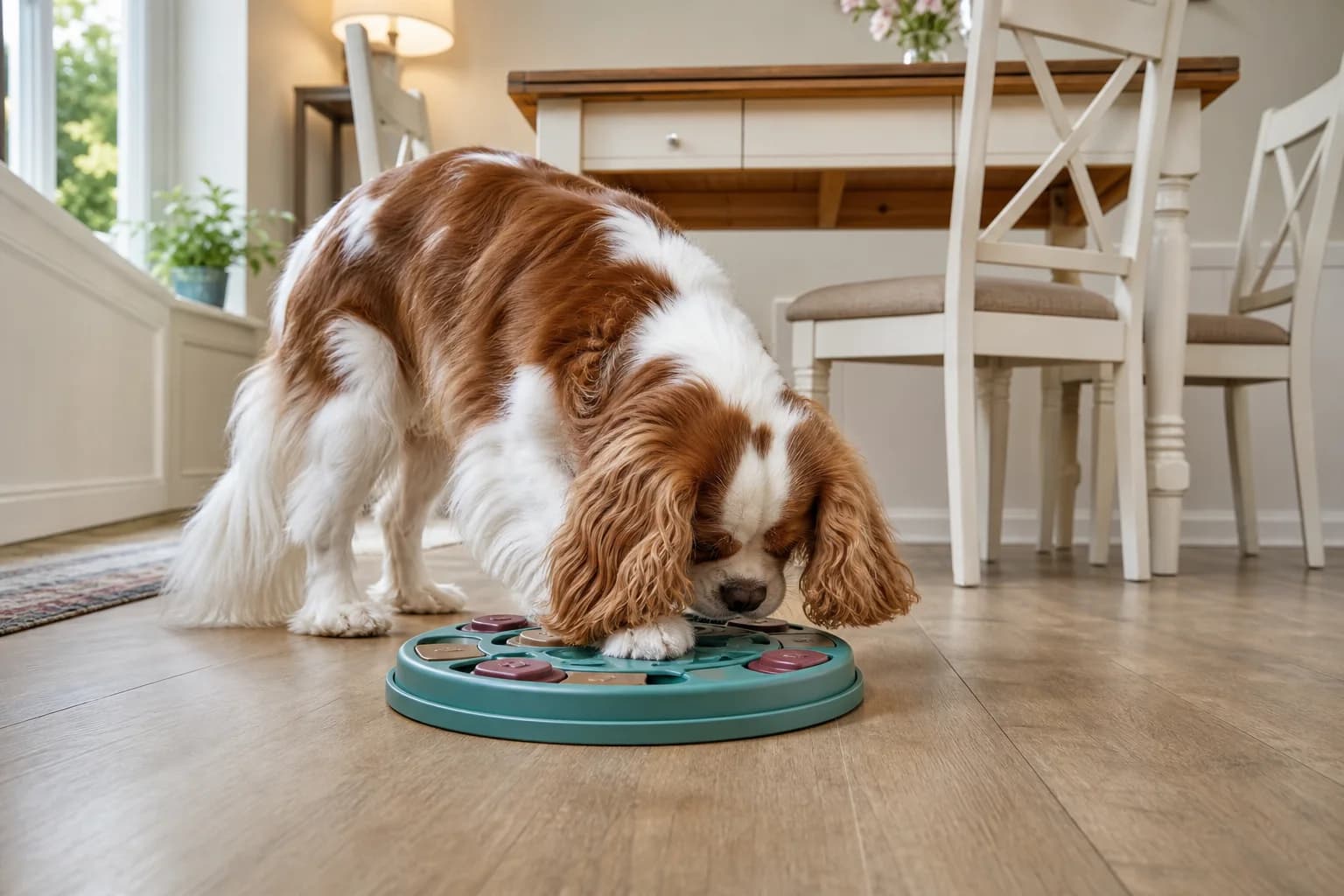
Cavaliers combine toy-spaniel size with a sporting ancestry. Many enjoy walks, scent games, retrieving, gentle hikes, and beginner dog sports. The useful measure is not one universal mileage number. Watch the individual dog’s gait, breathing, recovery, enthusiasm, and behavior later that day. For controlled walks, the Frisco dual-handle traffic leash offers two handling points, but secure harness fit and practiced technique still matter more than the hardware alone.
Build activity gradually:
- Start with comfortable walks on forgiving surfaces.
- Add duration or difficulty in small steps, not both at once.
- Include sniffing and choice instead of marching at one speed.
- Schedule rest after unusually stimulating outings.
- Reduce heat, pace, hills, or duration if recovery changes.
Puppies need age-appropriate free movement and skill building rather than forced distance. Adults returning from illness or inactivity also need a gradual plan. A veterinarian should guide exercise when heart, neurologic, orthopedic, respiratory, or weight concerns are present.
Enrichment for rainy or low-energy days
Mental work can make an indoor day satisfying without turning food into uncontrolled calories. Use part of the measured meal for training or a food puzzle, scatter a few pieces for a supervised search, or teach the dog to find a named toy.
Rotate activities:
- Sniff searches in cardboard boxes with packing material removed.
- Short shaping sessions that reward voluntary interaction with an object.
- Mat settling while normal household activity continues.
- Gentle tug or retrieve with clear start and finish cues.
- Handling practice for ears, paws, mouth, harness, and grooming tools.
Stop while the dog is still successful. Frustration, frantic movement, grabbing, or inability to disengage means the task should become easier.
Training priorities for the first months
Teach skills that make daily care safer before polishing tricks. Name response, recall, leash attention, a station cue, cooperative handling, trading objects, and calm door behavior reduce conflict across the dog’s life.
Reward what you want to see. If barking reliably makes people look, talk, or open a door, barking is being practiced even when the words sound corrective. Identify the function first. The dog may need distance from a trigger, a toilet trip, a predictable rest routine, or a taught alternative such as going to a mat.
Recall and outdoor safety
A friendly dog may approach strangers, wildlife, traffic, or another dog without recognizing risk. Use a secure leash or fenced area while recall is being built. Choose a cue that is not used casually, reward generously, and release the dog back to safe activity often so coming when called does not always end the fun.
Practice in layers:
- Indoors between two people.
- In a fenced, quiet area on a long line.
- Around mild, controlled distractions.
- At varied distances with rewards appropriate to difficulty.
- With an emergency turn-away cue for sudden hazards.
No recall is proof against every distraction. Management remains part of the skill.
Cooperative grooming and veterinary handling
Handling becomes easier when the dog can opt in and take breaks. Touch one ear, mark and reward, then stop. Briefly hold a paw, lift a lip, or place the brush on the coat before asking for longer contact. Use a nonslip surface so the dog is not balancing while being examined.
If the dog freezes, turns away repeatedly, mouths the tool, struggles, or refuses food, the step may be too difficult. Pain must also be considered when previously comfortable handling becomes unwelcome.
Build alone time as a skill
Following a person everywhere is not the same as being unable to remain alone, but constant access can prevent independent rest from developing. Begin with tiny, calm separations while the dog is already comfortable. A gate across the room can be easier than a closed front door.
A progression may look like:
- Rest on a bed while a person moves around the same room.
- Stay relaxed behind a gate for a few seconds.
- Remain comfortable while a person briefly leaves sight.
- Practice ordinary departure cues without leaving every time.
- Extend real absences only while the dog remains below distress.
Return before panic, not after a long test. Repeated distress can sensitize the dog. If video shows persistent vocalizing, pacing, drooling, destruction at exits, elimination linked to absence, or inability to eat, consult a qualified behavior professional and the veterinarian.
A coat-care calendar
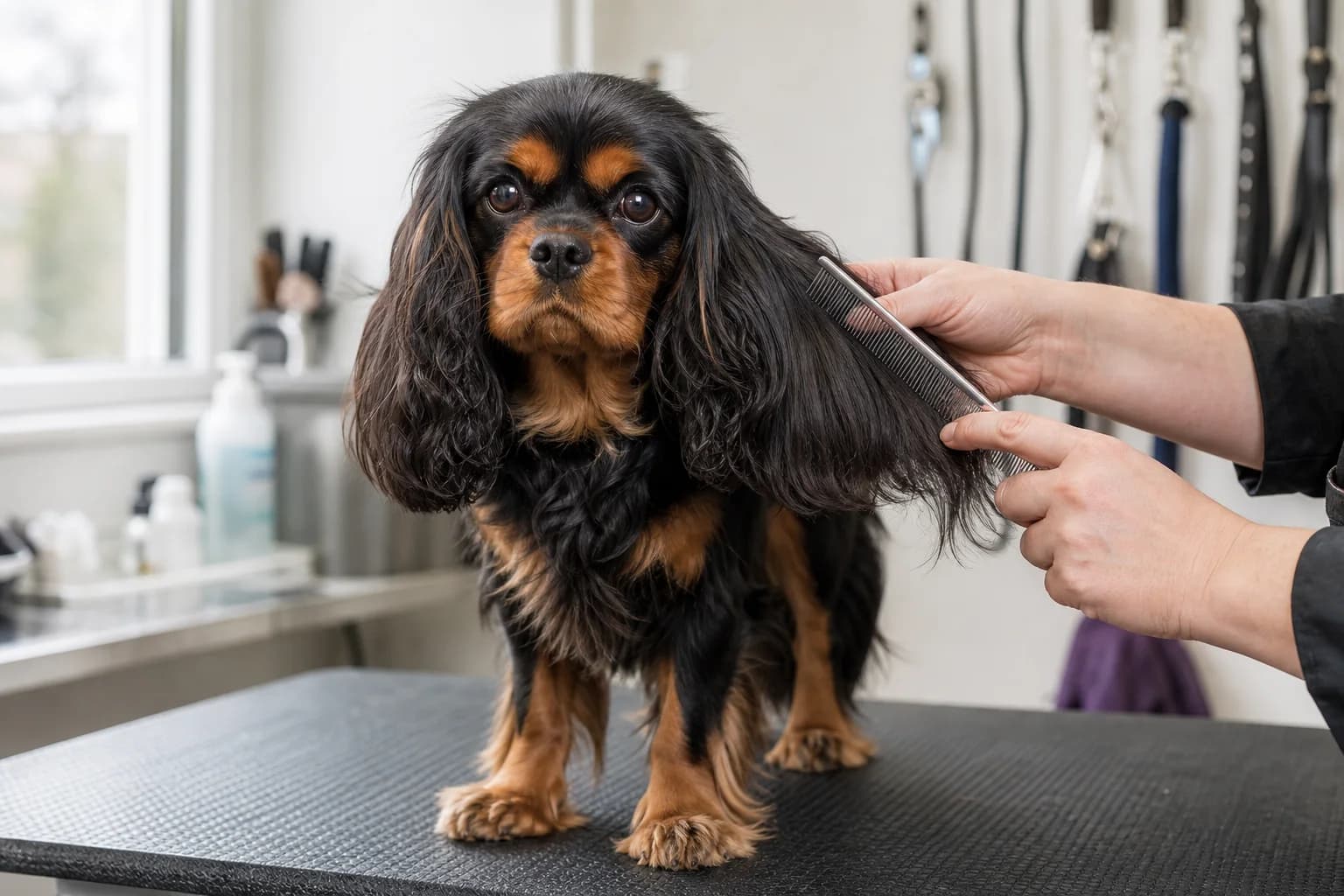
The silky coat needs prevention more than rescue. A quick daily finger check can catch debris or a forming tangle. Several thorough comb-throughs each week may be needed depending on coat length, season, activity, and the individual. The comb should reach the skin without scraping it. For routine bathing, Buddy Wash shampoo and conditioner is one option to compare for ingredient tolerance, followed by thorough rinsing and complete drying.
Use a simple calendar:
- Daily: check ears, eyes, feet, feathering, and anything caught after walks.
- Several times weekly: brush in sections and confirm with a metal comb.
- As needed: bathe with dog-safe products and dry the coat fully.
- Regularly: trim nails and check teeth, ears, skin, and body condition.
- Professionally when needed: ask for a comfort-focused trim and clear instructions about what will be shortened.
Cutting out a tight mat close to skin can cause injury because skin may be pulled into the tangle. A groomer or veterinary team can choose the safest removal method.
Travel, weather, and public life
Small dogs still need secure transport. Use a crash-conscious restraint or stable carrier appropriate to the dog and vehicle, and never attach a car restraint to the neck. Practice short rides before a long trip. Bring measured food, water, medications, identification, veterinary contacts, and a familiar rest surface. For outings, the Frisco collapsible travel bowl is one compact water option to compare after checking capacity, cleaning, and stability.
Heat plans should prioritize shade, cooler hours, water, and shorter activity. Cold or rain may call for a comfortable layer, but clothing must not rub feathering or restrict movement. Dry ears, feet, and coat after wet outings.
Public access is not a socialization contest. The dog should be able to observe without greeting every person or dog. Leave if body language shows avoidance, trembling, scanning, tucked posture, repeated lip licking, or inability to take food.
Housing and neighbor considerations
An apartment can work when exercise, toilet access, sound management, and alone time are planned. Hallways, elevators, windows, and shared doors create repeated triggers. Reward quiet observation, block rehearsed window barking, and avoid crowded greetings in tight spaces.
A yard is useful but not a substitute for walks, training, or supervision. Small dogs can slip through gaps, dig, follow wildlife, or be vulnerable to larger animals. Check fencing at ground level and supervise outdoor time.
Health evidence before appearance

A pleasant temperament, beautiful coat, or normal general examination does not replace breed-relevant screening. Ask for results that can be verified, identify the dog tested, show the date and evaluator, and match the breeding adults. A verbal statement that a line is healthy is not the same as documentation.
For a puppy or adult placement, collect:
- Registered names or permanent identification for the dog and parents when known.
- Cardiac, eye, orthopedic, and other breed-club-recommended results.
- The dog’s vaccination, parasite, medication, and veterinary history.
- Known conditions in parents, siblings, previous litters, and older relatives.
- A written contract explaining return support and health responsibilities.
Screening reduces uncertainty but cannot guarantee an individual outcome. The health guide explains how to continue monitoring after adoption.
Choosing an adult or rescue Cavalier
An adult may offer more observable information about size, coat, activity, handling, house habits, and recovery after stress. Foster notes can be valuable when they describe specific situations rather than labels such as perfect or sweet.
Ask how the dog behaves:
- When left alone and when people return.
- Around food, toys, grooming, restraint, visitors, dogs, and cats.
- During car rides, veterinary care, storms, and neighborhood walks.
- After excitement and during quiet household time.
- When access to a preferred person or place is blocked.
A shelter environment can suppress or amplify behavior, so plan a decompression period and use management while learning the individual.
The first 90 days
The first weeks should be predictable, not packed with introductions. Keep meals, toilet trips, sleep, walks, and medication on a simple schedule. Limit visitors and high-pressure outings. Give the dog a quiet area where contact is optional.
During the first month:
- Arrange a veterinary relationship and transfer records.
- Confirm identification and emergency contacts.
- Establish measured feeding and a baseline weight and body condition.
- Begin gentle alone-time, handling, recall, and settling practice.
- Record coughing, fainting, pain signs, digestive changes, scratching, or activity changes.
In later weeks, expand the dog’s world gradually. Add new walking routes, visitors, classes, or travel one layer at a time so the household can tell what helps and what overwhelms.
When a Cavalier may be the wrong choice
Choosing another breed or waiting is responsible when the core needs conflict with the household. A Cavalier may be a poor fit when the dog would routinely spend long days alone without a workable care plan, when grooming and health monitoring feel optional, or when the budget cannot absorb ongoing veterinary uncertainty.
Pause if:
- The household wants an independent dog with little social contact.
- Adults expect children to provide primary care.
- The plan depends on an unfenced yard or off-leash reliability.
- A seller discourages health-document verification or creates payment urgency.
- The household is unwilling to use gates, leashes, training, or professional help.
- Moving, travel, caregiving, or financial instability makes daily care uncertain.
The right decision is not proving that the breed can fit. It is deciding whether this particular household can meet the needs of this particular dog over time.
Create a shared care record
A shared record prevents details from being trapped in one person’s memory. Keep it simple enough that every caregiver will use it. Record meals, medication, toilet changes, exercise, grooming findings, behavior changes, and appointments.
Useful fields include:
- Date and time.
- Food amount and extras.
- Medication name, dose as prescribed, and person who gave it.
- Appetite, stool, urination, coughing, pain, itching, or mobility notes.
- Unusual events such as visitors, travel, missed sleep, or a long walk.
- Questions for the veterinarian, trainer, groomer, or sitter.
The record is not a substitute for professional assessment. It provides timing and context that can make a consultation more productive.
Train a backup caregiver
A backup plan is stronger when the person has already practiced. Invite the caregiver to walk the dog, prepare a measured meal, use the harness, review door routines, and locate records before an emergency.
Provide written instructions for:
- Veterinary and emergency contacts.
- Medication and feeding.
- Safe handling and transport.
- Triggers, management, and cues.
- Other-pet separation.
- Where the dog may sleep and eliminate.
- Who can authorize and pay for care.
Update the handoff after a diagnosis, medication change, move, or behavior concern. A plan written for a healthy puppy may not fit an older dog.
Audit quality of life in the home layout
The dog’s experience depends partly on the environment. Slippery floors, high furniture, crowded feeding areas, uncontrolled doorways, and inaccessible rest can create daily friction.
Walk through the home from the dog’s perspective:
- Can the dog reach water without crossing conflict?
- Is there a quiet bed away from children and visitors?
- Are stairs and furniture managed safely?
- Can cats and dogs be separated?
- Is grooming performed on stable footing?
- Are medication, food, cords, and small objects secured?
- Can the dog be moved without lifting by the collar or front legs?
Small environmental changes often make good behavior easier to practice.
Review the fit every year

A household that fit a young adult may need a different plan after work changes, a new baby, a move, caregiver illness, or the dog’s medical needs. Schedule an annual review instead of waiting for care to fail.
Revisit:
- Daily absence and hired-care coverage.
- Exercise and recovery.
- Weight, body condition, and feeding.
- Coat, dental, ear, and nail care.
- Veterinary monitoring and emergency access.
- Insurance, savings, and recurring cost.
- Mobility, pain, sleep, and valued activities.
The breed has not changed, but the practical match can. Adjusting the routine early protects both the dog and the household.
Choose professional help by scope
Different problems need different expertise. A groomer can teach coat maintenance but does not diagnose skin disease. A trainer can build skills but does not prescribe medication. A veterinarian evaluates medical contributors, and a veterinary behaviorist can address cases in which health and severe behavior problems overlap.
Before hiring, ask about:
- Education and credentials relevant to the service.
- Methods and equipment.
- Experience with small companion dogs and the specific concern.
- How pain, fear, and stress are handled.
- Communication with the veterinary team.
- What happens if the dog cannot safely continue.
Clear scope prevents one service from being asked to solve a problem outside its role.
Respond to change with a decision tree
When behavior or routine changes, ask what changed in health, environment, schedule, sleep, food, medication, exercise, and household access. Sudden withdrawal, irritability, grooming resistance, restlessness, or reduced activity can have a medical component.
Use this order:
- Address urgent breathing, collapse, severe pain, toxin, injury, or neurologic signs immediately.
- Contact the veterinarian for sudden or persistent physical or behavior change.
- Reduce demands and prevent rehearsal of unsafe behavior.
- Record timing and context.
- Add training only after the dog is comfortable enough to learn.
Do not punish a dog for communicating discomfort. Growling, moving away, freezing, or refusing handling is information that should change the plan.
Protect rest as a daily need
A companion dog can be near the family without being available for touch. Provide a bed where children, visitors, and other animals do not follow. Let sleeping dogs rest. For a dedicated rest spot, the FurHaven orthopedic sofa bed is one washable-cover option to measure against the dog’s fully stretched length; it is a comfort product, not a medical treatment.
Signs that the dog needs more distance can include turning the head away, lowering posture, lip licking, leaving, freezing, hiding, or becoming unable to settle. Respond early by increasing space and reducing pressure. A dog who can retreat safely is less likely to need a stronger response.
Keep an evacuation kit current
Store several days of food, water access, medication, identification, a leash or harness, carrier or vehicle restraint, cleanup supplies, and copies of records together. Rotate food and medication before expiration.
The kit should match the current dog. Recheck fit, dose instructions, emergency contacts, and caregiver authorization after growth, a diagnosis, a move, or a medication change. Practice calm carrier entry before an evacuation is necessary.
Keep identification redundant
Use a microchip with current registration, a visible tag, and recent photographs that show the whole dog and distinctive markings. Save the chip number, registration contact, veterinary record, and emergency contacts where more than one caregiver can find them.
Check the tag and harness before travel. A microchip is not a tracking device, and a tag can be lost, so no single method should carry the full recovery plan. Report a missing dog promptly through local animal services, shelters, clinics, and the chip registry.
Review the emergency kit twice each year and after every medication change.
Cavalier owner FAQs
Frequently Asked Questions
Cavaliers can learn to rest alone for reasonable periods, but the skill needs gradual practice and the individual limit varies. Begin with very short calm absences after exercise and a bathroom break. Repeated barking, drooling, pacing, destruction near doors, escape behavior, or refusal to eat suggests distress rather than stubbornness. A veterinarian or qualified behavior professional can help build a safer plan.
Many Cavaliers bark at doors, movement, excitement, frustration, or isolation, but heavy barking is not inevitable. Meet exercise and social needs, manage windows and entryways, reward quiet observation, and teach a settle behavior. A sudden increase can reflect fear, pain, cognitive change, or a changed environment, so treat new barking as information instead of punishing it.
Many do, because the breed is strongly people-oriented, but contact should remain voluntary. Some choose a lap while others lie beside a person. Let the dog move away, supervise children, and avoid restraining a dog for affection. Sudden touch sensitivity, yelping, neck scratching, or withdrawal can accompany pain and deserves veterinary attention. Respect that choice every time.
The main tradeoffs are strong companionship needs, regular brushing and coat care, daily activity, patient training, and meaningful health uncertainty. Long isolation is a poor fit for many Cavaliers, and a sweet temperament does not remove barking, housetraining, or handling work. Before choosing one, test whether the household can manage grooming, veterinary monitoring, health costs, supervised child contact, and a backup care plan.
Most Cavaliers benefit from daily walks, sniffing, play, and short training sessions, with the amount adjusted for age, conditioning, weather, and health. A yard does not replace shared activity, and a toy-breed label does not mean inactivity. Build exercise gradually, include rest and enrichment, and stop when heat, breathing, gait, pain, or recovery changes suggest the plan needs veterinary guidance.
A Cavalier can live well in an apartment when the household provides companionship, daily outdoor activity, toilet access, coat care, and calm noise training. Floor space matters less than the routine. An apartment is a weak fit if the dog will be isolated for a full workday, neighbors cannot tolerate barking, stairs are unsafe, or there is no plan for walks, emergencies, and backup care.

Coreen Saito is a pet writer and longtime shelter volunteer with more than a decade in animal rescue. She covers cat behavior, breed care, and the small, ordinary science of sharing a life with companion animals, with a particular focus on honest takes about the products and decisions that actually matter. At home in Arizona, she’s outranked by Mac (a dog with the loudest opinion in the house), Rebel (a cat who governs by quiet authority), and Meri (an orange tabby who runs the late shift and the laundry basket). She writes about all three, plus the rescues that keep coming through her life, at LifeWithMinty.com.