
Petful is reader supported. As an affiliate of platforms like Amazon and Chewy, we may earn a commission when you buy through links on this page. There is no extra cost to you.
The central Khao Manee vs white cat difference is ancestry, not one visible feature. A Khao Manee is a registered natural breed from Thailand with a written standard and documented pedigree. A white cat is any cat whose fur appears white, including millions of domestic shorthairs and cats from several pedigreed breeds.
You can compare a cat with the Khao Manee standard and decide that some traits are consistent with it. You cannot prove Khao Manee ancestry from white fur, blue eyes, odd eyes, a kitten head spot, a friendly personality, a photograph, or a breed-identification app. For a purebred claim, a verifiable pedigree and registry record are the strongest evidence.
- 1Every Khao Manee is a white cat under the current breed standard, but most white cats are not Khao Manees
- 2Physical similarities can support a possible match, not ancestry proof
- 3Blue or odd eyes are not unique to the breed
- 4Pedigree and registry records carry far more weight than an app score, seller claim, or visual guess
This guide compares the breed standard with the broad white domestic-cat population, then ranks the evidence that can support identification. For personality, care, and history, read Petful’s complete Khao Manee cat profile.
Petful may earn a commission when you click through to Chewy, at no extra cost to you.

Don’t Guess When It Comes To Your Pet’s Care
Sign up for expert-backed reviews and safety alerts all in one place.
Khao Manee vs. white cat: the short answer
“Khao Manee” and “white cat” are not parallel categories. One is a breed, while the other is a fur description. It is similar to comparing a Siamese with a pointed cat or a Bombay with a black cat. The broad visual category includes the breed, but it also includes many cats with completely different family histories.
The Cat Fanciers’ Association Khao Manee page and TICA Khaomanee profile describe a medium, athletic, shorthaired Thai breed with vivid eyes and a defined structure. Those traits help judges assess a known pedigreed cat against a standard. They were not designed to convert an unknown shelter cat into a pedigreed cat by resemblance.
A cat can match much of the standard by chance. Domestic cats have wide variation in head shape, body type, coat texture, eye presentation, and behavior. When family records are missing, the honest description is usually “white domestic shorthair” or “white domestic longhair,” with any possible breed resemblance stated as uncertainty and ancestry not proven.
- Comparison terms follow the same rule: Questions about Khao Manee vs. Puspin, a Khao Manee mix, or Khao Manee vs. Persian do not change the evidence standard. “Puspin” broadly describes a Philippine domestic cat, “mix” is an ancestry claim, and Persian is a separate pedigreed breed. Appearance can suggest a comparison, but it cannot establish which family tree applies.
Khao Manee vs. white cat comparison
Khao Manee vs. White Cat
| Question | Registered Khao Manee | White domestic cat of unknown ancestry | What it proves |
|---|---|---|---|
| Category | A defined pedigreed breed from Thailand | A pigmentation description across the domestic cat population | Category alone does not identify an individual |
| Documentation | Verifiable pedigree and registry record should connect the cat to registered parents | May have shelter, veterinary, or microchip records but no breed pedigree | Pedigree can establish documented lineage; ordinary records establish identity and history, not a rare breed |
| Fur | Short, fine, smooth, and white under the current standard | May be short, medium, long, plush, sparse, or curly while still appearing white | Fur can be consistent or inconsistent, but cannot prove ancestry |
| Eyes | Clear and vivid; blue, yellow, green, or odd-eyed presentations may occur | Blue, gold, green, copper, or odd eyes can also occur | Eye presentation is not breed-specific |
| Build | Medium, muscular, flexible, and athletic under the standard | Can be slight, athletic, round, heavy, long, or compact | Body type is a clue with broad overlap |
| Behavior | Breed sources commonly describe social, active, intelligent, communicative cats | Any personality is possible in the general population | Personality is too variable to prove a breed |
| Hearing | White pigmentation can be associated with congenital deafness; an individual test answers the hearing question | The same pigmentation-linked risk can occur in other white cats | Hearing status does not establish Khao Manee ancestry |
The comparison is deliberately asymmetric. The Khao Manee column describes a standard for documented cats. The other column describes a huge, genetically diverse population. A white domestic cat may resemble every row on a quick checklist and still have no Khao Manee ancestors.
Which physical clues fit the Khao Manee standard?
Physical clues are useful for asking better questions. They can tell you that a cat is consistent with the standard, clearly inconsistent with it, or somewhere in between. They cannot close the ancestry question.
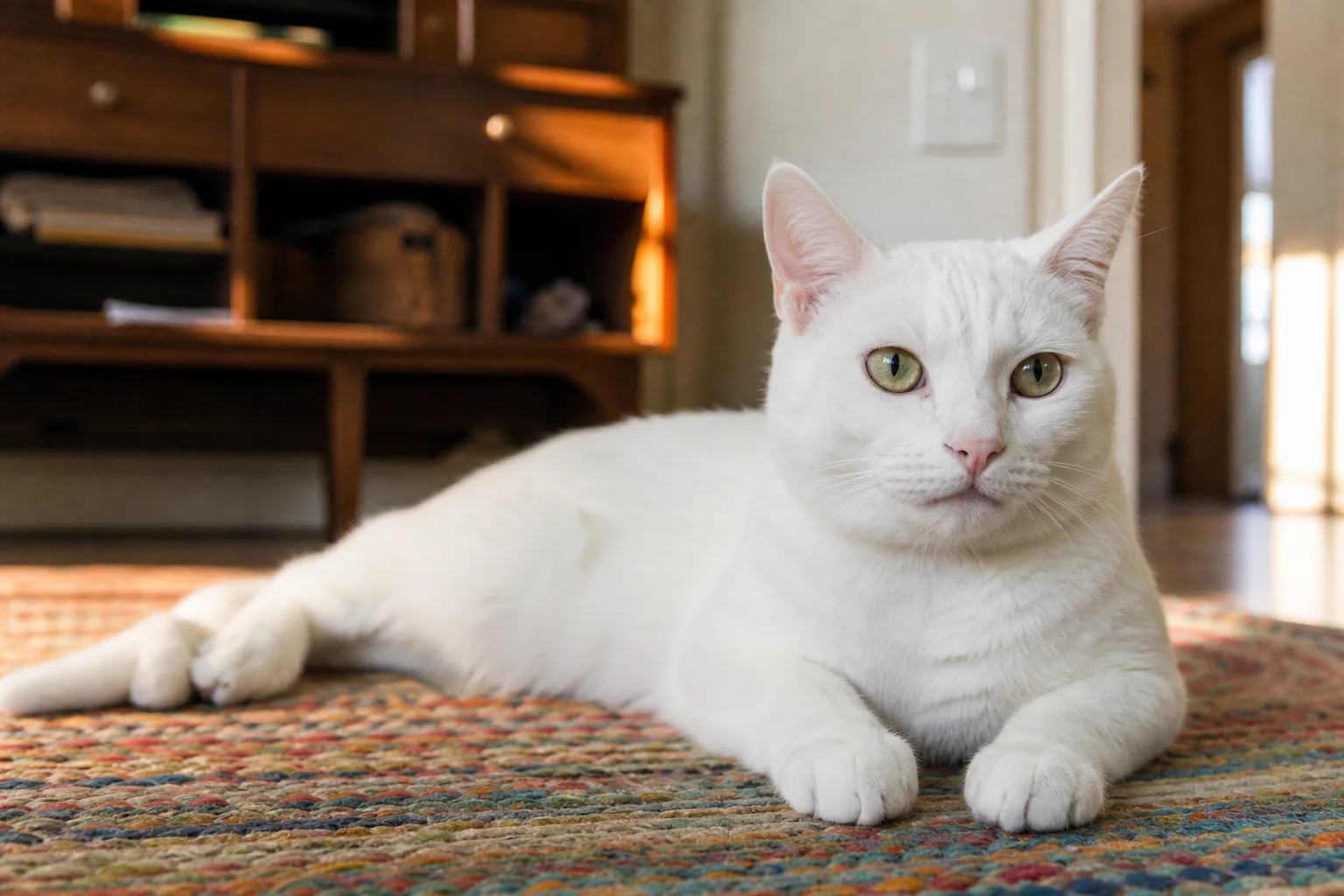
Khao Manee eyes may be blue, yellow, green, or odd-eyed, and the Khao Manee tail should be proportional to the body. A temporary Khao Manee black spot or colored head patch may appear on a white kitten and later fade. Searches for Khao Manee long hair usually concern a look-alike, because the current standard calls for medium-short hair. A search for “Khao Manee orange” may concern an orange head patch on a white kitten or a different cat altogether, not an accepted orange adult coat. Taken together, these details help describe consistency with the standard. None can prove ancestry.
The useful method is to evaluate the full pattern: coat, eye presentation, head, ears, body, tail, age, and documentation. A close match remains only a physical match until a traceable pedigree connects that individual to registered parents.
White, short, smooth fur
The current CFA standard describes a pure, glistening white cat with medium-short, fine hair and a sparse to moderate undercoat. The fur should reveal the athletic body rather than create a fluffy outline. A long, dense, or strongly curled coat would not fit the current show standard.
Still, short white fur is common among domestic cats. The dominant-white phenotype and white spotting can appear in many family lines. Coat length and texture are controlled by inherited variation that is not exclusive to one breed.
Blue, yellow, green, or odd eyes
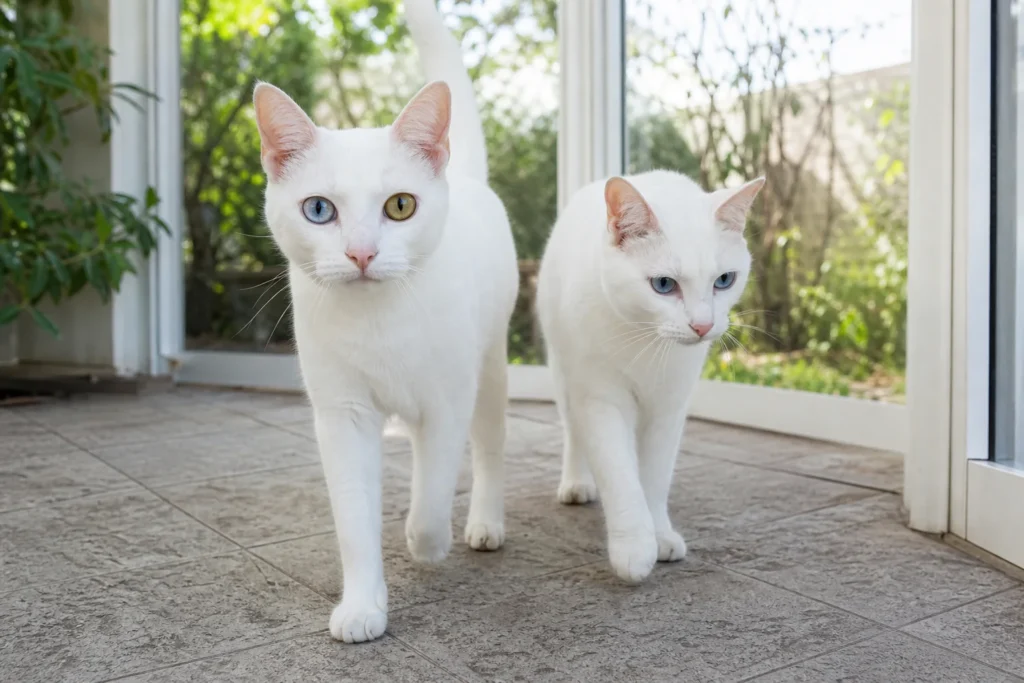
Khao Manees are famous for bright, jewel-like eyes. CFA permits clear and vivid eye shades, and both CFA and TICA describe blue, yellow or green, and odd-eyed presentations. Odd-eyed means the two irises differ, often with one blue eye and one non-blue eye.
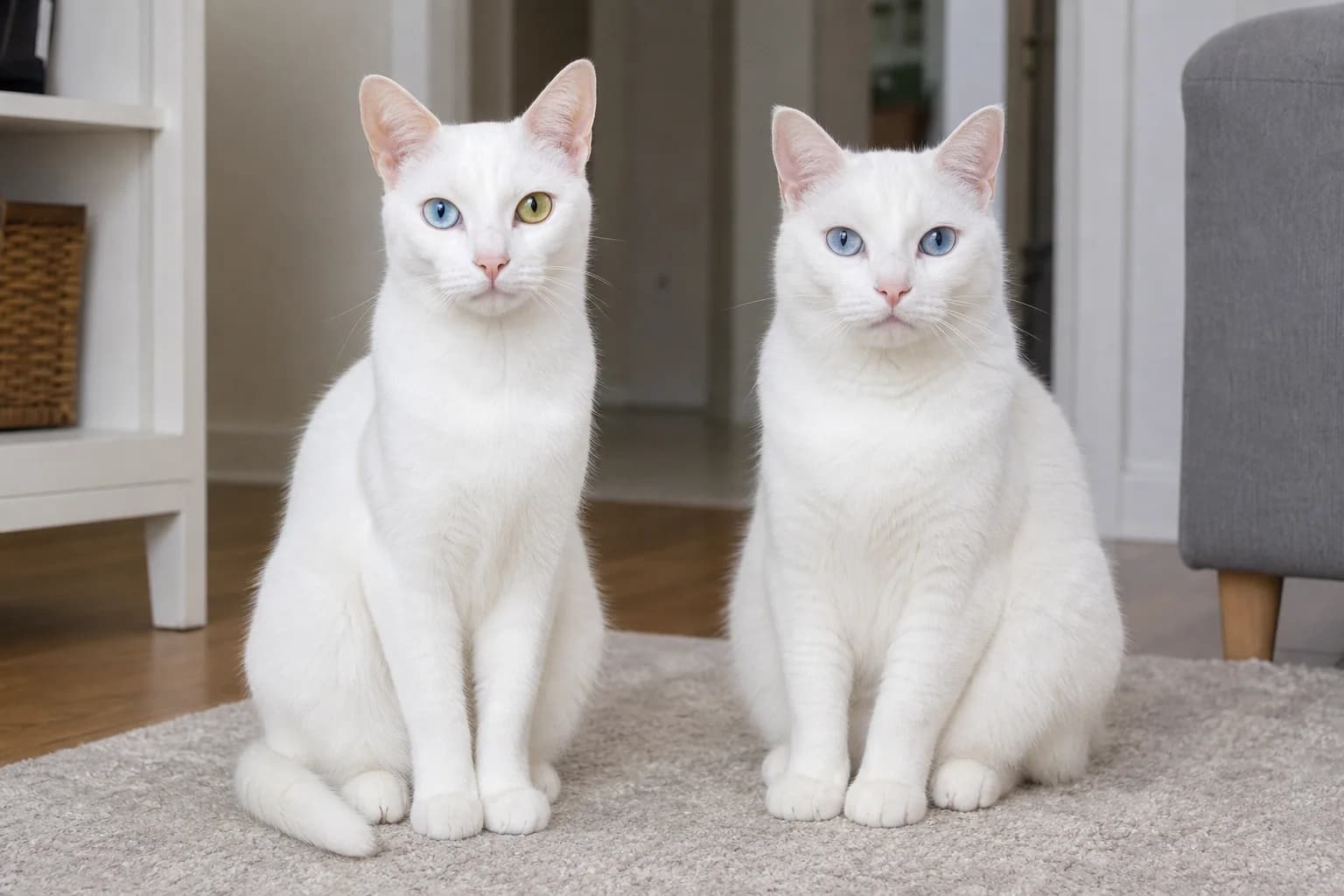
None of those eye presentations is unique to the Khao Manee. White domestic cats and other pedigreed white cats can be blue-eyed or odd-eyed. Camera white balance, flash, pupil size, and reflected light can also make eye color difficult to judge from a listing photo.
Eye presentation can raise a separate hearing question because congenital deafness occurs more often in some white-cat populations, especially among cats with blue irises. That association does not mean a blue-eyed cat is deaf, and it does not mean an odd-eyed cat is a Khao Manee. The hearing question belongs to testing and veterinary care, not ancestry guessing.
A colored spot on a white kitten’s head
The CFA standard notes that a patch reflecting underlying pigment may persist on a kitten’s head until about 18 months. The patch can fade as the cat matures. That can be consistent with the breed’s dominant-white genetics.
However, kitten head spots can occur in white cats outside this breed. A fading patch is not a secret marker of Khao Manee ancestry. Record it as an observable trait, then return to the pedigree question.
An athletic medium build
The standard describes a medium torso with firm musculature, flexibility, and agility. The head is a modified wedge with high cheekbones, the ears are moderately large, and the tail is proportional. The cat should not be extremely fine, bulky, or cobby.
These proportions make a full-body view more useful than a close-up face photo, but they still have broad overlap with domestic shorthairs. Growth stage and body condition can also distort comparisons. A lanky adolescent, an overweight adult, and a muscular mature cat will not present the same way.
Petful may earn a commission when you click through to Chewy, at no extra cost to you.
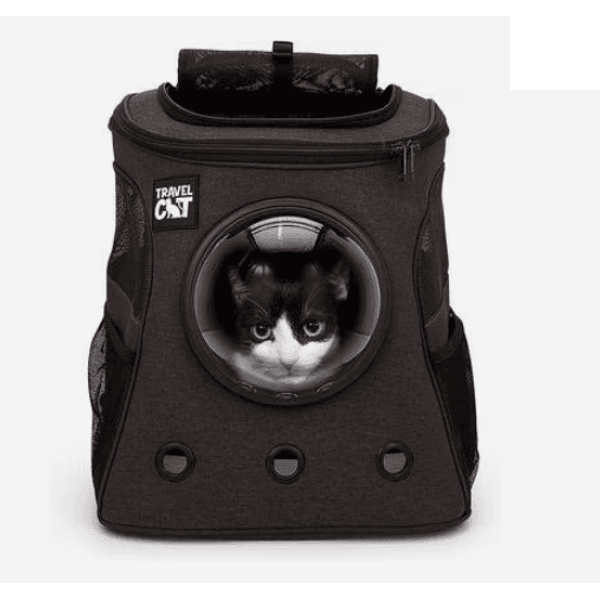
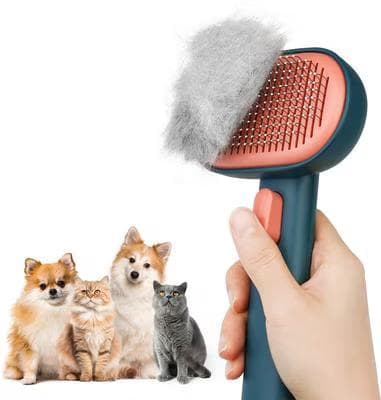
Check ventilation, load limit, and the cat’s standing dimensions before considering the Travel Cat Fat Cat carrier backpack; a carrier label cannot substitute for a calm fit test. For coat maintenance, the aumuca self-cleaning slicker brush is one tool to compare; use light pressure, work in small sections, and stop if the skin becomes irritated. The Resco cat nail clippers is one compact tool to compare for routine tip trims after the cat is comfortable with gentle paw handling.
What can actually confirm Khao Manee ancestry?
Khao Manee Identification Evidence Ladder
| Evidence | Confidence it supports | Why |
|---|---|---|
| Seller caption or social post | Very low | Anyone can use a breed name, copy photos, or repeat breed facts |
| Breed-identification app score | Very low | Image classifiers compare visible pixels with training examples; they do not inspect a family tree |
| Physical clues | Low | Several standard-consistent traits can support resemblance, but broad domestic variation creates look-alikes |
| Consumer DNA result | Limited and database-dependent | It may estimate relationships among represented populations, but confidence depends on reference cats and does not replace registry records |
| Breeder records | Moderate to high when independently verified | Parent identities, contracts, health files, and a consistent cattery history create a traceable chain |
| Registry pedigree and transfer record | Highest practical evidence | The record links the individual cat to registered parents and a documented lineage through a recognized organization |
How do I know if my cat is a Khao Manee? A possible match from coat, eyes, body, or behavior is only the beginning. Confirmation requires records that connect the individual cat to registered Khao Manee parents through a recognized registry.
For a Thai Khao Manee claim, verify the Khao Manee origin story at the level of the individual pedigree, not only the breed’s national history. Searches such as “Khao Manee TICA” or “Khao Manee cat club” can lead to registry and club resources, but a directory page does not itself authenticate a seller or cat.
Start by asking for the individual registration certificate or the paperwork needed to complete transfer. The document should identify the registry, cat, breeder, parents, and registration numbers. Contact the registry using details you find independently if anything is unclear.

The sale contract and veterinary records should agree with the pedigree on identifying details such as birth date, sex, name or number, breeder, and microchip when present. One mismatch may be a clerical error. Multiple inconsistencies, refusal to explain, or pressure to pay before verification should stop the transaction.
For a shelter or found cat, a microchip scan may recover an owner or prior record, but it usually will not establish a rare-breed pedigree. Shelter staff and veterinarians appropriately use physical descriptions when ancestry is unknown.
What about cat DNA tests?
A consumer DNA test can provide ancestry estimates, trait information, and genetic-health markers depending on the company. Its ancestry result is an inference from the company’s current reference database. Rare breeds may have fewer reference animals, and related Southeast Asian populations can be difficult to separate with high confidence.
Use a DNA result as one piece of context, not as a registry certificate. Before buying a kit, read which breeds are represented, how confidence is reported, whether the raw data can be downloaded, and how the company handles samples and personal information. A strong commercial score is not the same as a documented pedigree.
Why an app cannot settle it
An image app may identify patterns that resemble training images, but it cannot see parentage. Background, pose, lighting, age, grooming, and image compression can change the score. If an app calls the same cat several breeds across different photos, it has revealed the limit of the method.
App results can be entertaining and may suggest breeds to research. They should not be used to set a sale price, make breeding decisions, or tell a shelter that its records are wrong.
Physical clues are not a DNA test
- A cat that seems to match the Khao Manee standard may still be an unrelated white domestic shorthair. Do not claim purebred ancestry, breed a cat as Khao Manee, or pay a rare-breed premium based only on fur, eyes, behavior, photographs, an app score, or an unverified DNA estimate.

Petful may earn a commission when you click through to Chewy, at no extra cost to you.
Common white-cat look-alikes
The most common look-alike is not another rare breed. It is the white domestic shorthair. Domestic shorthair is a description for mixed or unknown ancestry, not a standardized breed. These cats can have almost any build, eye presentation, and personality.
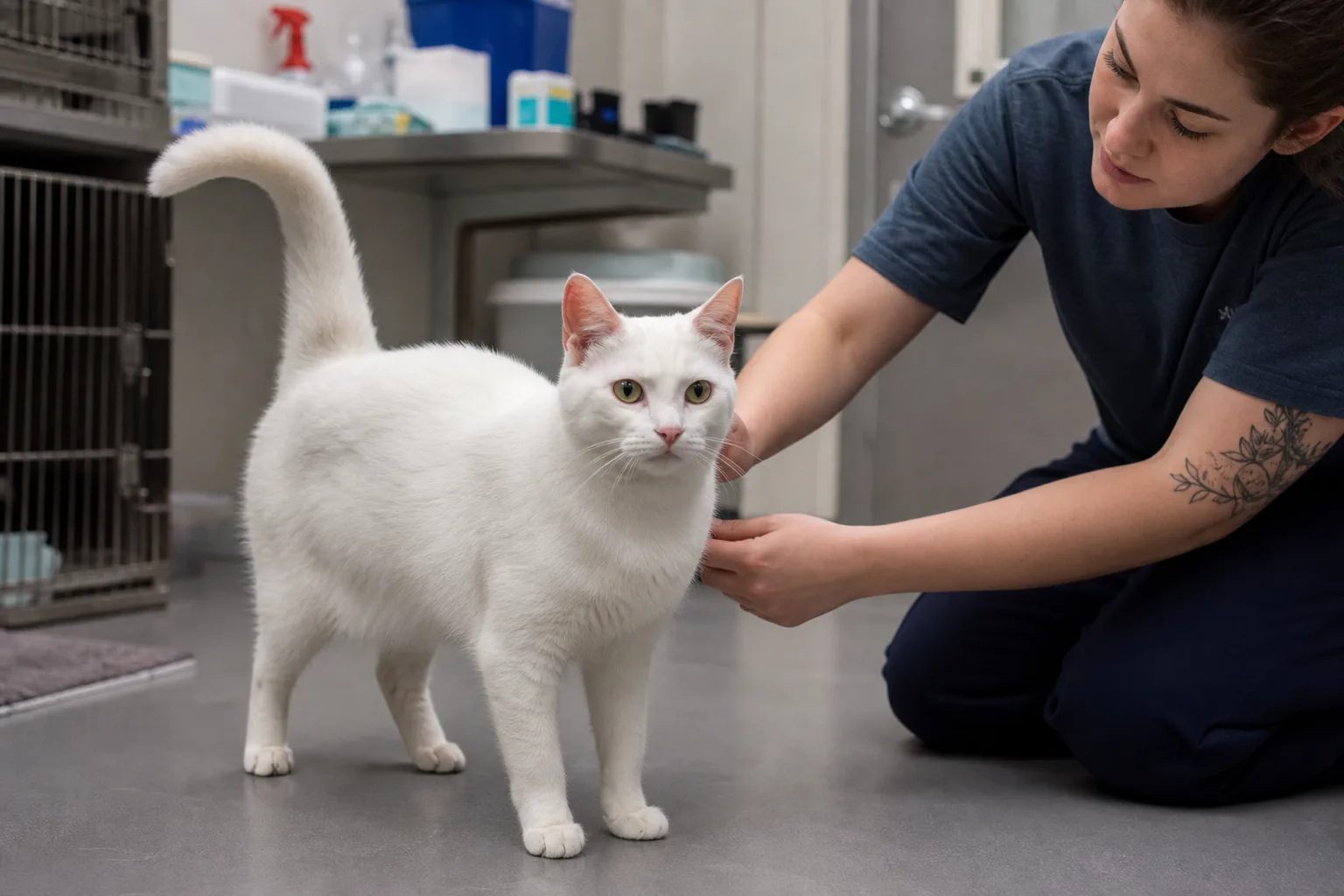
Other pedigreed breeds can also be shown in white. Depending on registry and line, Persians, British Shorthairs, Turkish Angoras, Oriental Shorthairs, Maine Coons, and others may have solid-white individuals. Their coat, head, body, and pedigree standards differ, but a cropped photograph may hide the useful distinctions.
Do not use a single difference to make a counterclaim. A cat that does not fit the Khao Manee standard may be another breed, a mix, or a domestic cat. The correct result may remain “unknown ancestry.”
Khao Manee vs. Turkish Angora
A Turkish Angora commonly has a longer, silky coat, a plumed tail, and a more delicate outline than the short-coated Khao Manee. White and odd-eyed individuals occur in both breeds. The coat difference can be informative, but registry pedigree remains the ancestry evidence.
Khao Manee vs. white Siamese-type cats
The Khao Manee shares a Southeast Asian context and an athletic outline with other Thai-origin cats, but its standard is distinct. A colorpoint Siamese has darker points and blue eyes, while an all-white Oriental-type cat may have a more extreme wedge and longer, finer body. Mixed ancestry can blur all of these differences.
Khao Manee vs. white Persian
A Persian has a long, dense coat, round head, and much shorter face under its breed standard. That is very different from the Khao Manee’s short coat and moderate wedge. A shaved, young, or mixed Persian can be harder to judge, which is another reason not to assign ancestry from one image.
Khao Manee temperament and care
Breed sources describe Khao Manees as intelligent, active, social, communicative, and affectionate. A known pedigreed cat may fit that pattern, but so can a mixed-breed domestic cat. Friendly behavior does not identify a breed, while shyness does not disprove one.
Temperament is affected by early experience, health, household conditions, and the individual cat. If you are evaluating adoption or purchase, meet the cat and ask how it handles play, restraint, visitors, children, other animals, and time alone. Petful’s Khao Manee breed guide covers home fit, enrichment, grooming, and routine care in depth. Before buying the Yaheetech multi-level cat tree, measure floor and ceiling clearance and confirm that the base, platforms, and placement are stable for the individual cat.
For either cat, useful supplies follow the individual need rather than the label: a secure top-opening carrier, stable scratching and climbing options, interactive toys, complete cat food, litter resources, and dental-care tools introduced gradually. Do not buy specialized products because a seller made a rare-breed claim. The Frisco feather teaser wand is one supervised play option; let the cat catch the toy and store the string out of reach afterward.
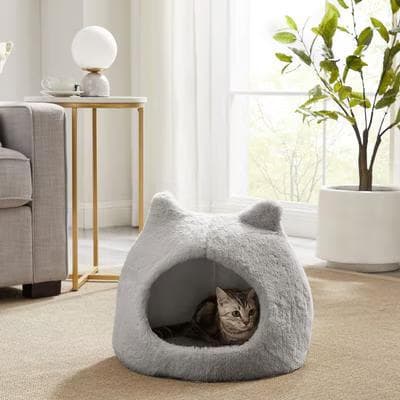
Covered, igloo-style cat bed in soft plush with a water-resistant bottom, giving cats a cozy enclosed spot to curl up. Grey.
Petful may earn a commission when you click through to Chewy, at no extra cost to you.
Hearing and health are separate questions
White pigmentation can be associated with congenital sensorineural deafness, and blue irises can be associated with higher risk in some studied populations. Neither fact identifies a Khao Manee. A white domestic cat can be deaf, a registered Khao Manee can hear normally, and a cat can have one hearing ear and one affected ear.
Behavioral tests at home are unreliable for one-sided deafness because cats respond to vibration, visual cues, air movement, and the hearing ear. A veterinary hearing discussion and, when indicated, a BAER test answer a different question: how each ear responds.
Read Petful’s veterinarian-authored guide to Khao Manee health, deafness, and lifespan for the evidence and care implications. Do not transfer a prevalence percentage from another white-cat breed or study population to the cat in front of you.
Keep the questions separate
- Pedigree records address breed ancestry. A veterinary examination and, when indicated, BAER testing address hearing. Neither result substitutes for the other.
For a private retreat, the Best Friends by Sheri covered cat bed is one enclosed option to compare after checking entry size, washability, and where the cat already chooses to rest. Place the Necoichi wall scratcher near an existing scratching or transition area and confirm that its mounted height lets the cat stretch fully. The PawsPik stainless-steel cat fountain is one water-station option to compare for capacity, cleaning access, filter cost, noise, and the cat’s actual drinking preference.
If the cat came from a shelter or was found
Begin with identity, not breed. Ask the shelter for intake records, prior-owner notes, medical history, and any microchip information. If you found the cat, have a veterinarian or shelter scan for a chip and follow local found-pet requirements before assuming the cat has no owner.
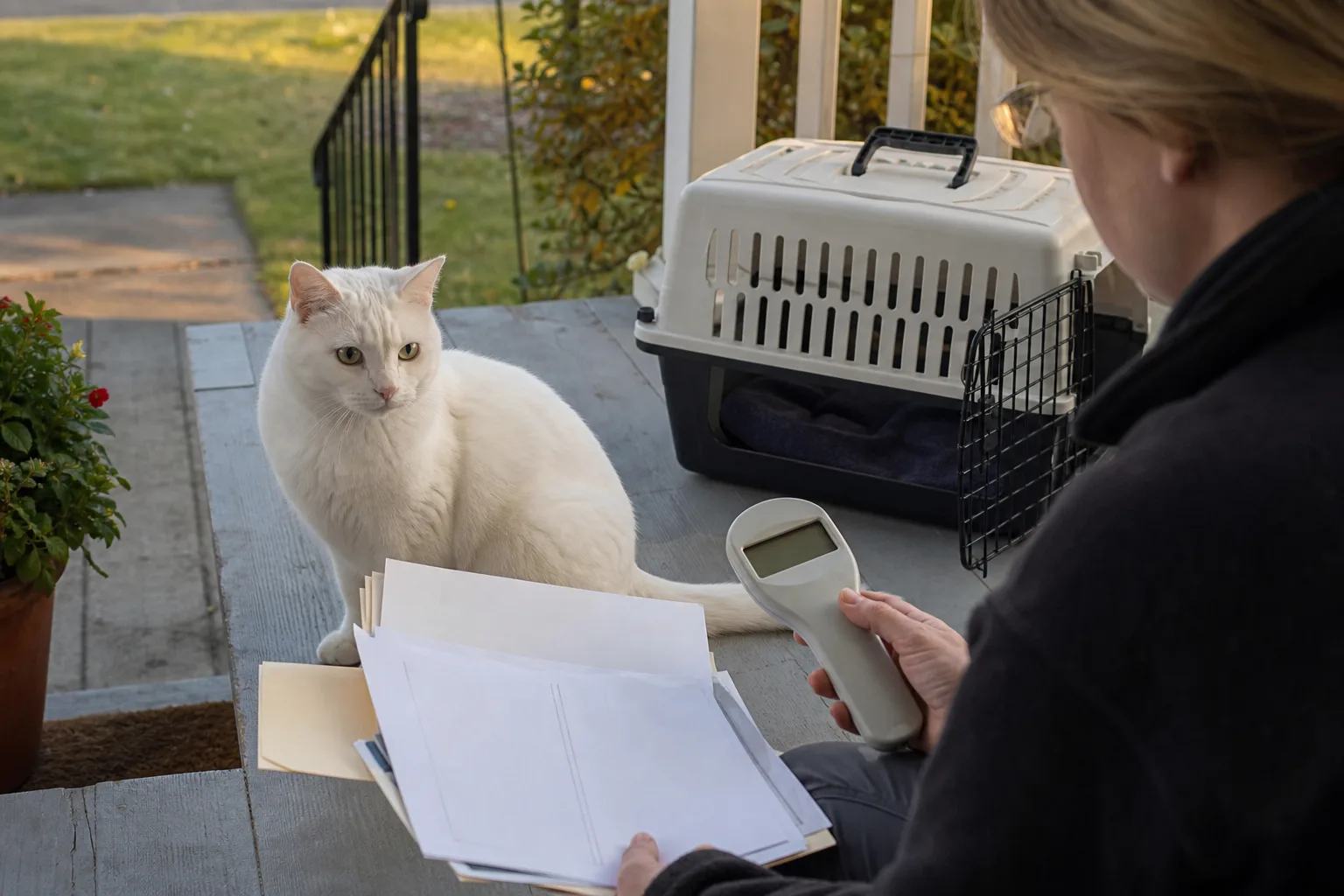
Shelter breed labels are often practical visual descriptions entered when family history is unavailable. Staff may use “domestic shorthair,” “mixed breed,” or “Khao Manee mix” to communicate resemblance. That label does not create a pedigree, and updating it to a more conservative description is not taking anything away from the cat.
If a prior owner supplies registry paperwork later, verify that the identifying details match. A pedigree for a different white cat is not evidence for this one. Compare sex, birth date, microchip, registered name, photographs, breeder, and transfer history.
Describe the cat accurately
An accurate shelter or veterinary description might read: “adult white domestic shorthair with one blue and one yellow-green eye, unknown ancestry.” That sentence tells future caregivers more than an unsupported breed label because it separates observed facts from an unknown family tree.
If the coat is long, record domestic longhair. If there are colored hairs or a fading kitten head patch, describe them. If the cat has normal or impaired hearing based on a veterinary test, record the result separately. None of those details requires a rare-breed conclusion.
Accurate records matter if the cat becomes lost, changes homes, receives insurance, or needs veterinary care. A current microchip registration, clear full-body photographs, and a note of distinctive marks are more useful for recovery than a speculative ancestry label.
If you already paid for a claimed Khao Manee
Gather the listing, messages, invoice, contract, pedigree, registration documents, veterinary records, microchip details, photographs, and payment record. Ask the seller in writing to resolve missing or inconsistent details. Keep the request factual and specific.
Contact the named registry through contact information you find independently. Ask whether the cat, litter, parents, breeder, and transfer record exist and what documentation should have been provided. A registry can explain its records, though it may not decide a private contract dispute.
If the seller used a copied identity, false paperwork, stolen photographs, or a nonexistent kitten, contact the payment provider promptly and report suspected fraud to the appropriate consumer authority. The FTC advises pet buyers to preserve evidence, check images, verify sellers, and avoid hard-to-reverse payment methods.
Focus on the cat’s welfare
Even when a seller’s claim was false, the cat in your home still needs ordinary care. Arrange a veterinary examination, verify the microchip, review vaccination and parasite history, and discuss hearing if relevant. Do not abandon, resell, or breed the cat to recover money.
A false breed label may affect the transaction, but it does not make the cat less worthy. Separate any consumer complaint from daily welfare. Ask a reputable rescue for help if you cannot keep the cat, and tell them honestly what is and is not documented.
Why breed labels matter
The goal of caution is not gatekeeping. Accurate breed labels protect cats and people. They reduce fraud, discourage breeding from unverified animals, keep health claims tied to relevant evidence, and help shelters communicate what they actually know.
An unsupported rare-breed label can create unrealistic expectations about personality, value, or health. It can also attract theft or irresponsible breeding. A precise domestic-cat description avoids those harms while leaving room to celebrate the same vivid eyes, white fur, and engaging personality.
Breed identity can matter to a conservation breeding program, registry, or buyer seeking a documented lineage. For everyday companionship, the individual cat’s health, temperament, and fit matter more than the prestige of the label.
Price does not prove pedigree
A seller can attach a high price to any listing. Matching a commonly repeated Khao Manee range does not make the cat registered, responsibly bred, or healthy. Low prices can signal a scam, but high prices can be manufactured to imitate legitimacy.
Petful’s Khao Manee price and responsible sourcing guide explains how to verify breeder identity, kitten records, pedigree, hearing information, contract terms, and payment methods. Complete those checks before debating whether a quote is fair.
Rarity should make verification stricter, not looser. If the documentation is missing, describe and value the cat as an individual rather than paying for an unproven ancestry story.
A practical identification process
- Scan for a microchip and gather existing shelter, veterinary, breeder, and ownership records.
- If a purebred claim is being made, request the pedigree and registration or transfer record.
- Verify the registry and breeder through contact information you find independently.
- Confirm that identifying details agree across the pedigree, contract, microchip, and veterinary record.
- Compare the cat with the current standard only as a consistency check.
- Treat apps and consumer DNA estimates as context with stated limits.
- If documentation remains absent, use an honest domestic-cat description.
This process may not produce an exciting label, but it produces a defensible answer. It also protects shelters, buyers, and cats from false claims that can drive irresponsible breeding or fraud.
Keep evidence and uncertainty in separate columns
When the information is messy, make a simple record with three headings: confirmed, consistent but unconfirmed, and unknown. Put the microchip, veterinary findings, and verified paperwork under confirmed. Put standard-consistent traits under consistent but unconfirmed. Put missing parentage and unresolved seller claims under unknown.
This prevents a plausible clue from slowly turning into a remembered fact. It also gives a veterinarian, shelter, registry, or future caregiver a clean starting point without forcing them to reconstruct the story.
Khao Manee identification FAQs
Frequently Asked Questions
The strongest evidence is a verifiable pedigree certificate and registry record that connect the individual cat to registered Khao Manee parents. White fur, a short coat, blue or odd eyes, an athletic build, and a social personality can all be consistent with the standard, but they are not unique to the breed. If the family history is unknown, describe the cat as a white domestic shorthair or longhair rather than claiming purebred ancestry. Apps and consumer DNA estimates can suggest possibilities, but they do not replace registered lineage.
The current Khao Manee standard calls for medium-short, fine hair that follows the athletic body rather than creating a fluffy outline. A long, dense, or strongly curled coat would not fit that show standard. That does not make a longhaired white cat less appealing or healthy; it means appearance points away from the standard. Coat length alone still cannot identify another breed or prove a mix, so use verified family records when making an ancestry claim.
Some white kittens can have a colored head patch that reflects underlying pigment and later fades. The CFA standard notes that such a patch may persist in a Khao Manee kitten until about 18 months, but similar kitten head spots can occur in white cats outside the breed. Record the patch as an observable trait, not a secret breed marker. A fading black spot cannot replace a pedigree certificate, registry transfer, or other documented evidence of lineage.
No. Khao Manees may have vivid blue, yellow, green, or odd eyes, but those presentations also occur in white domestic cats and other pedigreed breeds. Lighting and camera settings can further distort eye color in photographs. Eye presentation can be consistent with the standard, yet it does not establish ancestry or hearing status. Use a registry pedigree for lineage and an appropriate veterinary hearing assessment for the ears rather than asking one visible trait to answer both questions.
A consumer DNA test may offer ancestry estimates based on the populations in that company’s reference database, but the result is an inference rather than a registry certificate. Rare breeds can have fewer reference animals, and related populations may be difficult to separate confidently. Use a DNA estimate as context, not as authority to relabel a shelter cat, set a rare-breed price, or make breeding decisions. Registered lineage supported by verifiable records remains the strongest practical evidence.
Sources

Coreen Saito is a pet writer and longtime shelter volunteer with more than a decade in animal rescue. She covers cat behavior, breed care, and the small, ordinary science of sharing a life with companion animals, with a particular focus on honest takes about the products and decisions that actually matter. At home in Arizona, she’s outranked by Mac (a dog with the loudest opinion in the house), Rebel (a cat who governs by quiet authority), and Meri (an orange tabby who runs the late shift and the laundry basket). She writes about all three, plus the rescues that keep coming through her life, at LifeWithMinty.com.