
Petful is reader supported. As an affiliate of platforms like Amazon and Chewy, we may earn a commission when you buy through links on this page. There is no extra cost to you.
Choosing a flea spray for house treatment is not really a shopping decision, it is a biology decision. Only about 5 percent of a flea population is the adult insect you can see on your pet. The rest is eggs, larvae and pupae sitting in carpet pile, sofa seams and pet bedding, which is why a spray that only kills adults leaves you with a fresh crop two weeks later. The best flea spray for home use pairs a fast adulticide with an insect growth regulator, covers enough square feet to treat every room the pet uses, and carries a label you can actually follow in a house with cats in it. Below are six picks, the exact actives to avoid where cats live, and the re-treatment schedule that finishes the job.
- 1A household flea spray needs two things: an adulticide that kills adult fleas on contact and an insect growth regulator (methoprene or pyriproxyfen) that stops eggs and larvae developing
- 2Permethrin is the active to scrutinize in a home with cats, and etofenprox or an IGR-only product is the safer route
- 3Buy by coverage, not bottle size: one 16 oz aerosol treats roughly 2,000 square feet, which is one average floor, not a whole house
- 4Plan a second application 10 to 21 days after the first to catch fleas emerging from pupae, because no spray reliably penetrates the cocoon
- 5Environmental spraying supports vet-prescribed on-pet prevention, it never replaces it

Don’t Guess When It Comes To Your Pet’s Care
Sign up for expert-backed reviews and safety alerts all in one place.
Best flea spray for house and furniture: our top picks
Every house flea spray below is an EPA-registered pesticide or an EPA-exempt minimum-risk product, and each one solves a slightly different problem. Read the pick that matches your home rather than defaulting to the first one.
Shopping in a hurry? These are the sprays from this guide you can order today, grouped by the problem each one solves.
- Best overall household spray: Virbac Knockout E.S., one can pairing a permethrin adulticide with a pyriproxyfen growth regulator.
- Best cat-safe pick: Adams Flea and Tick Home Spray, etofenprox based, which is why it appears on labels for use around cats.
- Best value IGR for large homes: Martin’s I.G. Regulator, the same job as the Precor concentrate across more square footage.
- Best plant-based option: Vet’s Best Flea and Tick Home Spray, peppermint oil and clove extract for spot treatment and lighter problems.
Prices and stock move around, so check the current listing before you commit. Precor 2000 Plus and the Precor IGR concentrate are covered further down because they are worth knowing about, but both are professional pest-supply products rather than pet-retail ones, so those two you will be ordering from a specialist.

Product shots in this category all look alike, so it helps to know which container you are holding before you buy. A house flea spray arrives in one of three shapes. An aerosol can sprays under its own pressure and prints a single coverage figure on the label. A ready-to-use trigger bottle lets you work close in on furniture, seams and pet bedding without committing to a whole floor. A concentrate ships in a small bottle that means nothing until you dilute it, at which point it fills a pump spray bottle or a garden-style sprayer. Matching the format to the job is why the picks below are not interchangeable: aerosols cover open floor quickly, while a trigger sprayer earns its keep on upholstery.
- Aerosol can: coverage is printed on the can and describes one pass, roughly 2,000 square feet from a 16 oz can in this category
- Ready-to-use trigger bottle: no mixing, best aimed at sofas, pet beds and baseboards rather than whole rooms
- Concentrate: typically dilutes at 1 oz per gallon of water per 1,500 square feet and goes through a pump sprayer, never an aerosol
- Hold any nozzle or sprayer about 3 feet from the surface and mist until the fiber is just damp, not soaked
- Plan on two full applications two to three weeks apart, so double whatever can or bottle count a single pass suggests
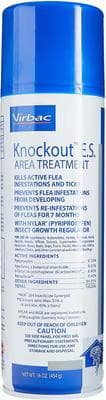
1. Virbac Knockout E.S. Area Treatment: best overall household flea spray
Knockout E.S. is the closest thing to a complete indoor answer in a single can. It combines pyriproxyfen at 0.10 percent, an insect growth regulator that stops flea eggs hatching and prevents larvae from ever becoming adults, with permethrin at 0.40 percent and pyrethrins at 0.05 percent for adult knockdown. One bottle covers roughly 2,100 square feet from a 16 oz can, and the pyriproxyfen component keeps working on the immature stages for up to seven months.
That residual is the reason it earns the top slot. Most people who fail at indoor flea control are not using a weak product, they are using a product with no growth-regulator residual, so the eggs already in the carpet hatch on schedule. The trade-off is the permethrin, which means cats need to be out of the treated room until every surface is completely dry.
Petful may earn a commission when you click through to Chewy, at no extra cost to you.
2. Precor 2000 Plus Premise Spray: best for a heavy infestation
Precor 2000 Plus is the professional-grade choice and the one to reach for when you are seeing fleas jump on your ankles rather than just finding the occasional one on the dog. It pairs (S)-methoprene, the original flea IGR, with two pyrethroids (permethrin at 0.350 percent and phenothrin at 0.300 percent) plus the synergists piperonyl butoxide and n-octyl bicycloheptene dicarboximide. A 16 oz can treats about 2,000 square feet and the methoprene keeps preventing re-infestation for around seven months.
- Best for: multi-room infestations, homes with an established flea population in carpet
- Adult kill: fast, pyrethroid-based
- IGR: (S)-methoprene, roughly 7 months of residual
- Cat consideration: contains permethrin, so keep cats out until dry
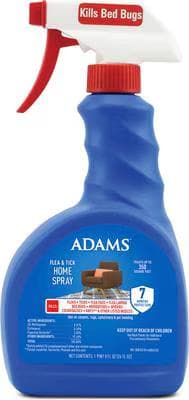
3. Adams Flea and Tick Home Spray: best cat safe flea spray for home use
If you want the safest flea spray for home use that still carries a real IGR, this is the one. Adams uses (S)-methoprene at 0.01 percent alongside etofenprox at 0.50 percent and piperonyl butoxide. Etofenprox matters here: it is a non-ester pyrethroid with a markedly better mammalian safety profile than permethrin, which is why it appears in products labeled for use around cats while permethrin generally does not. That combination makes it the practical answer for anyone searching for a cat safe flea spray for home treatment without giving up growth-regulator coverage.
The trade-off is potency. Etofenprox knocks down adults reliably but Adams is a lighter-duty household flea spray than Knockout or Precor, so a severe infestation may need two rounds rather than one. For most single-pet homes catching the problem early, that is a fair swap for the safety margin.
4. Precor IGR Concentrate: best pure IGR add-on
This is not a standalone product and the label says so plainly: Precor IGR Concentrate contains (S)-methoprene at 1.2 percent and will not kill adult fleas. What it does is dilute into a gallon of water to treat 1,500 square feet of floor and furniture, laying down a growth-regulator layer that shuts off the next generation.
- Use it when: you already own an adulticide spray you like, or you want IGR coverage in rooms you would rather not hit with a pyrethroid
- Mix rate: 1 oz per gallon of water per 1,500 square feet
- Application: a pump spray bottle or a garden-style sprayer, not an aerosol
- Limitation: zero effect on adult fleas, so it must be paired
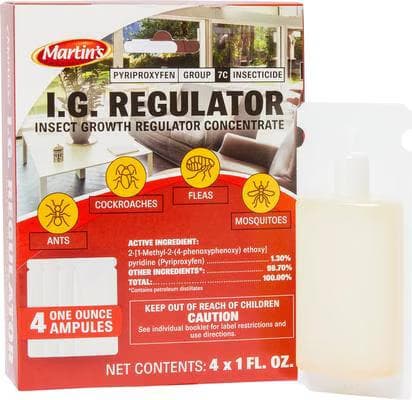
5. Martin’s I.G. Regulator: best value IGR for large homes
Martin’s uses pyriproxyfen rather than methoprene and works out cheaper per treated area than almost anything else in the category. The concentrate mixes at 1 fl oz per gallon per 1,500 square feet and holds its effect on immature stages for up to seven months. Like Precor IGR, it does not kill adults, so it belongs alongside an adulticide rather than instead of one.
The reason to choose it over the methoprene concentrate is durability. Pyriproxyfen tolerates light and heat better than methoprene, which makes it the more reliable pick for sun-exposed rooms, conservatories and any floor that gets strong afternoon light through big windows.
6. Vet’s Best Flea and Tick Home Spray: best non toxic flea spray for home use
Vet’s Best is the plant-based option, built on peppermint oil at 0.30 percent and eugenol (clove-derived) at 0.70 percent with sodium lauryl sulfate as a surfactant. It kills fleas and eggs on direct contact and it is the honest answer for anyone specifically looking for a non toxic flea spray for home use, or a home flea spray safe for pets in a household with young children crawling on the floor.
Be clear-eyed about what it is. There is no insect growth regulator in it and effectively no residual, so it is a contact treatment for spot problems and light infestations, not a solution for an established population. It also contains essential oils, and cats metabolise phenolic compounds poorly, so apply it to surfaces only, follow the label, and keep cats out of the room until it has dried.
Never use a dog product on a cat
- Product labels are legally binding instructions, not suggestions. A spray, spot-on or shampoo labeled for dogs only is labeled that way because the active ingredient or its concentration has not been cleared as safe in cats. Read the species line on every label before you buy, and if you own both a dog and a cat, buy the product cleared for both.
How we picked these flea sprays
Every recommendation above had to clear the same four filters, and the first one eliminates most of what ranks for best flea spray for home and furniture. One clarification before the criteria: if you are shopping for the best flea spray for the home rather than for your animal, remember that a household flea treatment spray and an on-pet product are separate EPA registrations with separate safety data, and they are never interchangeable.
- Does it carry an insect growth regulator? Anything without methoprene or pyriproxyfen is a knockdown-only product. It solves today and does nothing about the eggs already in your carpet.
- What is the active ingredient, and is it cleared for the species in the house? We list the exact active and percentage for every pick rather than repeating marketing phrases like “pet safe.”
- What is the real coverage area? We convert can size into treatable square footage so you can count rooms rather than guess. This is the single most common buying mistake in the category.
- Is the label achievable in a normal home? A product that requires a four-hour evacuation and a respirator is not a realistic best flea and tick spray for home use, however well it performs.
Indoor Flea Spray Comparison
| Product | Adulticide | Insect Growth Regulator | Coverage | Cats in the Home |
|---|---|---|---|---|
| Virbac Knockout E.S. | Permethrin 0.40%, pyrethrins 0.05% | Pyriproxyfen 0.10%, ~7 months | ~2,100 sq ft per 16 oz | Keep cats out until fully dry |
| Precor 2000 Plus | Permethrin 0.350%, phenothrin 0.300% | (S)-methoprene, ~7 months | ~2,000 sq ft per 16 oz | Keep cats out until fully dry |
| Adams Flea & Tick Home Spray | Etofenprox 0.50% | (S)-methoprene 0.01% | ~345 sq ft per 24 oz | Etofenprox is the better-tolerated pyrethroid |
| Precor IGR Concentrate | None | (S)-methoprene 1.2% | 1,500 sq ft per 1 oz diluted | No adulticide, pair with one |
| Martin’s I.G. Regulator | None | Pyriproxyfen, up to 7 months | 1,500 sq ft per 1 oz diluted | No adulticide, pair with one |
| Vet’s Best Home Spray | Peppermint oil 0.30%, eugenol 0.70% | None | Contact only, no residual | Surfaces only, keep cats out until dry |
The coverage column is the one worth staring at. A 16 oz aerosol treating 2,000 square feet sounds generous until you realize that a 1,800 square foot house with a finished basement needs more than one can for a single full treatment, and the protocol below asks for a second application two to three weeks later. Most households that “tried a flea spray and it did not work” bought one can for a two-can house.
Petful may earn a commission when you click through to Chewy, at no extra cost to you.
Do the coverage area arithmetic before you reach the checkout, because this is where most households underbuy. Take the treatable square footage printed on the can, then adjust for reality: upholstery, stairs and cluttered rooms consume product faster than open floor does. Then double the total, because the protocol below asks for a second full application. Reading the active ingredient panel and the coverage area together is the whole buying decision, and on most labels those two numbers are printed within an inch of each other.
- Measure only the rooms your pet actually enters. Length times width per room, added together, is your real treatable square footage.
- Add a margin for soft furnishings, because a sofa, an armchair and a stair run take noticeably more product than the same footprint of bare carpet.
- Multiply the final figure by two applications before you compare it against the coverage area on the label.
- A 16 oz aerosol rated for roughly 2,000 square feet is one full pass of a small flat, not two passes of a family house with a basement.
- If a label states no coverage area at all, you cannot size the purchase, and that alone is a fair reason to choose a different product.
What is the most effective flea spray for home?
The most effective flea spray for home use is a combination product containing both a pyrethroid adulticide and an insect growth regulator, applied at full label coverage and repeated once. On that definition, Virbac Knockout E.S. and Precor 2000 Plus are the most effective options a consumer can buy without a pest control license, because each delivers immediate adult kill plus roughly seven months of IGR residual against eggs and larvae.
Effectiveness in this category is not about which product kills a flea in a petri dish fastest. Every pyrethroid on the shelf does that. It is about whether the product still suppresses the population 30 days later, and only the IGR-containing sprays do.
IGR vs adulticide: what actually breaks the flea cycle
An IGR flea spray and an adulticide spray do completely different jobs, and the reason most indoor treatments fail is that people buy only the second one.
An adulticide is a nerve poison for insects. Pyrethroids such as permethrin, phenothrin and etofenprox, and the natural pyrethrins they are modelled on, disrupt sodium channels in the flea’s nervous system. They kill on contact and they kill fast, which is satisfying but short-lived. They have no meaningful effect on eggs, minimal effect on larvae buried deep in carpet pile, and none at all on pupae inside a cocoon.
An insect growth regulator is not a poison at all. Methoprene and pyriproxyfen are synthetic analogues of insect juvenile hormone. Larvae exposed to them are prevented from completing metamorphosis and die instead of maturing, and the same compounds have ovicidal activity, meaning treated eggs never hatch. The Companion Animal Parasite Council names methoprene and pyriproxyfen specifically as the IGRs used in flea control, precisely because they prevent flea eggs from hatching and kill larvae or early pupae.
- Adulticide alone: fleas disappear for a few days, then return as the existing egg bank hatches
- IGR alone: the adults you already have keep biting and laying for weeks while the next generation is quietly shut down
- Both together: immediate relief plus a population that cannot rebuild
What to look for on the label
- Turn the can around and read the active ingredient panel, not the front. You want to see methoprene or pyriproxyfen listed. If neither appears, the product is a knockdown-only flea control spray and you will need a separate growth regulator to finish the job.
This is also why the term IGR flea spray for home use has become its own search: the category split is real, and the label panel is the only reliable way to tell which side of it a product sits on. Marketing language like “long lasting” or “kills flea eggs” appears on both types. The active ingredient panel does not lie.
Because the two categories behave so differently, the active ingredients that make a spray unsafe around cats sit almost entirely on the adulticide side. Permethrin is the one to know by name, because cats clear it poorly and it is the active behind most serious pyrethroid poisonings in the species. Phenothrin and other concentrated pyrethroids carry the same family of caution. Botanical sprays are not automatically safer either, since several plant actives are also poorly tolerated by cats. Read the active ingredient panel, then decide.
- Permethrin: the highest-risk active in this category for cats. If a product contains it, cats leave the room before you spray and do not return until every treated surface is dry to the touch.
- Phenothrin and other concentrated pyrethroids: same chemical family, same caution, and no reason to choose one for a cat household when an etofenprox or IGR-only option exists.
- Tea tree (melaleuca), pennyroyal, and citrus oil extracts such as d-limonene and linalool: sold as natural, still poorly tolerated by cats, and not what you want on a surface a cat lies on.
- Etofenprox, methoprene and pyriproxyfen: the actives that appear on labels cleared for use in homes with cats, which is why they carry the picks above.
- If a label names no active ingredients and no percentages at all, treat that as a reason to put the bottle down rather than a sign the product is mild, and ask your veterinarian before using anything new around a cat, kitten or sick animal.
Why the flea life cycle decides how you spray
The flea life cycle has four stages, and understanding the timing is what converts a single frustrating spray session into an actual eradication. The life cycle of a flea runs egg, larva, pupa, adult, and only the last stage lives on your pet.
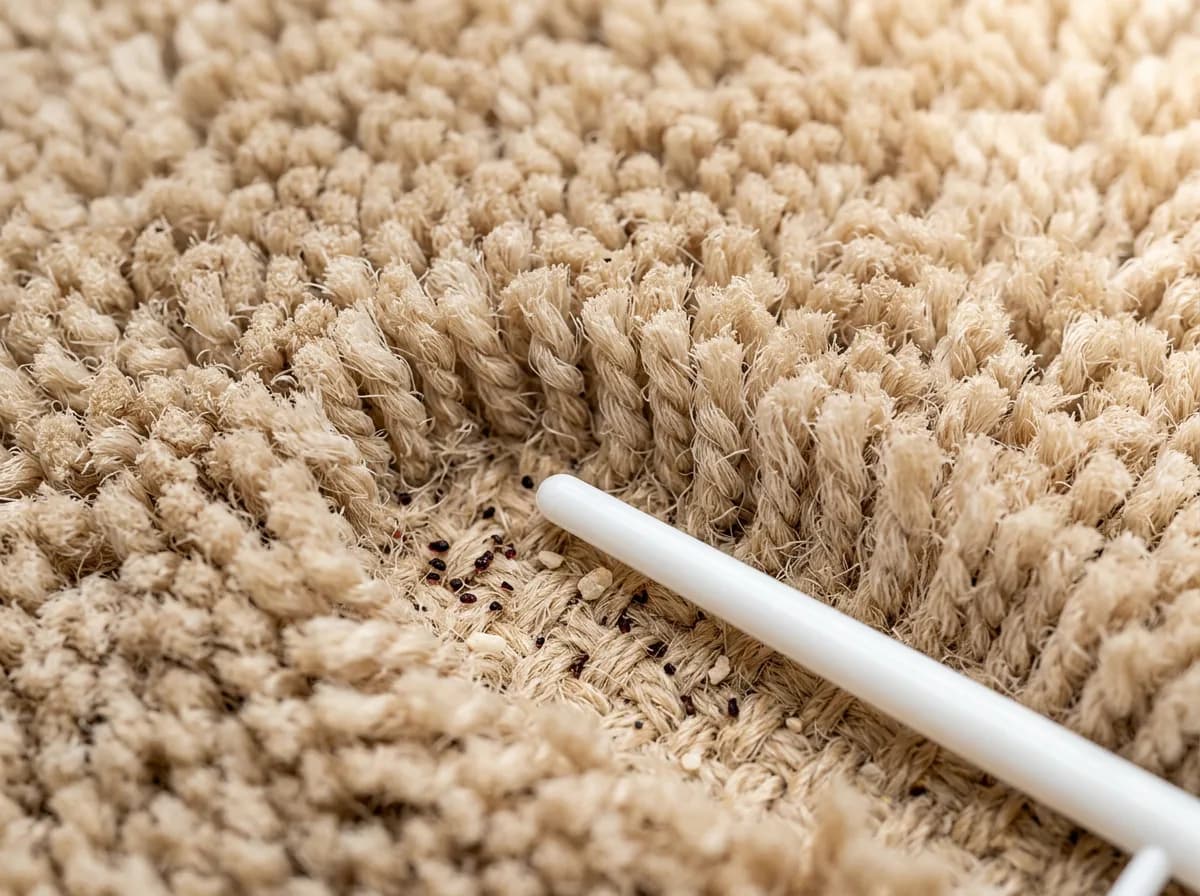
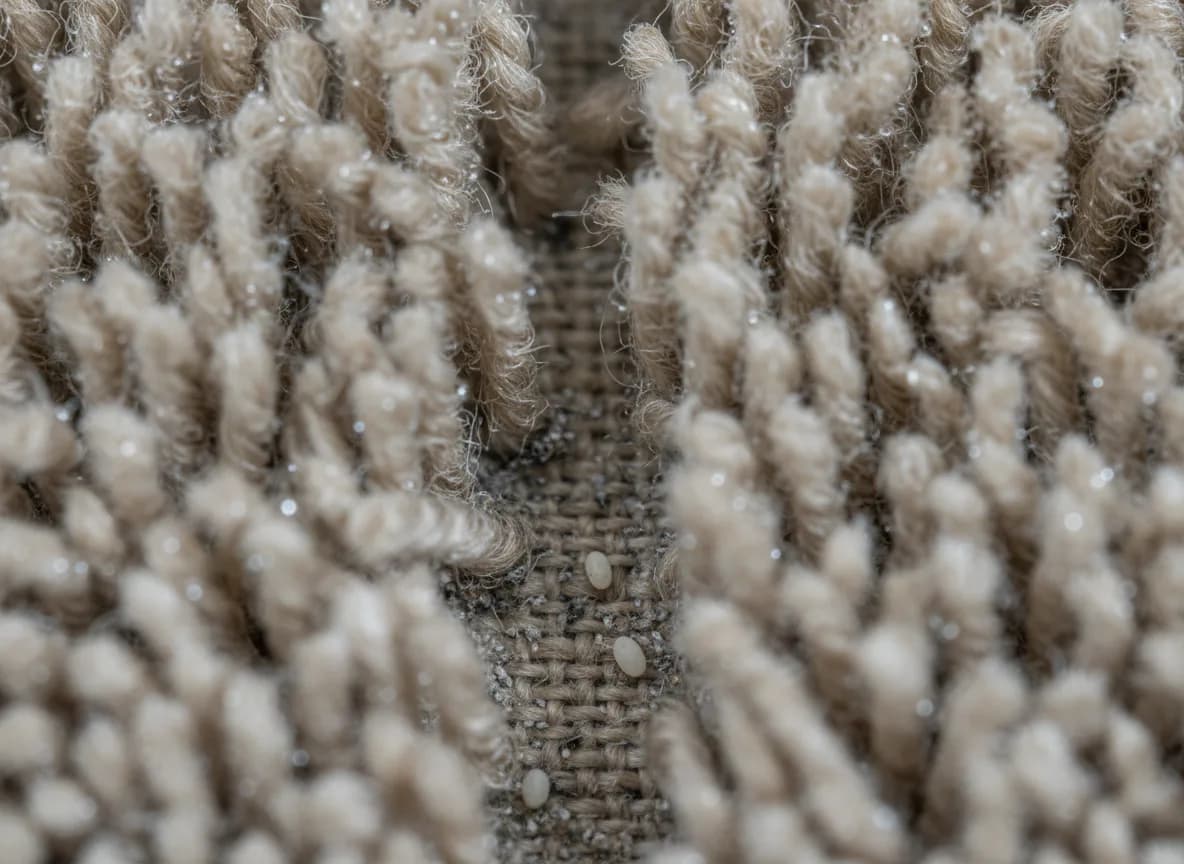
- Egg: roughly 0.5 mm long, laid on the pet and falling into the environment within a few hours. This is why flea eggs treatment is an environmental job, not an on-pet one.
- Larva: hatches in the carpet or crevice, feeds on adult flea feces (the “flea dirt” you find when combing), and avoids light by burrowing deep into pile and upholstery.
- Pupa: spins a sticky, debris-coated cocoon. This is the armoured stage. No household spray reliably penetrates it.
- Adult: emerges, finds a host, and starts laying within about 24 to 48 hours. Adults generally survive 2 to 3 months.
The pupa is the whole problem. According to CAPC data, adult cat fleas begin emerging about 8 days after pupal development starts and are usually all emerged by day 13 at 24°C (75.2°F), but in temperate conditions 90 to 95 percent of fleas emerge across a 21 to 35 day span. In cool, humid conditions adults can remain quiescent inside the cocoon for up to 30 weeks. That is the pupal window, and it is why the fleas come back a fortnight after a treatment that seemed to work.
The re-treatment schedule that actually finishes it
Because nothing you spray gets inside a cocoon, the only way to kill the pupal generation is to wait for it to emerge onto a treated surface. That means the schedule matters more than the product.
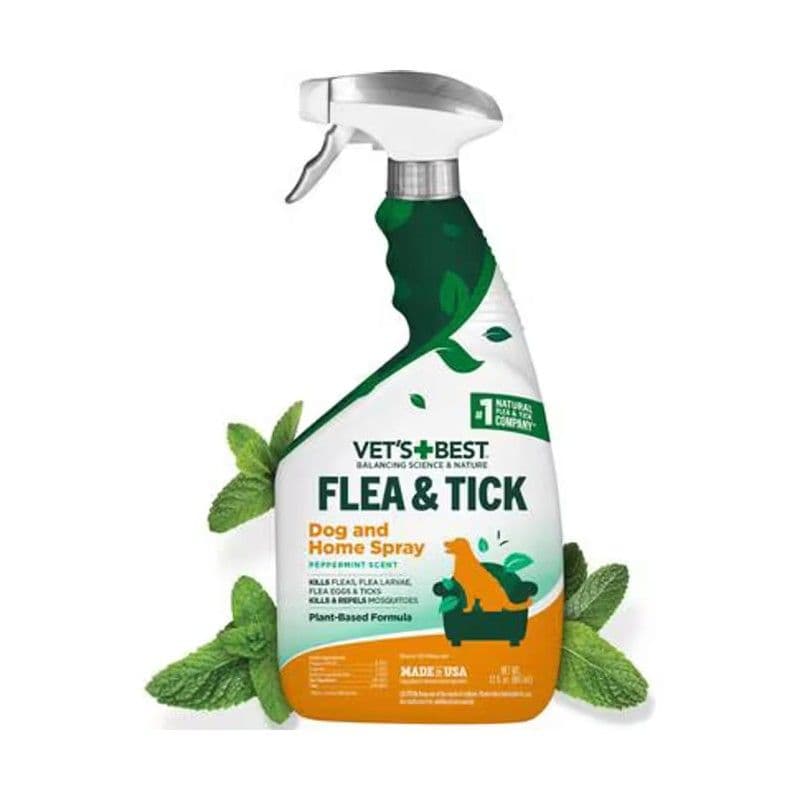
Plant-based peppermint and clove indoor home spray that kills fleas, flea eggs and larvae, and ticks on contact on carpets, furniture, and bedding, and repels mosquitoes.
Petful may earn a commission when you click through to Chewy, at no extra cost to you.
- Day 0: vacuum thoroughly, then apply full-coverage spray to all floors, upholstery and pet bedding
- Days 1 to 14: vacuum every day or every other day. Vibration and warmth trigger pupal emergence, so vacuuming actively pulls fleas out of the cocoon and onto your treated surfaces
- Day 10 to 21: apply the second application, targeting the same surfaces. This is the step almost everyone skips and it is the one that ends the infestation
- Weeks 3 to 8: keep vacuuming weekly and keep every pet on vet-prescribed prevention. CAPC notes that a significant infestation may take several months to bring fully under control
Do not judge the product on day 3
- Seeing fleas again a week after spraying is not evidence the spray failed. It is the pupal generation emerging exactly as expected. Judge the treatment 30 days out, after the second application, not in the first week.
Write the dates on a calendar the day you spray, because a schedule tied to the pupal stage is the only one that finishes the job. Nothing you apply reaches a flea sealed inside its cocoon, so the second treatment has to land while emerging adults are still walking onto treated carpet. Spray once, see fleas again at day ten, and it is natural to call the product a failure. That bounce is the pupal generation doing exactly what it always does. A warm, dry house gives you a tighter emergence window, so a second pass at day ten to fourteen catches most of it. A cool, humid house stretches it, which moves the second pass nearer day twenty-one and adds a third around day thirty.
- Count from the day of the first application, not from the last flea you saw.
- Vacuum every day or two in between. Vibration pulls pupae out of the cocoon and onto the surface you are about to re-treat.
- Warm and dry house: second pass at day 10 to 14. Cool and humid house: day 21, plus a third pass near day 30.
- Buy enough product for two full passes up front, because a half-finished second application does roughly what none would.
- Judge the result at the end of the cycle, not in the middle of it.
Flea spray safety around cats and dogs
This is the section that decides which product you should buy, because cats and dogs do not tolerate the same chemistry. The single most important fact in indoor flea control is that permethrin kills cats at the concentrations used in canine spot-on treatments, where 45 to 65 percent formulations are common. The Merck Veterinary Manual states plainly that some pyrethroids, permethrin among them, can be highly toxic to cats, producing muscle fasciculations and seizures.
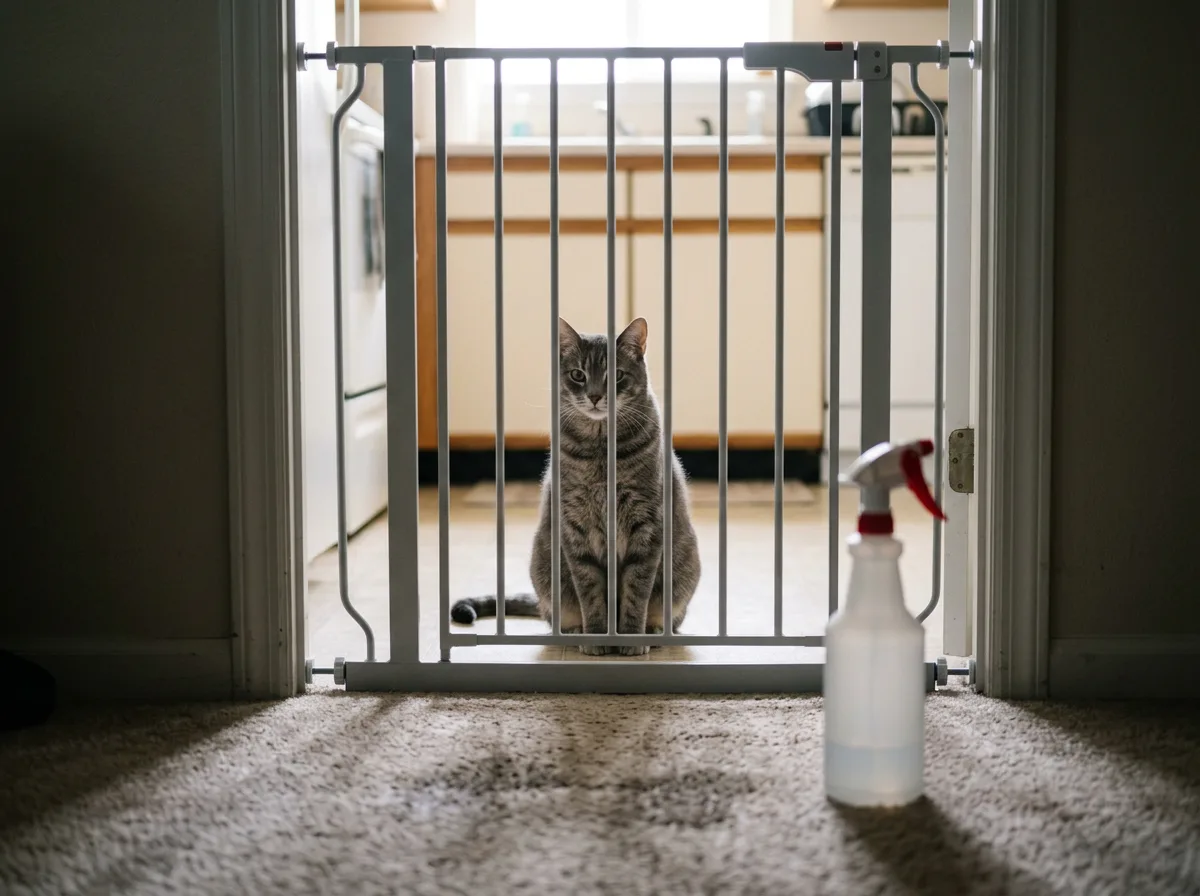
Premise sprays are a much lower concentration, typically 0.35 to 0.40 percent, and a dried treated carpet is not the same exposure as a spot-on applied to skin. But the margin is narrower for cats than for any other pet in the house, so the safe practice is not negotiable: cats leave the room before you spray and do not come back until every treated surface is completely dry to the touch.
Active Ingredient Safety Around Cats
| Active Ingredient | Type | Use Where Cats Live? |
|---|---|---|
| Permethrin | Pyrethroid adulticide | Premise use only, cats fully excluded until dry. Never apply a permethrin dog product to a cat |
| Phenothrin | Pyrethroid adulticide | Premise use only, cats excluded until dry |
| Etofenprox | Non-ester pyrethroid | Better tolerated, appears in cat-labelled products |
| (S)-methoprene | Insect growth regulator | Widely used in cat products, low mammalian toxicity |
| Pyriproxyfen | Insect growth regulator | Widely used in cat products, low mammalian toxicity |
| Peppermint oil / eugenol | Botanical contact killer | Surfaces only, cats excluded until dry, cats metabolise phenols poorly |
A genuinely cat safe formula is one that leans on the IGR for its persistence and uses either etofenprox or no adulticide at all. That is the working definition of a safe flea spray for house use in a mixed household, and it is what we mean when we name a best flea spray for home safe for cats rather than repeating a brand’s own marketing claim. It is also why Adams sits where it does in the picks and why the two IGR concentrates are useful in a cat household: you can lay down growth-regulator coverage everywhere and reserve the pyrethroid for the rooms the cat does not use.
The rest of the safety rules are the same whichever product you choose.
- Remove pets, children, food, dishes and bird cages from the room before spraying, and cover fish tanks and turn off their air pumps
- Ventilate the room during application and while surfaces dry
- Let every treated surface dry completely before pets or people walk on it, sit on it or lie on it
- Never apply a premise spray directly to an animal. Home sprays and on-animal sprays are different products even when the brand name matches
- Store the product in its original container with the label intact
The EPA’s guidance on pet pesticide products is worth reading before you treat, particularly its reminder that residues on pets and treated surfaces transfer readily to children. For cat-specific flea safety, our sister publication’s vet-reviewed guide to natural remedies for fleas on cats covers what is and is not appropriate around felines, and EPA pesticide safety for pets sets out the regulator’s own position. If a pet does get into a freshly treated room, stop and call your veterinarian or ASPCA poison control rather than waiting to see whether signs develop.
Signs of pyrethroid toxicity in a cat
- Call a veterinarian immediately if a cat shows muscle twitching or tremors, unsteadiness on its feet, drooling, agitation, a raised body temperature or seizures after any pesticide exposure. This is an emergency, not a wait-and-see situation, and treatment is far more successful when it starts early.
If a spray you already own names permethrin or phenothrin on the panel, you do not have to throw it away. Those specific active ingredients are what make a spray unsafe around cats while it is still wet, and the margin widens considerably once the film has dried. Use it in rooms the cat is shut out of, keep the door closed for the whole drying window, and reserve an etofenprox product or an IGR-only concentrate for the rooms the cat actually lives in. Ventilate hard, wipe down any hard surface the cat will later walk on, and ask your veterinarian before you treat at all if the cat is elderly, pregnant, a kitten or unwell.
- Check the panel before the bottle leaves the shop: permethrin, phenothrin and other concentrated pyrethroids are the actives to avoid where a cat lives.
- Wet residue is the exposure that matters. Keep cats out until every treated surface is dry to the touch, which on carpet is commonly two to four hours.
- Botanical is not automatically safer. Tea tree, pennyroyal, d-limonene and linalool are all poorly tolerated by cats.
- If a label lists no actives and no percentages, you cannot make this judgment at all, so choose a product that does.
- Call your veterinarian or an animal poison control service immediately if a cat shows tremors, twitching, drooling or unsteadiness after any treatment.
Where to spray: furniture, bedding, and baseboards
Flea larvae are negatively phototactic, which is a technical way of saying they crawl away from light and into exactly the places you do not spray. A flea spray for furniture and floors only works if you treat the dark, protected micro-habitats rather than the open middle of the room.
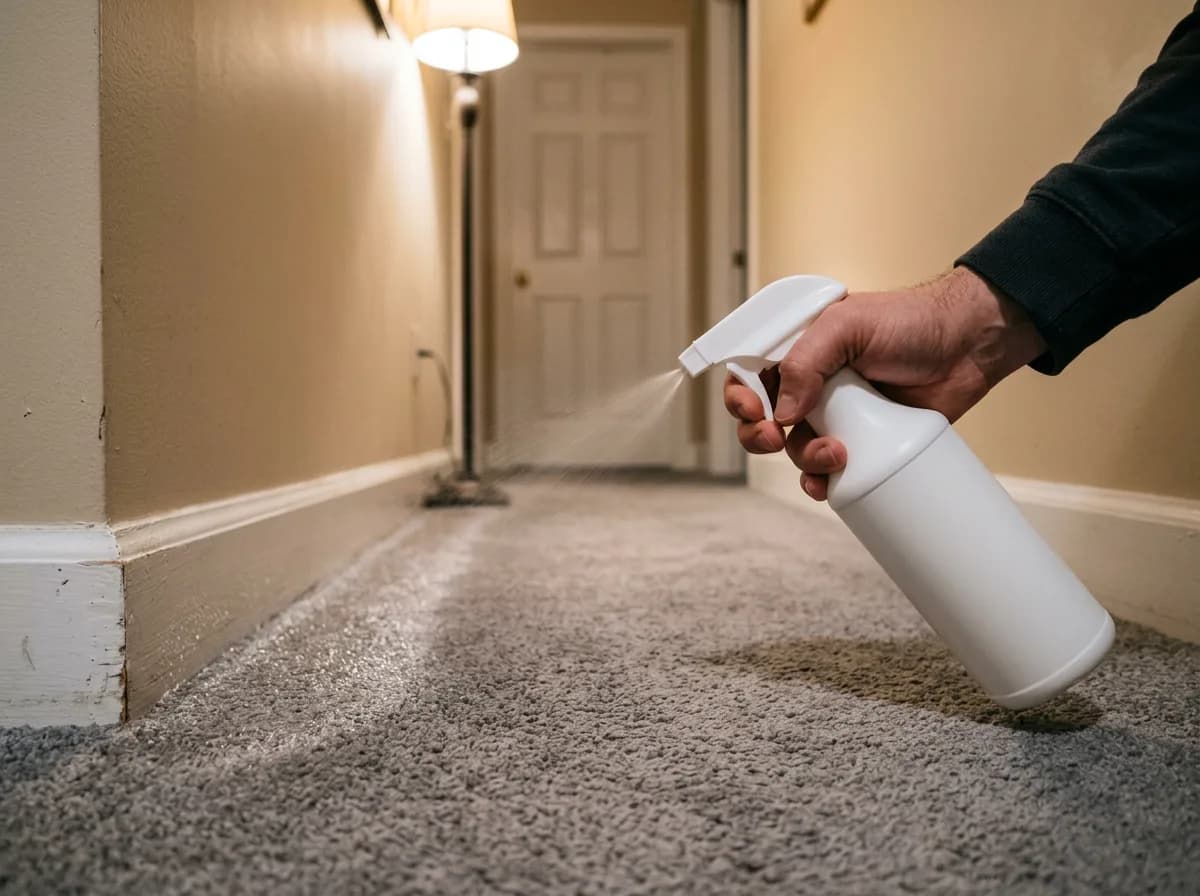
Work through the house in this order.
Petful may earn a commission when you click through to Chewy, at no extra cost to you.
- Carpet and rug edges: the perimeter where carpet meets skirting board holds the highest larval density in most homes. Treat a band at least 12 inches wide along every wall
- Under and behind furniture: move the sofa, do not spray around it. A flea couch spray applied only to the visible cushion misses the majority of the population
- Upholstery seams and cushion undersides: the piping, the gap where the back meets the seat, and the underside of every removable cushion
- Pet bedding and the pet’s favourite spots: wash bedding at 60°C first, then treat the surface underneath it. This is the highest-density flea site in most houses
- Hard floor cracks and crevices: gaps between floorboards, the edges of laminate, and the join under skirting boards
- Beds: if a pet sleeps on the bed, a flea spray for bed treatment means stripping and hot-washing all bedding, then treating the mattress seams and the base, not the sleeping surface itself
- Under-stair cupboards, closet floors and any room the pet enters: fleas do not respect the room you think of as “the dog’s room”
The floor spot your pet lies in most is the densest larval site in the house, and you cannot re-spray it every week: a washable pee pad laid over it strips off and goes through the same 60°C wash as the bedding, which removes eggs mechanically instead of chemically. Check whether the cover actually comes off before you treat a pet bed. A zip-off cover can be washed at 60°C, which kills every life stage, while a sealed foam bed can only be surface-misted, so a calming bolster bed with a removable cover is the more practical choice in a house that has had fleas more than once. A fabric-lined den is soft furnishing that almost everyone forgets to treat. A folding wire crate with a slide-out plastic tray wipes down in about two minutes and has no seams or piping for larvae to burrow into, which makes it far easier to keep clear than a padded enclosed bed.
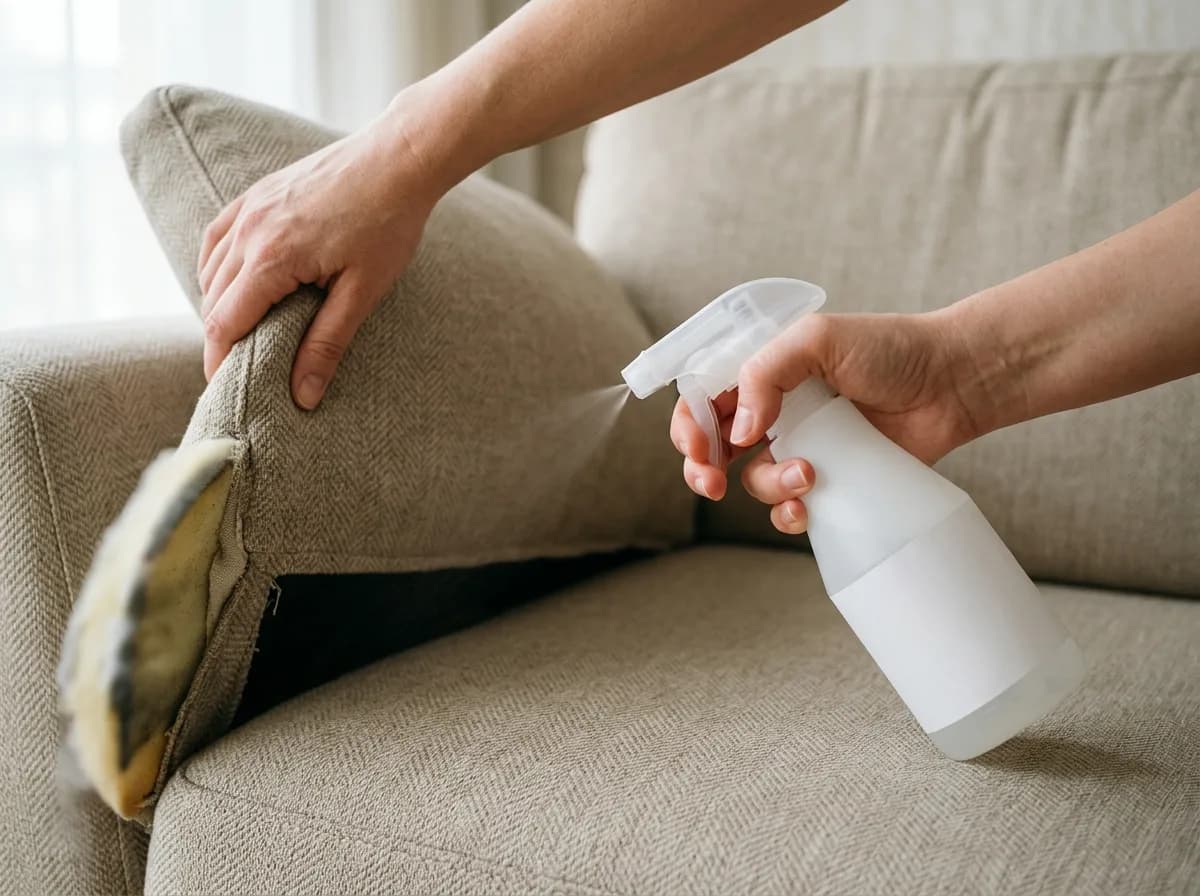
The application technique matters as much as the coverage. Hold a trigger sprayer or aerosol nozzle about 3 feet from the surface and sweep steadily. You want a light, even mist that just dampens the fiber, not a soaked patch. Over-application does not improve kill rate, it just wastes product and extends the drying time you have to keep pets out for. If you are using a diluted concentrate in a pump spray bottle, agitate it periodically so the mix stays even.
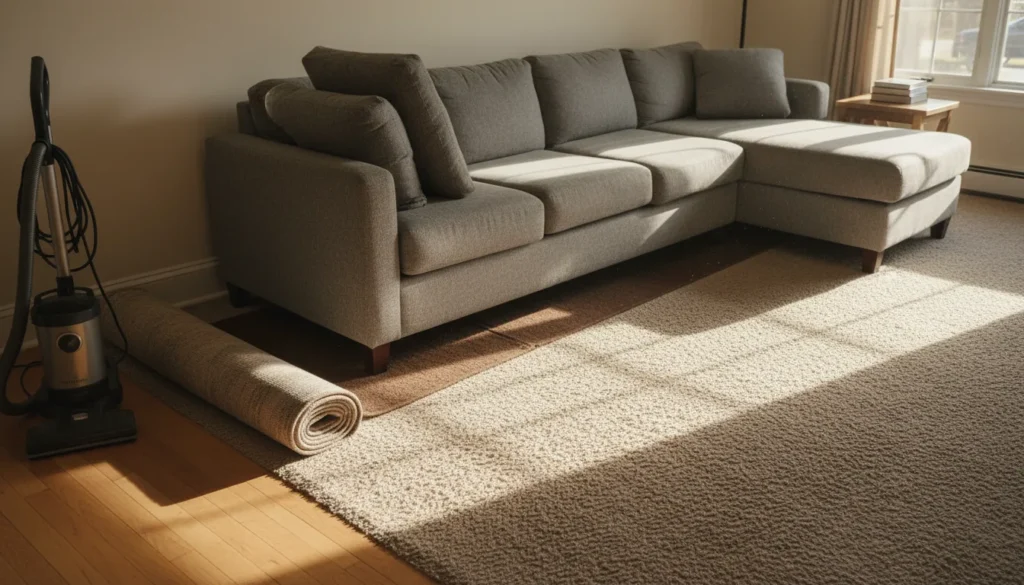
For a combined flea spray for carpet and furniture pass, treat the soft furnishings first and finish with the floor, so you are not walking across freshly treated carpet to get to the sofa. A proper flea furniture treatment reaches the seams, the piping and the cushion undersides, which is why a flea spray for couch surfaces alone leaves most of the population untouched. Then leave the room, ventilate it, and stay out until it is dry.
How to deflea a house step by step
To deflea a house, you treat every pet and every indoor surface in the same 24-hour period, then repeat the environmental treatment 10 to 21 days later to catch the pupal generation. Skipping either half of that, the pets or the second pass, is why infestations drag on for months. Here is the compressed sequence.
- Start the pets first. Every dog and cat in the home goes onto a vet-recommended flea product before you touch a spray can. Untreated pets re-seed the house continuously
- Strip and hot-wash all bedding. Pet beds, blankets, throws, and human bedding if pets sleep on it. Tumble dry on high
- Vacuum everything, then bin the bag. Floors, upholstery, under furniture, along skirting boards, up the stairs. Empty the canister or remove the bag straight into an outdoor bin
- Apply the spray at full label coverage. Work room by room, soft furnishings then floors, following the coverage area on the label rather than guessing
- Stay out until dry. Pets and children back in only once every surface is dry to the touch
- Vacuum daily for two weeks. This deliberately triggers pupal emergence onto treated surfaces
- Re-treat between day 10 and day 21. Same coverage, same rooms
- Keep prevention running year-round. Environmental control buys you a clean house, prevention is what keeps it clean
Drying time is the step people cut short, and “keep the pet out” only holds if there is a physical barrier. A pet gate and playpen closes off a treated room for the two to four hours carpet typically needs to dry to the touch, without shutting the animal in a bathroom for the afternoon. Food and water dishes have to leave the treated room, so set the temporary station up before you spray rather than after. A collapsible travel bowl folds flat and moves water into an untreated room for the day, which saves buying a second set of dishes for one afternoon. A confined pet with nothing to do will test the barrier for the entire drying window. An interactive puzzle feeder loaded with part of the day’s ration buys roughly 15 to 20 minutes of settled behavior per fill, which is usually enough to get one room dried without a standoff at the gate.
Our sister publication’s vet-reviewed walkthrough of how to get rid of fleas in your house and yard goes deeper on sequencing the indoor and outdoor halves together, and Petful’s own complete guide to getting rid of fleas in the house is the full step-by-step protocol this product guide sits underneath. Use this page to choose the product, use the pillar guide to run the process.
One clarification on that schedule, because this is where most people decide a spray failed. The second application is not insurance. It is the treatment for the pupal generation, which cannot be killed inside the cocoon and has to emerge onto a treated floor first. Seeing fleas again a week after you spray is the expected shape of the curve rather than evidence the product did nothing. Judge the result at the end of the re-treatment cycle, not in the middle of it.
- Expect a visible bounce somewhere between day 7 and day 21 as cocooned pupae hatch. That emergence is exactly what the second application exists to catch.
- In a cool or humid house the pupal window stretches, so plan a third pass at around day 30 rather than concluding the spray failed at week three.
- Do not skip vacuuming in the days before the second application. The vibration pulls pupae out of the cocoon and onto the surface you are about to re-treat.
- Count from the first application, not from the last flea you saw. A schedule anchored to sightings drifts and never closes the cycle.
- If counts are still climbing four weeks in with both applications done correctly, the cause is almost always an untreated pet, an untreated room or the yard rather than the product.
What kills fleas in the house fast?
A pyrethroid-based household flea spray kills adult fleas fastest, generally within minutes of direct contact, because permethrin, phenothrin, etofenprox and natural pyrethrins act directly on the flea’s nervous system. Vacuuming immediately before you spray is the second-fastest lever, since it lifts adults, eggs and larvae out of the pile and exposes what remains to the treatment.
Speed is only half the story though. Fast knockdown handles the fleas you can see today, and a product carrying an IGR handles the roughly 95 percent of the population you cannot. Anything sold on speed alone will disappoint you in week two.
What spray can I use to kill fleas in the house?
Use an EPA-registered premise spray labeled for indoor use on carpets and upholstery, and check that the label names the species living in your home. The realistic options are:
- Combination premise sprays such as Virbac Knockout E.S. or Precor 2000 Plus, which carry both an adulticide and an IGR
- Etofenprox-based household sprays such as Adams, when there are cats in the house
- IGR concentrates such as Precor IGR or Martin’s I.G. Regulator, diluted and applied with a pump sprayer, always paired with an adulticide
- Botanical contact sprays such as Vet’s Best, for spot treatment and light problems
- None of the above go on the animal. The on-pet counterpart is a flea and tick shampoo, which strips the adults already on the coat in one wash but leaves essentially no residual, so it is a same-day reset before the environmental work rather than ongoing control.
What you must not use is an on-animal spray on your carpets, a carpet spray on your animal, or a garden or agricultural insecticide indoors. Those are different registrations with different safety data, and mixing them up is how pets get hurt.
Once you have picked the type, work out how far one bottle actually goes, because an aerosol converts into treatable area differently from a concentrate. An aerosol prints a single coverage figure on the can, and that figure is one pass, not a season. A concentrate prints a mix rate instead, so bottle size and coverage sit one multiplication apart: at 1 oz per gallon per 1,500 square feet, every ounce in the bottle is worth 1,500 square feet of floor. Then count properly. Add up the square footage of every room the pet enters, double the total for the second application, and buy against that figure. This is the point where readers underbuy, and one short can is the most common reason an indoor treatment stalls in week two.
- Measure room by room: length times width, and only for the rooms your pet actually enters.
- Add roughly a third for upholstery, stairs and clutter, which soak up product faster than open floor does.
- Double the total before you compare it against the coverage figure printed on the label.
- A concentrate at 1 oz per gallon per 1,500 square feet turns each ounce into 1,500 square feet, so a small bottle can cover a large house.
- A label with no stated coverage area cannot be sized at all, which is reason enough to pick a different product.
How to permanently kill fleas in your house
There is no product that will permanently kill fleas in your house in one pass, and any label promising it is selling you the wrong expectation. What actually works is a sequence held for long enough to outlast the pupal stage: treat the pet, treat the environment with a spray carrying both an adulticide and a growth regulator, then vacuum and wash on a schedule for several weeks. Permanent is the wrong word for a single treatment and the right word for the routine, because ongoing on-pet prevention is what stops the next infestation from starting.
- Treat every pet in the home on the same day, not just the one you have seen scratching.
- Choose a spray that pairs an adulticide with an IGR so eggs and larvae are covered as well as adults.
- Vacuum daily for the first two weeks, and empty the canister or bin the bag outside each time.
- Wash all pet bedding hot, then repeat weekly through the treatment window.
- Expect a bounce around day 7 to 21 as pupae hatch. That is the cycle, not a failed product.
Permanent is the wrong word for any single treatment, because fleas are re-introduced every time a pet goes outside. What you can achieve is a house with no self-sustaining flea population, and that takes three things running together rather than one product working harder.
- Year-round prevention on every pet in the home. CAPC is explicit that every pet in the household has to be treated, not just the one that is scratching
- Two environmental treatments spaced 10 to 21 days apart, using a product with a growth-regulator residual so the carpet stays hostile to larvae for months
- Mechanical control that never stops: weekly vacuuming, regular hot-washing of pet bedding, and keeping the yard from becoming a reservoir
- If you find live adults on the pet on treatment day, an oral flea tablet clears them within about 30 minutes but is spent inside 24 hours, so it belongs alongside the year-round prevention your veterinarian recommends and never in place of it.
- Weekly grooming is the cheapest early-warning system in the house: work a slicker brush through the coat over a white towel, and black specks that smear rust-red when damp are flea dirt, which tells you the population is rebuilding weeks before anyone notices the pet scratching.
Homes that stay flea-free are not using a secret product. They are using an ordinary IGR spray on a correct schedule alongside consistent on-pet prevention, and they treat the house as maintained rather than cured.
Does Dawn soap get rid of flea eggs?
Dish soap kills adult fleas it directly contacts, by breaking the surface tension of water so the flea sinks and drowns, and by stripping the waxy cuticle that stops it dehydrating. It is genuinely useful in a bath or in a shallow bowl-and-nightlight trap. It does not get rid of flea eggs in any meaningful sense, because it has no residual activity at all and cannot reach eggs buried in carpet pile, upholstery seams or floorboard gaps.
Treat dish soap as a first-aid measure for a flea you can see right now, not as flea egg treatment. Killing eggs and larvae in the environment requires either physical removal by vacuuming and hot-washing, or an insect growth regulator that stops them developing.
Fleas already living in the carpet
If you are already finding flea dirt in the pile, fleas in carpet are the core of the infestation rather than a side effect of it, and carpet needs its own treatment sequence: vacuum, treat the edges and under furniture, then vacuum daily to force pupal emergence. Flea larvae in carpet migrate deep into the pile away from light, so surface misting alone will not reach them, and a flea carpet treatment applied without an IGR leaves the flea eggs in carpet fibers completely untouched. Any flea killer for carpet worth buying therefore has to carry a growth regulator, not just a knockdown active. Our complete guide to getting rid of fleas in the house carries the full carpet protocol, including how deep to work the product and how to handle a flea infestation in carpet that has been building for months.
Spray or fogger?
Flea bombs and a targeted flea spray are not interchangeable, and the honest answer to “do flea bombs work” is: partially, and less well than the label implies. A flea fogger releases insecticide upward and lets it settle, which means it lands on the tops of carpets and furniture but not under the sofa, in the seams or along the skirting boards where larvae actually live. If you are weighing a flea fogger for house treatment or hunting for the best flea bomb for house use, read our dedicated breakdown of whether flea foggers work first, because for most homes a directed spray outperforms a fogger at the same cost.
Where diatomaceous earth fits
Diatomaceous earth kills insects mechanically rather than chemically, by absorbing the oils and fats from the cuticle of the exoskeleton so the flea dries out. That makes diatomaceous earth powder for fleas a reasonable adjunct in cracks and low-traffic areas, with two hard caveats: only food-grade DE belongs anywhere near pets, because filter-grade and pool-grade products are calcined and carry far higher crystalline silica, and even food-grade DE irritates airways if it is inhaled. Using diatomaceous earth for fleas on carpet also means a fine dust in the exact space your pet breathes. Our full guide to diatomaceous earth for fleas covers grade selection, application and the limits of flea powder diatomaceous earth as a standalone answer.
Homemade and natural flea sprays
A homemade flea spray built on vinegar, lemon or dish soap will kill or repel individual fleas on contact, and that is genuinely useful between treatments. What DIY flea spray cannot do is provide growth-regulator coverage, so a natural flea spray used alone leaves the egg and larval population intact and the infestation simply cycles. If you want to make up a homemade flea spray for house use safely, particularly around cats, our guide to home remedies for fleas has the recipes worth using and the ingredients to avoid, because several popular homemade flea spray for home recipes involve essential oils that are genuinely dangerous to cats.
Using flea traps to check your progress
Flea traps are monitoring tools, not treatments, and that is exactly what makes them valuable after you spray. Indoor flea traps use light and warmth to draw emerging adults onto a sticky pad, giving you a nightly count that tells you whether the population is falling or whether the pupal window is still producing. Setting flea traps for home monitoring in the two rooms your pet uses most turns “I think it is getting better” into an actual number. Our guide to whether flea traps work explains placement, what a realistic catch rate looks like, and which of the best flea traps are worth the money.
Do not forget the yard
If a pet goes outside, indoor treatment alone is a leaking bucket. Yard flea spray targets the shaded, humid ground where larvae survive, which in practice means under decks, along fence lines, beneath shrubs and in any spot the dog lies down, not the open sunlit lawn where fleas cannot persist anyway. Anyone trying to kill fleas in yard conditions should read our guide to outdoor and yard flea treatment, which covers when an outdoor flea spray is warranted, which flea and tick spray for yard products are safe once dry, and how to time it against the indoor treatment.
If fleas keep coming back
Recurring fleas in house conditions almost always trace to one of four causes: an untreated pet, a missed second application, an outdoor reservoir, or wildlife under a deck or in a loft. The signs are consistent too, and knowing the fleas in house signs (flea dirt in bedding, ankle bites, a pet scratching at the tail base) helps you catch a rebuilding flea infestation early rather than at week six. The full diagnostic sequence for a stubborn recurrence lives in our complete guide to getting rid of fleas in the house, which covers the pupae reinfestation window in depth.
Treat the pet at the same time
No environmental product replaces veterinary flea prevention, and this is the single most important sentence in this guide. Modern flea control products for pets, including prescription flea pills, topical spot-ons, long-acting collars and flea shampoo for immediate relief, are what stop a pet re-seeding the carpet every single day. The CAPC flea guidelines are unambiguous on this: every pet in the home must be treated for control to be achieved. Talk to your veterinarian about which product suits each animal, then read our guide to the safest flea treatment for dogs and our sister publication’s vet-reviewed take on the safest flea treatment for dogs for the on-pet half of the job. Environmental spraying clears the house you already contaminated; prevention is what stops you contaminating it again tomorrow.
The division of labor
- Think of it as two jobs with two tools. Vet-prescribed on-pet prevention stops new eggs being laid. Household spray with an insect growth regulator clears the eggs and larvae already in your carpet. Do one without the other and the infestation persists, which is why so many owners feel like nothing is working.
Flea spray for house FAQ
Frequently Asked Questions
The best flea spray for home and furniture is a combination product carrying both a pyrethroid adulticide and an insect growth regulator. Virbac Knockout E.S. (pyriproxyfen plus permethrin, roughly 2,100 square feet per 16 oz can) and Precor 2000 Plus ((S)-methoprene plus permethrin and phenothrin, about 2,000 square feet per can) are the strongest consumer options. In a home with cats, Adams Flea and Tick Home Spray, which uses etofenprox alongside (S)-methoprene, is the better-tolerated choice. Whichever you pick, buy enough to cover every room the pet uses and plan a second application 10 to 21 days later.
No household pesticide is safe to spray onto a pet or to walk a pet through while wet, but several products are safe to use in a home with animals once applied correctly and allowed to dry. The safest flea spray for home use in a cat household is one built on etofenprox or on an insect growth regulator alone, since permethrin and phenothrin carry the highest feline risk. Botanical products using peppermint oil and clove-derived eugenol are the lowest-toxicity option but have no residual activity. In every case, remove pets from the room, ventilate it, and keep them out until every treated surface is completely dry.
Apply once, then repeat between day 10 and day 21. That second application is essential because flea pupae are protected inside a cocoon that no household spray penetrates, so the only way to kill that generation is to wait for it to emerge onto treated surfaces. In temperate conditions 90 to 95 percent of fleas emerge across 21 to 35 days, and in cool humid conditions pupae can stay dormant for up to 30 weeks. If the product carries a growth regulator with a seven-month residual, two applications are usually enough, backed by weekly vacuuming and year-round prevention on every pet.
Yes, but the active ingredient matters enormously. Permethrin kills cats at the high concentrations found in canine spot-on products, and even the 0.35 to 0.40 percent found in premise sprays is a reason to exclude cats from a treated room until every surface is bone dry. A cat safe formula leans on etofenprox for adult kill or uses methoprene or pyriproxyfen alone with no adulticide at all. Never apply a product labeled for dogs only to a cat, and never spray a premise product directly onto any animal.
A standard 16 oz aerosol premise spray treats roughly 2,000 to 2,100 square feet of floor and furniture, and one bottle covers about one average storey rather than a whole house. IGR concentrates go further per unit: 1 fl oz diluted in a gallon of water covers about 1,500 square feet. Work out the treatable square feet of every room your pet enters, then double it, because the protocol requires a second full application 10 to 21 days after the first. Underbuying is the most common reason indoor flea treatment appears to fail.
Only if it contains an insect growth regulator. Methoprene and pyriproxyfen are synthetic analogues of insect juvenile hormone: they have ovicidal activity, so treated eggs never hatch, and larvae exposed to them cannot complete metamorphosis. A pyrethroid adulticide on its own kills adult fleas but leaves the egg bank in your carpet fully intact, which is why fleas reappear a week or two after a knockdown-only treatment. Check the active ingredient panel on the back of the can for methoprene or pyriproxyfen before you buy.
Yes. Environmental spraying and on-pet prevention solve different halves of the same problem and neither works alone. Household spray clears the eggs, larvae and adults already in your carpet and furniture; vet-recommended prevention stops the pet laying a fresh crop of eggs into that carpet every day. The Companion Animal Parasite Council is explicit that every pet in the home must be treated for control to be achieved. Speak to your veterinarian about which prevention product suits each animal in the household.

BVMS, MRCVS
Dr. Pippa Elliott, BVMS, MRCVS, is a veterinarian with nearly 30 years of experience in companion animal practice. Dr. Elliott earned her Bachelor of Veterinary Medicine and Surgery from the University of Glasgow. She was also designated a Member of the Royal College of Veterinary Surgeons. Married with 2 grown-up kids, Dr. Elliott has a naughty Puggle named Poggle, 3 cats and a bearded dragon.