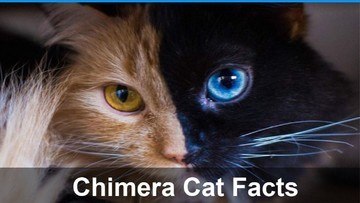

Have you ever heard of a “split-faced” cat, or a “two-faced cat”? These are names often used to describe a chimera, and there are some pretty famous ones out there. If you haven’t heard of these chimera cats yet, read on to meet them!
What is a Chimera Cat?
The simplest explanation is that a chimera cat has one color scheme on half of its face and/or body and another on the other half. The line that separates them is sometimes uncannily straight, making the face look like Mother Nature was having a little joke—trying to blend two cats into one.
Which is actually not far from the truth.
If you’re familiar with the chimera of Greek mythology, you would be forgiven for thinking the chimera is a magical cat. The chimera from Homer’s Iliad was a fire-breathing monster with the head of a lion, a goat’s body, and a serpent’s tale.
But the feline chimera is a more down-to-earth creature with a logical scientific explanation.
What Causes the Chimera Phenomenon?
A chimera cat is one cat that started out as two. Chimera cats have two sets of DNA because a pair of embryos fused together early in the mother’s womb. So, chimera kittens are born with their own individual DNA, plus the DNA from a second embryo. (Some like to say that a chimera is its own identical twin.)
The newborn kittens can be born with coloration differences so slight that it’s not really noticeable or with differences that can’t be seen. Occasionally, though, one will show a difference that’s so dramatic that it’s startling.
Why Do Some Chimera Cats Have Different-Colored Eyes?
Chimeras will often have eyes that don’t match. This can be
the most noticeable feature of some chimeras. It’s a phenomenon called heterochromia.
Most cats with “odd eyes,” as it’s often called, are not chimeras, But it is more likely to happen with chimeras because of the two sets of DNA these cats have. They get one color from their own DNA and another from the second set.
Are Calicos and Tortoiseshells Chimera Cats?
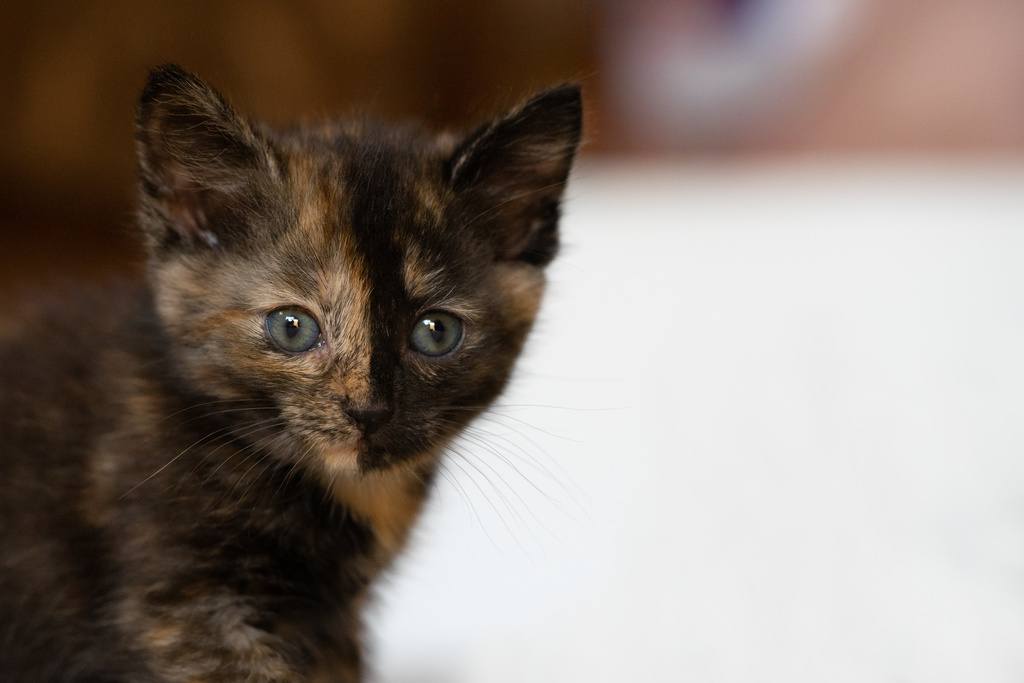
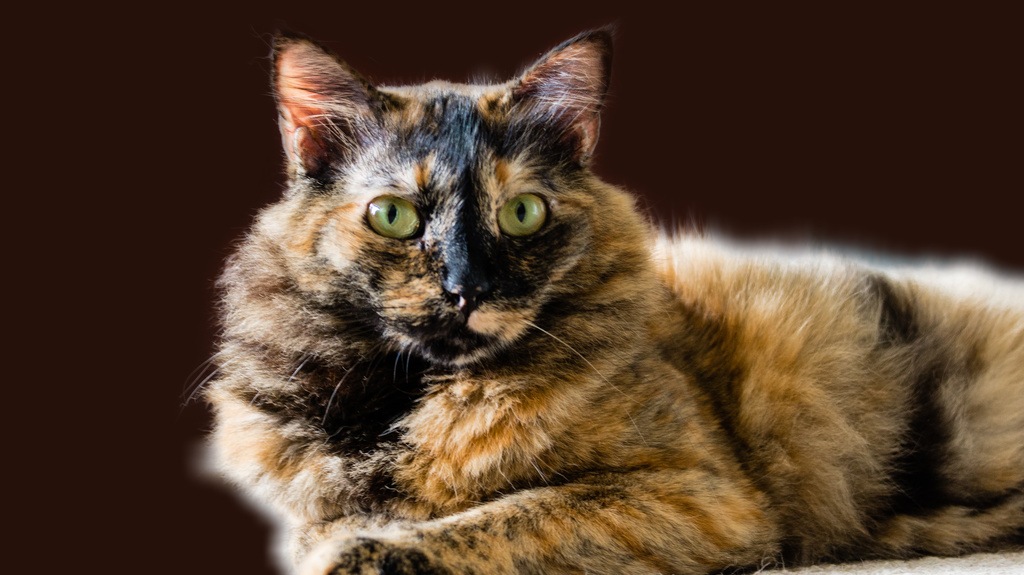
Calicos and tortoiseshell cats often look like chimeras, but most are not. Most of these cats are females, but once in a great while a male will be born. Chances are good that that male will be a chimera.
This happens because of the XX sex chromosomes that females
carry and the XY of the males. The mother and the father each pass one
chromosome on to the offspring.
Like humans, the mother cat can only contribute an X, but
the father can pass an X or a Y. If he contributes the X, the offspring will be
XX, or female. If he contributes the Y, the offspring will be XY, or male.
The gene for calico and tortoiseshell coats is only carried on
the X chromosome, so dad’s Y can’t produce a calico or tortie. Therefore, nearly
all cats with these color patterns are female (X from mom and X from dad equals
XX, or female).
Once in a while, an embryo fusion will take place. If one of the fused embryos were female and one was male, that cat could be male. That male is more than likely to be a chimera (but again, not always).
Unfortunately, male torties and calicos will remain rare
because most of them are sterile.
How Do I Know if My
Cat’s a Chimera?
The differences caused by chimerism can be subtle, so your cat could be a chimera even if it’s not obvious. On the other hand, a calico or tortoiseshell’s natural coat pattern may look like a chimera’s when it’s not. The only way to know for sure is to have your cat DNA tested.
Will A Chimera Cat Have
Chimera Kittens?
Chimerism can be hereditary, according to Healthline. Depending
on which parts of the mother’s body the second set of DNA affects, it is
possible for a mother to pass two sets of DNA to the kittens, resulting in a
chimera.
But this is impossible to predict. Even if you DNA tested the mother,
there is no way to know which traits she will pass on to her kittens or which
they will inherit from their father.
Chimera Cat Traits and Personality
Because chimerism is not a breed but a genetic phenomenon that can happen to any cat, there is no one personality type and no standard traits. Chimeras will have all of the natural variety of the feline species.
Famous Chimera Cats
If you already know about chimeras, chances are you’re
familiar with one of the famous chimera cats that have become popular through
Instagram and other online sites.
We do need to point out, though, that without DNA tests,
it’s impossible to tell if these cats truly are chimeras. According to geneticist
Dr. Virginia Papaioannou in an interview with The
New Republic, they could just have coincidental color patterns.
Either way, we think they’re adorable!
Venus
Venus may be the first well-known chimera cat. She has a striking two-colored face with orange on the left and black on the right.
She also has heterochromia with one blue eye and one green.
Venus has a large following on Instagram and her Facebook page. She
also has her own merchandise, including a stuffed animal version of herself and
a calendar. She even made an appearance on ABC’s Good
Morning America.
Narnia
Narnia is a gorgeous British Shorthair bred and owned by Stéphanie
Jimenez of the Grace Cattery in France. His body is black, but half of his face
is blue (cat talk for a color that’s more like slate gray), and the other half
is black. Both of his eyes are blue.
Like Venus, Narnia has a large following on both Facebook and Instagram.
Quimera
Quimera is, interestingly, almost the mirror image of Venus.
Her face has black on the left and orange on the right. She also has one green
eye and one blue. See Quimera on Instagram, or check out this story
about her at People.com.
Yana
Yana is another tortoiseshell cat with features of a chimera.
She is owned by a woman named Elizabeth from Belarus, who found her through a
classified ad when she was just a kitten. Yana also has the split facial
coloring, but unlike Venus and Quimera, her eyes are both green. You can visit
with Yana as a kitten on her Instagram
page.
How Common Are Chimera
Cats?
Chimeras with the dramatic facial features we see in Venus
and Narnia are very rare. But chimerism may be much more common than we’d think.
A cat could have more than one set of DNA, but sometimes the parts of the body
that are affected aren’t visible.
For example, some chimeras are born with two blood types
mixed in their veins. Others are born with both male and female reproductive
organs but might appear female from the exterior with their male organs tucked
inside.
In cases like that, only DNA testing (or surgery) would
prove if the animal were a chimera.
Chimera Cat versus Janus Cat
Because we often hear the chimera called a “two-faced cat,” it’s
easy to confuse them with another cat that shares that nickname. Obviously, chimeras
have only one face. But occasionally a cat will be born with two actual
faces.
These are the real two-faced cats, and they’re called Janus
cats. They’re named for the Roman god Janus, who was said to have two faces so
he could see back into the past and forward into the future.
Janus cats are extremely rare and
very few live beyond a few days. But some beat the odds. This CNN
video features two Janus cats. One is a just-born kitten, and the other is
the longest surviving Janus cat, named Frank and Louie.
Frank and Louie (whom the media
cruelly nicknamed Frankenlouie) made it into the Guinness Book of World Records
when he was 12 for the longest-surviving Janus cat. He was 14 years old at the
time of this video.
Where Can I Find a Chimera
Kitten for Sale?
The short answer is that you probably can’t. Again, because
chimeras aren’t a breed but only a genetic variation, you can’t just shop for one.
Unfortunately, there is no such thing as a chimera cat
breeder. You can visit shelters and
rescues and watch classified ads, and one day you might get lucky. (After all, Elizabeth
found Yana through a classified ad!)
But finding a true chimera cat (or even a cat that looks
like one) is probably less likely than finding a four-leaf clover in your
backyard.
If you did get lucky and find one, it would be impossible to
predict a chimera cat price. Because of
their rarity, even if you were to find someone willing to part with one, if
they knew the value of what they had, the price would probably be high.
Can Humans Be Chimeras?
Yes! But you probably wouldn’t know it in most cases. There
are a few famous examples of human chimeras who only found out because of DNA
testing done for other reasons. To learn more about them, check out this
article at Scientific
American.
Not only can it happen with cats and humans, but chimerism occurs
with other animals as well. For some interesting possibilities, check out this
story on Weird
Nature. While we can’t guarantee
that these are all legitimate chimeras, it’s scientifically possible.
A Final Note
Dr. Leslie Lyons, a professor at the University of California Davis, in an interview with National Geographic about Venus, explains that her unique coloration can be explained by the natural course of genetics, that she may not be a chimera. She also says that her theory doesn’t explain Venus’s one blue eye, however. She concludes, “She is a bit of a mystery.”
Isn’t that wonderful?