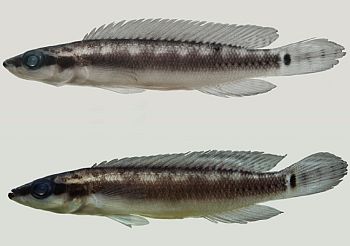

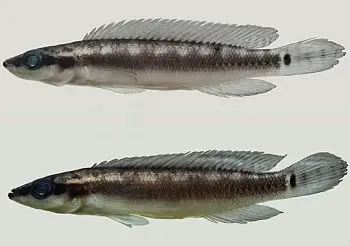
Crenicichla anamiri, holotype, male, INPA 46650, 42.9 mm SL, Itapuama, below confluence with rio Iriri, State of Pará, rio Xingu (above); paratype, female, INPA 46651, 43.3 mm SL, same locality of holotype (below). © Douglas Bastos
The dwarf pike cichlid known to aquarium hobbyists as Crenicichla sp. cf. regani ‘Xingu’ for more than two decades is described as C. anamiri Ito & Rapp Py-Daniel 2015 in the latest issue of the journal ‘Neotropical Ichthyology’.
It can be distinguished from all congeners except C. notophthalmus, C. regani, C. urosema, and C. virgatula by the presence (vs. absence) of serrations on the supracleithrum (vs. absent). It differs from C. notophthalmus and C. regani by the presence of a black vertical elliptic blotch on the centre of the caudal-fin base (vs. an ocellated blotch on the dorsal portion of the caudal-fin base), from C. regani, C. urosema and C. virgatula by possession of two to four rows (vs. more than four rows) of teeth in both jaws, and from C. virgatula and C. urosema by the presence (vs. absence) of vertical bars on the caudal-fin.
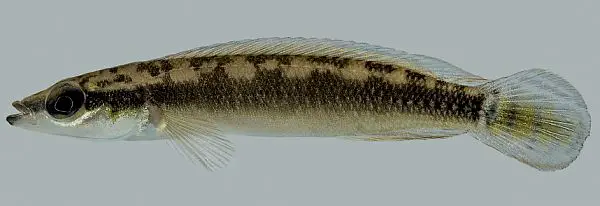
Crenicichla anamiri, live specimen, paratype, INPA 46651, 43.3 mm SL, Brazil, State of Pará, Itapuama, rio Xingu. © Leandro Sousa
The new species is known from a number of localities in the middle rio Xingu basin, Brazil, upstream of Belo Monte and in the vicinity of Altamira. This area is due to be affected by completion of the Belo Monte dam, although C. anamiri is less likely to be affected than those species inhabiting flowing water since it appears to favour marginal sandy areas with submerged tree roots.
The species name is derived from the tupi-guarani word ‘Anãmiri’, which transates as ‘dwarf’, in reference to its small adult size. Among the type series the largest individual measured just 47.8 mm SL.
Matt Ford
For further information see the full, open access paper: Ito, P. M. M. and L. H. Rapp Py-Daniel, 2015. A small new species of Crenicichla Heckel, 1840 from middle rio Xingu, Brazil (Teleostei: Cichlidae). Neotropical Ichthyology 13(3): 471-478.