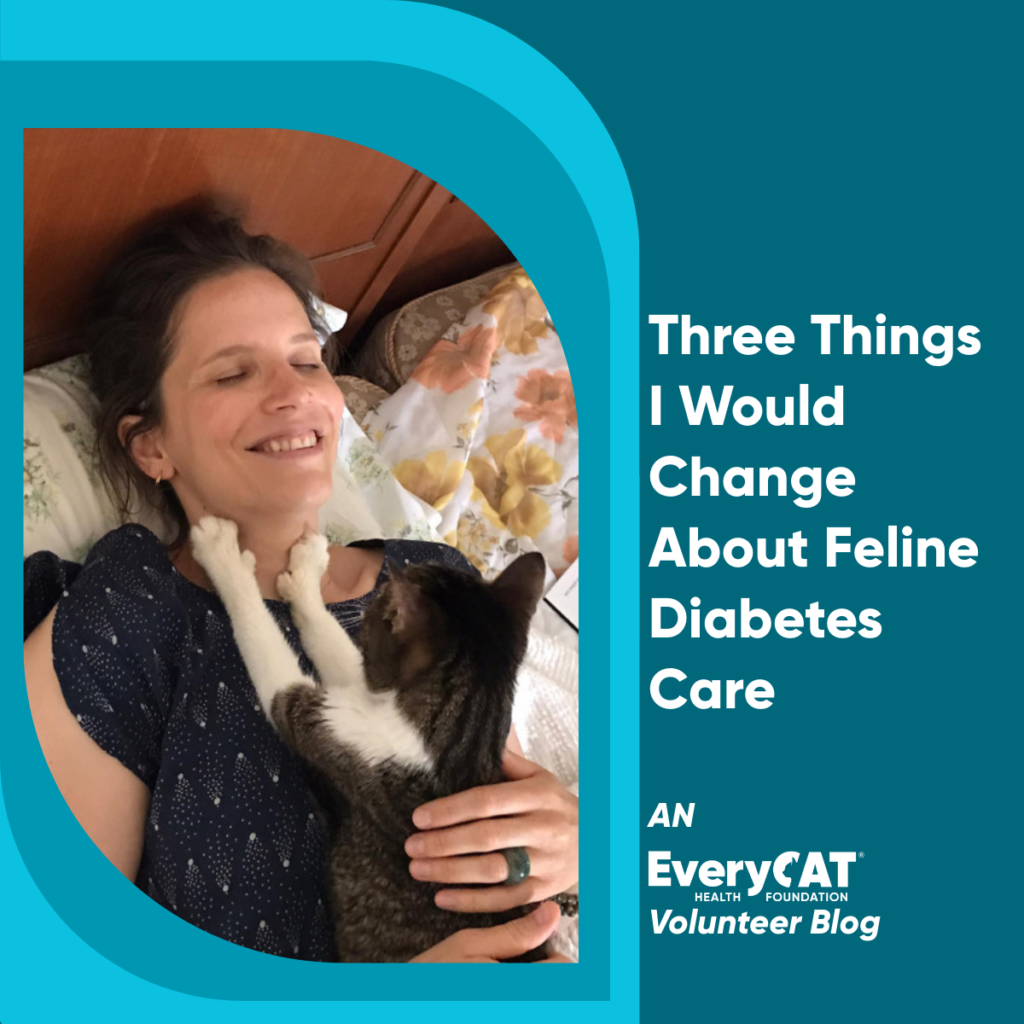

My Mosi was diagnosed with diabetes at 17. We shared four more years. I often struggled to manage her condition. If I could wave a magic wand and change three things about feline diabetes care, here’s what they would be.
1. Glucose Monitoring
Glucose monitoring was excruciatingly difficult.
In cats, blood glucose levels are typically measured from the ears or the toes. To obtain enough blood from the toes requires using a relatively large-gauge needle — something I was never comfortable doing. For toe sampling, standard human finger-prick devices cannot be used. Ear sampling is considered easier, but “easier” is relative. First, you have to get your cat to sit calmly on your lap. Then you need to warm the ear — but not too much, or you risk excessive bleeding. I usually warmed Mosi’s ears with a sock filled with salt and heated in the microwave. Then I applied a tiny bit of Vaseline so the blood wouldn’t disappear into the fur. You have to prick near, but not into, a vein. Then quickly slide the measuring strip into the blood drop before it clots, all while keeping your cat still. Sometimes, it looked like there would be enough blood for a reading, but there wasn’t. The blood would stop halfway up the measuring strip. The glucometer would flash an error message, and I would have to start over. I read extensively and practiced every recommended technique. Still, too often, I had to attempt multiple pricks before getting a readable sample. Other times, I drew too much blood and made Mosi wince. I wanted to help her. I didn’t want to hurt her. And yet, there I was, poking her ears repeatedly, trying to get a reading that would guide her insulin dose. It was beyond stressful for both of us. I sometimes cried from frustration.
Over time, her ears developed scarring. Toward the end of her life, I accidentally hit a vein at the tip of her left ear. The damage was severe. We treated it for weeks with anti-bruising cream, but the tip necrotized and eventually fell off. I was devastated. Fortunately, it came off on its own. At her age and in her frail state, surgery was not an option. At one point, our vet suggested trying a continuous glucose monitor designed for humans and used off-label in animals. I had high hopes. We tried three monitors. One failed to activate, and the others stopped working well before the promised 14-day period ended. Each required shaving, surgical glue, and stressful removal from her fragile skin. Mosi hated the small shirt used to secure the device, which restricted her already limited movement due to arthritis. I liked the idea of continuous monitoring. It meant not having to prick her ears or inject insulin without knowing her blood glucose levels. But I couldn’t justify repeatedly putting her through the stress of vet visits, shaving, glue, malfunctioning devices, and difficult removals. We need continuous glucose monitors designed specifically for cats: tailored to feline body morphology, smaller, lighter, and gentle enough for thin or elderly cats. They should be easy to apply and remove at home. They should work reliably.
We also need better cat-specific glucometers. My veterinarians recommended a human device — the same brand they used at the clinic — so that’s what I used. Later, I learned that feline physiology differs enough that animal-calibrated meters may provide more accurate readings. I tried switching, but the scale and instructions were confusing, so I sent it back. Managing feline diabetes should not feel like a constant technical experiment.
2. Injection Best Practices
In the beginning, injections were manageable. We found a rhythm. However, we could not alternate injection sites as many guidelines recommend because different areas appeared to cause Mosi discomfort. At one point, I learned about injection pens. But the pen produced a loud clicking noise. Mosi had an auditory disorder, and clicking-type sounds triggered seizures. That option was immediately off the table. When Mosi lost significant weight in her final year of life, injections became much more complicated. I kept accidentally injecting insulin into her fur instead of under the skin. Standard advice says not to re-inject in case some insulin has already gone in, because the risk of a too-high dose is life-threatening hypoglycemia. I followed that guidance rigidly, even when I was nearly certain the dose had not been delivered. In retrospect, I probably should have taken that risk occasionally. But at the time, I was terrified of making a mistake and harming her or even putting her life at risk. I tried to improve my injection technique and looked for guidance specific to thin cats. Most instructional videos featured cats of average weight with generous skin folds. Eventually, we shaved the area between Mosi’s shoulder blades. It became the only reliable way to ensure the insulin actually went in.
We need better, quieter injection pens designed for feline use. And we need clear, practical guidance for injecting thin or frail cats, not just easy, perfect examples. Real cats age. Real cats lose weight. Care instructions must reflect that reality.
3. Veterinary Guidance and Education
Despite regular appointments at a large, reputable clinic, including with a diabetes specialist, I often felt that I did not have enough guidance. At Mosi’s initial diabetes appointment, I was told that I could reuse each syringe twice. I don’t know what drove that recommendation. I followed that advice for years. Later, I began worrying about contaminating the insulin, which must be stored carefully and rolled rather than shaken before use. I stopped reusing syringes and felt guilty that I hadn’t done so sooner. Even later, I found conflicting information about needle reuse. I would have preferred clear, consistent guidance from the start. The handout sheet we received at diagnosis said nothing about injection technique. I later learned from online research that holding the needle bevel-side up can help the needle slide in more smoothly and reduce discomfort. I wasn’t told about discarding insulin after 20 days. I discovered that detail by using a magnifying glass to read the tiny print on the vial.We also learned too late that early, tightly regulated treatment in the first months after diagnosis can sometimes lead to remission in cats. I was a dedicated, proactive, and well-resourced caregiver. We sought help frequently: regular clinic visits, occasional home visits, even emergency care for hypoglycemia. Yet I often felt that Mosi and I were alone in our fight against diabetes. I wish I had had easier access to real-time guidance tailored to her situation. I suspect many other caregivers feel the same.
How could this be improved? Caregivers should be provided clearer, more comprehensive information at diagnosis and more through structured follow-ups. In addition, for caretakers of animals with chronic illnesses such as diabetes, who require more extensive care, clinics could offer video consultations or subscription-style access to a veterinarian or veterinary nurse for ongoing support.
My hope is that feline diabetes care will continue to improve with the help of research and education funded by EveryCat Health Foundation. The changes I’ve described are practical necessities and getting them right would significantly improve the lives of diabetic cats and their caretakers. ~Katia Colitti
Join EveryCat Health Foundation during our 2026 “Springing into Action” campaign and help us fund on-going diabetes studies! Donate to The O’Malley Fund for Diabetes and Endocrinopathies HERE. Together, we can make a difference for cats.
 About the Author:
Katia Colitti is a Ukrainian-American lawyer living and working in Belgium. A lifelong cat lover, for nearly two decades, she has shared her home with three rescue cats. Katia holds an MSc, International Animal Welfare, Ethics, and Law from The Royal (Dick) School of Veterinary Studies, The University of Edinburgh and has published and presented on animal welfare issues. Katia has extensive experience and deep interest in caring for geriatric and diabetic cats.