
If you’ve ever wondered what it’s really like to travel with parrots, you’re in the right place. I have traveled with my birds by plane in cabin many times, by car, and towing RVs with dedicated bird rooms. We have stayed in Airbnbs, hotels, rustic cabins, and of course, our RV. Every trip has taught me something new and helped me be even better prepared for the next one. Here, I share what I have learned and the tips that have made traveling with my parrots easier and more enjoyable.
A smooth trip always starts with preparation well ahead of departing! Winging it (pun intended 😜) is not my recommendation for successful travel with parrots!
Making reservations and training your bird to be comfortable going into and spending time in their crate should happen weeks if not months ahead of time.

Coco the Scarlet Macaw feels right at home in her crate 🥰
Crate Training Should Begin Now
If your bird is not completely comfortable with going in and out of a crate make a training plan well ahead of time to work on this behavior so your bird can be more at ease during travel. This will also allow you to relax knowing that when it is time to hit the road or the airport that your bird has the crating behavior down pat. Here’s a playlist of Crate Training videos to help you get started. 😊 Need one-on-one help? Book a consult today to get your bird travel ready.
Pet-friendly does not always translate to parrot-friendly
Don’t leave accommodations to chance! It is important to call ahead of time and make sure that the pet-friendly hotel or airline is in fact parrot-friendly! Not all are! Also, when it comes to Airbnb’s that are NOT pet-friendly, don’t be afraid to contact the owner or management company to see if they will make an exception for your caged parrot(s). Myself and other freeflight graduates have been successful with this many times! Just leave it clean when you leave so they stay open-minded to the next bird owner.

Baby Halo and I in a hotel on our way to see Jamie
Preparing to Travel on a Plane with your Parrot
There are two ways to travel with your bird via plane (well besides chartering a private plane or flying your own) either in cabin or by cargo transport.
My preferred option is in cabin. Not all birds qualify for this option though, either because they are too big to fit under the seat in a regulation size carrier or due to individual airline restrictions.
I have traveled many times in cabin with my birds. I use a carrier that meets the regulation requirements set by the airlines and has stainless steel mesh to prevent the parrot from chewing its way out mid flight.
When your bird travels via cargo it will be important to prepare your crate ahead of time. Airlines have strict instructions that must be followed to the letter or you can be rejected from getting your bird on board. Here is a video that goes over all of this in great detail – How to Travel on Airlines With Parrots. Also, be prepared to be at the airport cargo drop off a few hours ahead of the flight departure time.

Zip and Zoom traveling from me to Jamie via cargo
Make sure that you check with the airline for their specific requirements for both options. You must call the airline directly to reserve a spot for your parrot ahead of time. There is a limit on how many animals can be on board and it is on a first-come, first-basis.
Check with the airline for the requirements of a health certificate as well. Not all airlines require them but if they do, you won’t be able to travel without it. Not every avian or exotic veterinarian are licensed to issue health certificates so be sure to check ahead of time to see if yours does.
Car travel requires advanced planning as well!
My first concern when traveling with my parrots in a car is to prevent breaking down! Parrots are sensitive to temperatures both hot and cold and the last place I want to be is stranded on the side of the road in the middle of nowhere. So car maintenance is always a part of my prep plan. Oil changes and tire checks are the most obvious but if you have not had that check engine light checked yet, now would be the time!
Always travel with blankets in the cold temps to cover the cages if needed and lots of water no matter the temps!
Making sure you have restraints for the crates or backpacks is also important. This blog post will go over recommendations for securing your parrot’s carrier in the car to assure their safety in the event of a fast stop or accident – Restraining A Bird In A Car
It’s Almost Go Time!
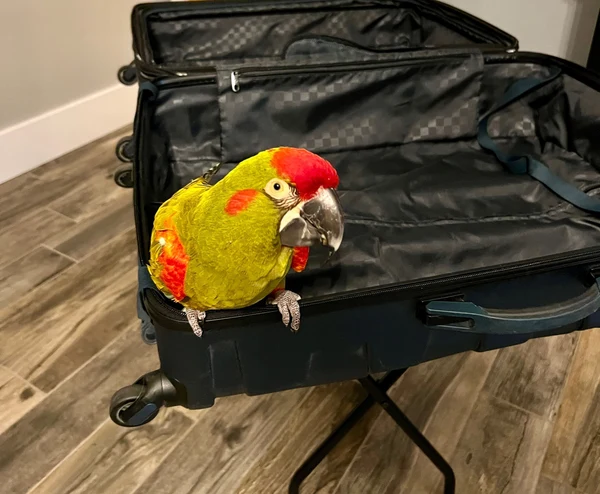
Staying organized during packing
When packing for your trip it is important to make sure that not only do you have enough supplies for the days you plan on being away but also bring extra just in case you have an unexpected delay with your return. When in doubt – DON’T leave it out! Finding bird supplies that are of good quality can be more challenging than finding dog or cat supplies especially if you are traveling in remote areas.
Here is a list of what I pack when traveling with my birds. I keep this list in a spreadsheet that I can open each time I am packing for a trip.
- Scale
- SFS – Frozen (I use a plug-in ice chest to transport this)
- SFS – Freeze dried (just in case my frozen chop thaws by mistake or for convenience)
- Pellets
- Bottled water
- Paper for cages
- Cleaning supplies
- Toys
- Perches
- Folding cat cage or large dog crate (will explain this in part 2)
- Spray bottles (for showering birds)
- Humidifier (important if traveling to a dry climate)
- Treat pouch
- Target stick and clicker
- Extra treats
- Training stand
- Extra bowls
- Bowl holders
- Harness for Halo (he is the only one I use a harness with)
- Sweet potatoes (this comes in handy as a binder to encourage a bird to eat on the road.)
- Temp gauge for RV (I use the brand Waggle)
- Printed Lost Poster for Each Bird (hopefully never needed but important to have in case your bird accidentally gets out)
- Locks for Twitch’s cages and crates (it’s a Blue Throated Macaw thing… LOL)
** there is more but the rest is all related to freeflight supplies

Ready to hit the road with Twitch and Ricochet (he is in the backpack)
The Night Before I Leave
I always have my crates ready to go with clean bowls, perches, toys and locks (if it is Twitch, lol) the night before. If traveling by car I put them to bed 12 hours ahead of when we are leaving if possible so they start out the trip well rested. If traveling by plane in cabin, I actually am ok with them getting a little less sleep so they are willing to nap in the dark carrier.
I double check my packing list, turn on my ice chest to cool down if I am using one, gas up the car (or make sure I am checked in for my flight) and then try to get a good night sleep myself.
Travel Day!
Car:
The morning of, everyone’s breakfast is waiting in their crates so they have motivation to go in their crates and to keep them busy as we hit the road. The only exception to this rule is for my conure, Piper. She gets car sick so I have found that waiting to feed her for at least an hour after we are driving she does much better. I also cover her cage on the sides so she can only see out the front which seems to also help a ton!
Every bird handles car travel a bit differently. Most will take it in stride but issues can come up. My first piece of advice is to expect there to be vocalizations. Sometimes I play music and that works, other times my parrots settle down more with an audiobook playing and other times we drive in complete silence. Whatever seems to be working in the moment is what we do.
Hopefully your bird stays engaged with toys during travel! A busy bird tends to be a quieter bird! When choosing toys for the trip give your birds toys that are on the softer side if you are hanging them for safety purposes. I use side mounted toys to offer harder woods to the bigger beaks without the risk of them being hit with the heavier toys during travel.

Twitch will severe the hanger on toys so I hang his up from the car outside of his cage!
When I have to stop to go to the restroom I turn on the auto start to run the A/C when I am inside and lock up the car. I find that my parrots are typically very quiet when left in the car. I think it comes from them being insecure in a strange environment without me and so instinct kicks in and they stay quiet. I was so pleased with this the first time I traveled alone with them.
If you are traveling at sunset there will be vocalizing from the time the sun starts to go down until it is completely dark, unless you cover their crates ahead of time. My african grey, Reggie, has to be covered before it gets dark because he gets freaked out by the headlights from oncoming traffic and panics.
I do have a rule with most of my parrots while traveling in a car which is, I rarely make the decision to take them out of their crate. I don’t want to risk a bird refusing to go back into the crate and delaying us getting back on the road. I just want to get where we are going just as quickly as we can so they can settle in for the night and get quality sleep.
When you stop anywhere look back and check everyone is still securely in their crates before opening doors. I failed to do this once and opened the door at a gas station on a windy day to Ricochet sitting in his crate but he had opened the door to his crate and left it wide open. Thank goodness he wasn’t out on top of the crate as that could have been a disaster!
Plane:
When traveling in cabin or cargo (specifically on Alaskan Airlines as of the time of writing this article) you will need to take your bird out of its crate for a security check so in these situations I hold back breakfast until I am putting them back into their crate at the airport. This way I know that my bird will be more motivated to take treats for the crating behavior at the airport. I typically use pellets for airline travel to make this easier and cleaner. With most other airlines that ship birds cargo you will not need to do this step so I would load them up with their breakfast ahead of time. Be sure to talk to the airline you are traveling with to get the specifics on what this will look like for you and your bird.
When you go through security with your bird you will need to take them out so make sure you have your treats on hand. You and your bird will be in a secured room while a TSA agent runs the crate through the x-ray. One agent will stay with you and your bird. If the room is open at the top (as some are), don’t be afraid to speak up and insist on a completely closed space to assure your bird can not fly out of the room into the main airport area. If there is any doubt about your bird cooperating with this process then training them to be toweled ahead of time could be helpful.

Taking my project bird, Delta, to her forever home on Delta Airlines, LOL
Anytime I have traveled with my parrots in cabin, after the security check I close up all the flaps on the carrier to keep them quiet while in the terminal and on the plane. Most parrots will naturally go quiet in the dark. Once I close those flaps, I don’t peek! Peeking just encourages vocalizations. You can be asked to deplane if noise becomes an issue.
I will also add one more tip that can be the most important when it comes to keeping your bird quiet during the flight. Don’t be social with those sitting around you, LOL! I don’t know about your flock but mine like to vocalize when they hear my voice. So I always become even more of an introvert than usual to avoid conversations that could trigger my bird to scream. I figure being unsocial is better than subjecting them to a discontent parrot during their flight.
I hope this blog has helped you feel more prepared for getting ready for and traveling with your parrot! Stay tuned for part 2 which will be all about setting you and your flock up for a low stress stay away from home! I say low stress because there is always stress when traveling with parrots but the more prepared we are ahead of time the more we can minimize that stress.
To be continued…
Article by Kim Russell, Parrot Behavior and Diet Consultant (she is not currently taking new clients) but if you find yourself in need of support you can book with our other wonderful consultants here.