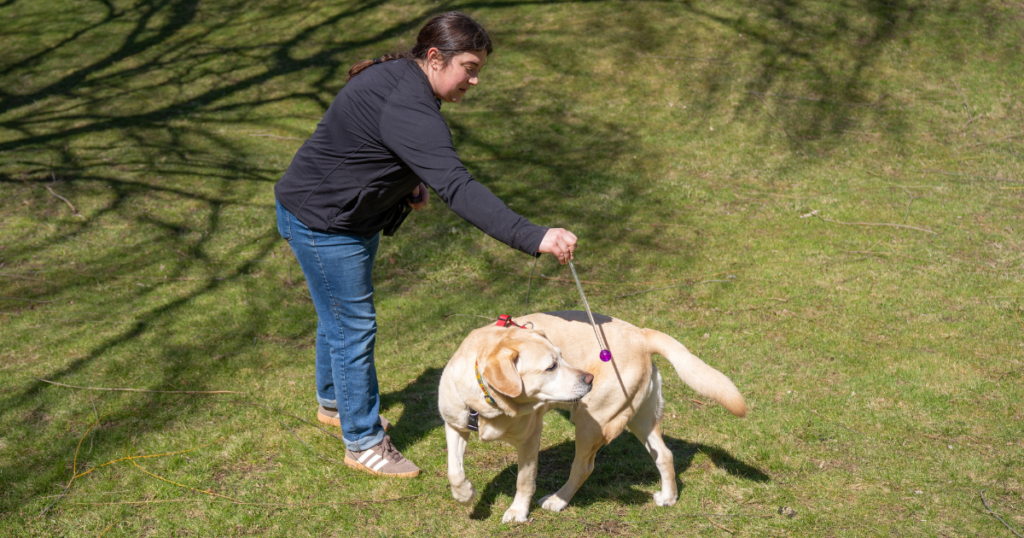

We often hear trainers say, “Reinforce desired behavior, ignore unwanted behavior.” In dog training, it is common practice to ignore unwanted behavior in order to encourage positive actions.
But what does that actually mean? Can we really ignore unwanted behavior? Is that a practical approach? What does it look like? How do we operationalize it?
I am guilty of using the phrase quite often, actually. It is overly simplistic — and intentionally so. It’s shorthand for, “Do your best not to call attention to the undesirable behavior and try not to reinforce it accidentally.”
What “Ignore Unwanted Behavior” Really Means
When I worked in the zoological environment, I taught a tool called the LRS— the Least Reinforcing Scenario. That’s a specific, pre-trained protocol I’ll cover in a future article. But when I’m teaching students, I keep it simple:
Ignore unwanted behavior, maintain your animal’s attention, and move on.
No need to say “no”. No need to apply a punisher. Just ignore the fact that they didn’t do what you expected, adjust your plan, try to set them up for success, and do what you can to keep the animal engaged.
This is the best option for positive reinforcement in everyday training. It’s not a response to serious behavioral concerns like aggression, though under certain conditions, it could be. It’s a straightforward strategy designed to prevent accidental use of a punisher.
Some may question whether simply moving to another behavior might actually reinforce the undesirable response. But that will only happen if you keep repeating the same actions. A mistake from your animal is really a message to you, the trainer: your learner is confused, distracted, or needs more clarity. It’s a cue to the trainer to change something in the environment so that it doesn’t happen again.
A mistake from your animal is really a message to you, the trainer: your learner is confused, distracted, or needs more clarity.
Real World Example
I wait a few seconds to allow him to see that there is nothing of concern happening in the direction of the sound. When my dog glances back at me, I call his name. He returns and makes eye contact with me, so I reinforce him for coming back and reengaging. I ask for a few simple behaviors that he does well. When I ask for his paw, he doesn’t offer it. I recognize he’s still a bit distracted by the sound, so I immediately pivot to a target behavior — one with a strong reinforcement history. Hesitating too long would likely cause him to disengage again.
I am engaged in a simple training session with my dog. A few minutes into the session, there is an unusual noise in the distance. My pup decides to break away from me to investigate the sound. I do not try to stop him because he is already distracted and no longer looking at me (I am ignoring the unwanted behavior).
In effect, I ignored the unwanted behavior and continued with the session. I changed our location, asked for simple behaviors to rebuild engagement, and once we’d settled, I asked for the paw again. This time, he offered it. I do a few more behaviors with my dog, then wrap up the session.
Not calling attention to the unwanted responses didn’t correct those behaviors — but it prevented me from reinforcing them. I adjusted my approach to set him up for success, then ended the session. Had I been concerned that my dog might get into a dangerous or unsafe situation when he left me, I would have had him on a leash during the session.
After the session, I evaluated what happened. Do we need more desensitization work? Should I modify the environment to reduce distraction next time? Ignoring unwanted behavior wasn’t a correction, it was a way to keep the problem from getting worse.
Evaluating an Error
Some trainers express concern that moving on to the next behavior will create a small chain and inadvertently reinforce the undesirable behavior. You are only reinforcing an undesirable behavior if you continue to allow the same mistake to occur. You should always evaluate an error and make the needed adjustments to prevent the likelihood of the same mistake happening again. When an error continues to occur, that’s your signal to ask: Does this behavior need to be retrained? Are there environmental adjustments that still need to be made? Ignoring an error is a starting point — not a permanent solution.
You are only reinforcing an undesirable behavior if you continue to allow the same mistake to occur.
A Simple Guideline, Not a Complete Protocol
There are undoubtedly many situations where simply “ignoring the unwanted behavior” may not be the best choice in that moment. But it’s a good place to start, especially for a novice trainer. Although I use a variety of techniques after an unwanted behavior, the idea of ignoring the response and simply moving on is still my go-to response seven out of ten times.
“Ignore the unwanted behavior” has always been more of an idea than a protocol. It’s verbal shorthand for “stay positive and keep your animal engaged.” It’s a simplified guideline for newer trainers and a helpful reminder for experienced trainers. Let’s not throw out simple sayings just because they are incomplete – it’s meant as a reminder, not a well-thought-out articulated protocol.
“Ignore the unwanted behavior” has always been more of an idea than a protocol. It’s verbal shorthand for “stay positive and keep your animal engaged.”
So, the next time someone suggests that you should just ignore the unwanted behavior, don’t bristle with frustration. Follow up with a question: What does that look like? What should I do in that moment? There should always be a follow-up to that mantra.
Happy Training,
Ken