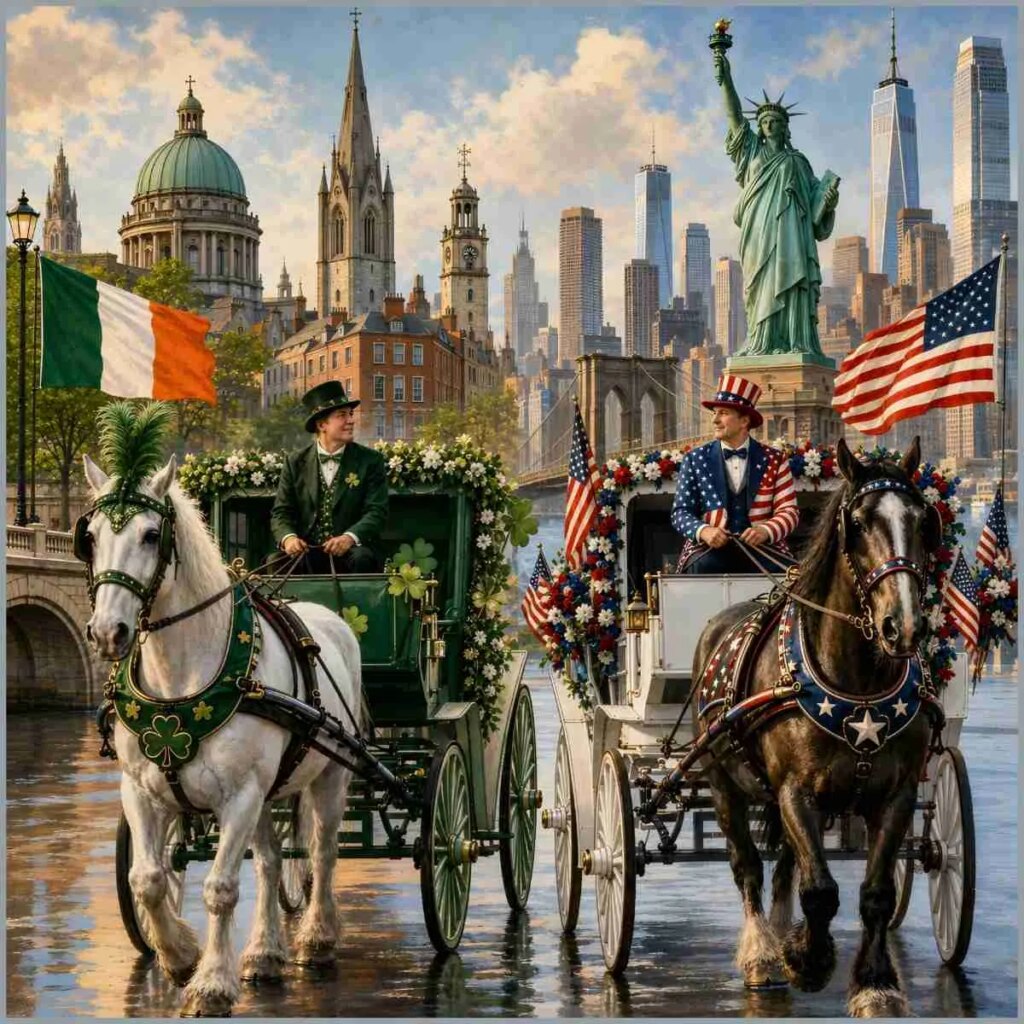


Horse-drawn carriage fight now before the New York City Council also rages in Dublin, Ireland
DUBLIN, Ireland; NEW YORK CITY––Horse-drawn carriages as New York City knows them arrived in the immediate wake of the passage of the Dublin Carriages Act of 1853.
That, 173 years later, has much to do with political battles now underway in both New York City and in Dublin over the future of the horse-drawn carriage industry.
Aiming to bring order to the crowded cobblestone streets of the Irish capital city, where the historical Molly Malones still wheeled their barrows, through streets broad and narrow, singing “Cockles and mussels, alive alive-o!”, the Dublin Carriages Act of 1853 both enfranchised the best-established jarveys, as horse-drawn carriage drivers are known in Ireland, and exiled a generation of unlicensed competitors to New York City.

(Beth Clifton collage)
Jarveys were among the “Gangs of New York”
No one in New York City at the time really noticed the Irish-accented arrival of the horse-drawn carriage industry, apart from the many other economic, cultural, and technological changes then overtaking the city, highlighted in the 2002 Martin Scorcese film Gangs of New York. Almost all vehicles were then drawn by animal power, especially horses.
The Dublin jarveys and their hansoms and landaus for hire were just another small component of the peak of famine-driven Irish immigration to the U.S. between 1845 and 1855. Only a few hundred men at most drove hansoms and landaus, among more than 1.5 million Irish men, women, and children arrived in the U.S. during that 10-year span.
But the Dublin jarveys established a New York City industry which to this day maintains close ties to the parallel Dublin horse-drawn carriage industry.
Those ties have included vigorous defenses of the New York City jarveys delivered both in 2009 and 2014 by Gangs of New York star Liam Neeson, an immigrant from Ballymena, County Antrim, in Northern Ireland.

Irish dominate carriage and stable ownership
“More than 90% of the 150 active carriage drivers in New York City are immigrants,” Keyian Vafai reported for Documented on December 24, 2025. “Irish immigrants originally made up the majority of the carriage trade,” Vafair recognized, “but today, drivers hail from a diverse assembly of nations,” also including Turkey, Mexico, Russia, and Ghana.
The Irish, however, many of whom originally learned their trade in Dublin, continue to dominate carriage and stable ownership.
Examples include Conor McHugh, stable manager and co-owner of Clinton Park Stables in Hell’s Kitchen.
“McHugh emigrated to New York City from Ireland in 1986 and found himself behind the reins of a carriage within a matter of months, driving for over 30 years,” Vafai wrote.

“Trust fund horses”
Jarvey Stephen Malone, identified by Peter McDermott of Irish Echo as “a New Yorker who followed his County Louth-born father into the industry,” in 2009 incensed animal advocates opposed to the horse-drawn carriage industry by alleging to McDermont that carriage horses are “Trust fund horses, born with a silver bit in their mouths.”
In truth, many of the horses used to pull carriages in New York City are former Amish plough horses. Some are former standard-bred harness racing horses. Most have had hard lives even before “retirement” from other work to the asphalt surrounding Central Park.

(Roger the NYC Carriage Horse Facebook photo)
The McKeever brothers
Among the most controversial New York City horse-drawn carriage owners in recent years have been Irish-born brothers Ian and Colm McKeever.
Ian McKeever, who emigrated to New York from Meath, Ireland in 1985 and became a carriage horse driver in 1987, has owned as many as eleven carriage horses at a time, in partnership with his younger brother Colm, and reportedly owns Chateau Stables on West 48th Street.
Formerly a co-lessor of Shamrock Stables, a West 45th Street facility leased from New York City that housed as many as 78 horses from 1968 to 2010, Ian McKeever won a long political battle to find alternate quarters for the horses after the city sold the land and cancelled the lease.
Along the way, Ian McKeever in January 2010 won a fine of $104,290 against the League of Humane Voters of New York City for failing to file lobbying accountability reports.

Ryder’s Law
News reports published at various times since 2014 trace the decline of the McKeever holdings to as few as six horses as of August 10, 2022, when Ian McKeever was videotaped in the act of allegedly whipping, shouting at, and otherwise abusing a fallen horse named Ryder.
(See Why was a sick horse, too old to work, pulling a New York City carriage?)
At least one witness reportedly charged that Ian McKeever had also abused Ryder about four hours earlier.
Ian McKeever was in July 2025 acquitted of misdemeanor animal abuse in connection with the Ryder incident, but the case had already brought the introduction before the New York City Council of Ryder’s Law, a bill to phase out the horse-drawn carriage industry in New York City.

Romanch’s Law
Ryder’s Law, recast as Romanch’s Law, has now been endorsed by a majority of 26 New York City Council members including speaker Julie Menin, according to Voters for Animal Rights director Julie Cappiello.
This puts Romanch’s Law only votes by the council Health Committee, the full council, and the signature of New York City mayor Zohran Mamdani from final enactment.
As Romanch’s Law, the bill is named after Romanch Mahajan, 18, who on June 17, 2026 became the first human to die in a New York City horse-drawn vehicle accident at least since 1989, when horse-drawn carriages were restricted to operating in Central Park and on the streets leading to and from their stables.
(See Will human sacrifice end the New York City horse-drawn carriage trade? and No more neighs for ban on New York City horse-drawn carriage trade?)

Ireland had double fatality
The Irish horse-drawn carriage industry on April 9, 2018 had a double fatality with repercussions echoing on in Dublin, even after the last related lawsuits were reportedly settled in November 2023.
Tourists Rosalyn Joy Few, 64, and her partner Normand Larose, 62, of Phoenix, Arizona, were killed when the two-wheeled pony trap in which they were riding toppled into a deep ravine on a narrow mountain pass, near Kate Kearney’s Cottage at the Gap of Dunloe in County Kerry.
Jarvey Dan Casey, of Beaufort, Killarney, reportedly survived by leaping from the trap as it plunged off the trail.

(Beth Clifton collage)
Similar but different
Kate Kearney was a long-ago famed moonshiner. Her remote hideaway was by intent about as different from Central Park in New York City as might be imagined.
The Gap of Dunloe is almost diagonally across Ireland from Dublin. Two-wheeled pony traps such as carried Few and Larose are about different from a New York City landau or hansom as a motorcycle is from a limousine.
The deaths of Few and Larose, however, sparked attention throughout Ireland to what such incidents might do to tourism, which accounts for nearly 10% of the total Irish economy.
In Dublin that meant action to finally update the Carriages Act of 1853, leading to a bill introduced into Leinster House, seat of the Irish parliament, on July 8, 2026.

“Danger to pedestrians & customers”
“The aim of this legislation is to tackle the actions of unlicensed operators in Dublin, particularly in the city center, who pose a danger to pedestrians and their customers,” explained Grace Harte for Irish Echo.
“The welfare of pedestrians was raised as an issue by reputable carriage owners,” Harte said, “who fear that without action, a pedestrian death is possible due to the lack of safety knowledge from unlicensed carriage operators.
Added Leinster House representative Máire Devine, “Residents are frustrated by piles of horse manure outside their homes and by anti-social behavior and mistreatment of horses by unlicensed operators.”

No formal regulation since 2018
Horse-drawn carriages in Ireland have “operated without formal regulation since 2018, when Dublin City Council stopped issuing licenses following a review of legislation,” reported Josh Crosbie for Irish Echo on June 17, 2026.
“Horse-drawn carriage operators in Dublin say the practice is ‘out of hand’ and needs to be regulated, warning a lack of licensing is attracting inexperienced drivers and damaging its reputation. The warnings also come after recent incidents which have raised fresh concerns about safety and animal welfare,” Crosbie mentioned.

“Somebody will get hurt”
“Earlier this month,” Crosbie recounted, “a Dublin man was convicted of animal cruelty in connection with a horse used for carriage work.
“Separately in April 2026, footage appeared on social media of a horse bolting on O’Connell Street,” which is to Dublin more-or-less as Fifth Avenue is to New York City.
“In the video,” Crosbie described, “the animal could be seen colliding with a bus, falling to the ground, and continuing to run uncontrolled through the city center.”
Cautioned jarvey Patrick ‘Padser’ Harris, to Crosbie, “It’s out of hand at the moment, but it really will get worse. Somebody will get hurt. Very, very badly.”

(Beth Clifton collage)
“The drivers are hacks”
Addressing the New York City horse-drawn carriage industry, Animal Wellness Action and Center for a Humane Economy president Wayne Pacelle on July 19, 2026 might have been writing of Dublin too in emails sent to members of both organizations.
“The carriage drivers have contemptuously disobeyed rules and regulations,” Pacelle alleged.
“The drivers are hacks when it comes to horse care. No responsible horse person would put horses in such a minefield for them, just like no parent would let their children play in traffic. Risks abound, and it’s no wonder horses are known to go on a tear because of the sounds and sights that stir panic and flight.

“The carriage drivers know the names of their horses,” Pacelle charged, “but they do not know them. That was evident to me as they urge lawmakers to adopt more regulations and step up enforcement, rather than to ban the enterprise.
“But if the drivers were capable caretakers of horses,” Pacelle suggested, “neither new regulations nor more robust enforcement would be needed. Their deflections and their blaming lawmakers and regulators are par for the course for people in over their heads on animal care.”
Please donate to help our work:
More related posts:
Discover more from Animals 24-7
Subscribe to get the latest posts sent to your email.