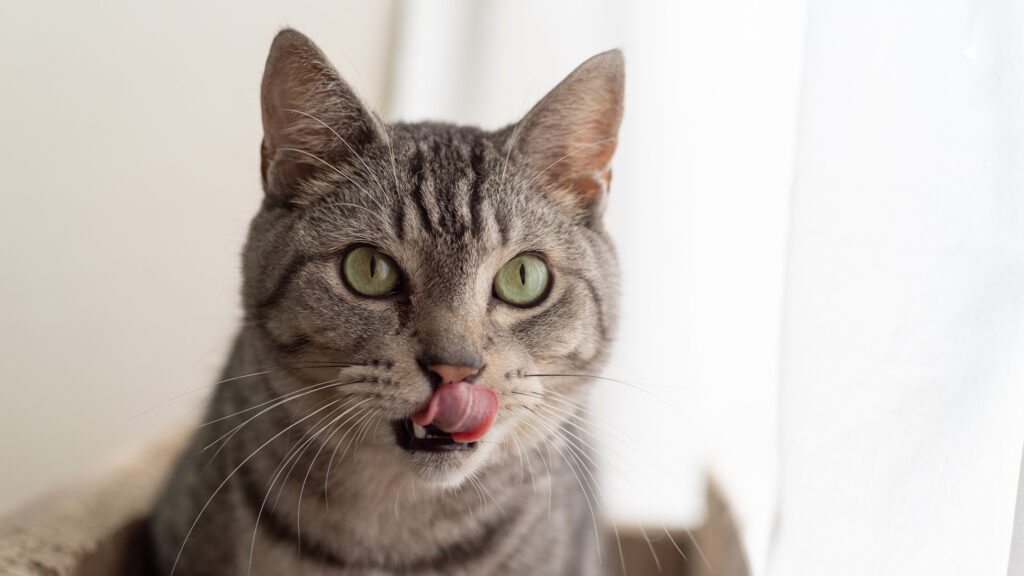

Cats may seem picky about their food, but their sense of taste is actually much less sophisticated than ours. While humans have more than 9,000 taste buds, cats make do with only about 470 to 500. This means our feline friends experience food differently than we do.
While humans can distinguish a wide variety of flavors, a cat’s taste system is built for identifying nutrients, especially those that are found in animal-based foods. This helps them to identify foods that support their carnivorous lifestyle.
If your cat has ever licked you, you’ll know that our feline friends have a surprisingly rough tongue. Much of the tongue’s surface is covered with tiny, backward-facing spikes called filiform papillae. While these structures are very helpful when eating or grooming, they do not contain any taste buds. A cat’s taste buds are located on the tips, sides, and rear of the tongue, where fewer or no spikes are present.

One flavor cats are particularly good at detecting is umami, the savory taste associated with meat and other protein-rich foods. Scientists have even discovered that not all umami flavors are equal to our feline friends. Cats’ umami receptors are great at detecting histidine and inosine, two compounds that are abundant in… tuna! This may help explain why so many cats find tuna irresistible compared to other foods.
Unlike humans, cats cannot taste sweetness. Our feline friends lack one of the two proteins needed for the sweetness sensory receptor in their taste buds to work. During their evolution as strict meat-eaters, the gene responsible for detecting sweet flavors (Tas1r2) became inactive. As a result, sugary foods simply do not taste great to cats the way sweet treats do to us. While we may enjoy fruit, candy, or desserts, cats have little reason to be interested in these foods from a taste perspective.
Although cats have far fewer taste buds than humans, their taste system is perfectly suited to their lifestyle. Cats are obligate carnivores, which means they need to eat meat to survive. Therefore, instead of focusing on a wide range of flavors, their taste buds focus on identifying protein-rich foods that provide the nutrients they need.